
What Commands Do You Teach a Guide Dog?
This post may contain affiliate links. We may earn money or products from the companies mentioned in this post.

One question I often get concerning Stetson (my guide dog puppy in training) is does he know any tricks. As a puppy raiser we are not supposed to teach our Guide Dog puppies any tricks. We have a specific list of commands that we must adhere to.
There are actually only nine primary commands on our list and almost all nine commands are something you may have already taught your own dog. For those of you who were wondering what commands we teach our puppies…here’s the list (this list comes directly from a printout I have from Guide Dogs of America).
Did You Know: that raising a service dog is different then raising a guide dog? One of the biggest differences is service dog puppy raisers teach 30+ commands compared to only 9 for guide dog puppies.
What Commands Do You Teach A Guide Dog Puppy?
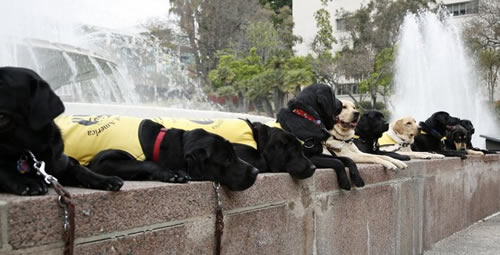
- SIT: The proper positioning would be for the puppy to be on the handlers left side facing the same direction. Place the puppy’s rump on the ground. The puppy must remain in a sitting position with the aid of the STAY command until told to do otherwise by the handler. The ultimate goal should be for 3 minutes.
- DOWN: The proper positioning would be for the puppy to be on the handler’s left side facing the same direction. The puppy must lie down on the ground with his elbows hitting the floor. The puppy then must remain in a down position with the aid of the STAY command until told to do otherwise by the handler. The ultimate goal should be 5 minutes.
- STAND: The proper positioning would be for the puppy to be on the handler’s left side facing the same direction. The puppy must be up on all four feet and remain in a standing position with the aid of the STAY command until told to do otherwise by the handler.
- STAY: (remain in exact place) When used this command serves to help aid the puppy in extending the time of the SIT, DOWN, and STAND commands.
- COME: When the dog hearshis name and the command “come” he should immediately respond and come to you.
- FORMAL COME: From any position relative to the handler, the puppy returns to the handler, coming to the handlers left side and turning into the handler and ending up facing forward in a sit position at the left side of the handler. ie…the puppy should not become engaged in any distractions when on his return to the handler.
- GET BUSY: Tells the puppy to urinate and defecate on lead. The puppy should be able to relieve himself on a variety of surfaces (grass, rocks, cement, dirt, etc..) The dog should be commanded to GET BUSY and the handler should not allow the puppy to do it on its own free will when out on a walk.
- LEAVE IT: Verbal corrections for stopping unwanted behaviors from the puppy. It should be used for such behaviors as excessive smelling, jumping up, excitable greetings, growling or barking etc.
- O.K.: Releases the puppy from any command that had previously been given by the handler.
Those are the 9 commands on our primary commands list. Of course there are a few others I can think of off the top of my head including NO _____, WAIT, and HERE.
- NO ____: I use NO pretty much the same way I use LEAVE IT. It’s used to discourage an unwanted behavior and often used in conjunction with another word such as NO DOG or NO SNIFF.
- WAIT: This command should not be confused with STAY. WAIT is like putting up a barrier that your dogs should not cross. When your dog is in a WAIT command they can be sitting, standing, or down and moving between positions as long as they don’t cross the barrier. However, when a dog is in a STAY the dog should not leave their position. For instance, if the STAY command is given while the dog is sitting then the dog should not leave the sit position until released with the O.K. command by the handler.
- HERE: This is the same as the regular COME command (not to be confused with the FORMAL COME command).
That’s about all I can remember right now.
If there are any GDA puppy raisers out there reading this article let me know if I’m missing any important commands on this list.
If your puppy already knows these 9 commands you might want to check out our list of the 30+ commands we teach our service dog puppies in training.

Top Picks For Our Puppies
- BEST DOG CHEW
We Like: Beef Collagen Sticks - All of our pups love to bite, nip, and chew. We love using Collagen Sticks to help divert these unwanted behaviors. - BEST PUPPY TOY
We Like: Calmeroos Puppy Toy w/ Heartbeat and Heat Packs - Perfect for new puppies. Helps ease anxiety in their new home. - BEST DOG TREATS
We Like: Crazy Dog Train-Me Treats - We use these as our high-value treats for our guide dog puppies. - BEST FRESH DOG FOOD
We Like: The Farmer's Dog - A couple months ago we started feeding Raven fresh dog food and she loves it! Get 50% off your first order of The Farmer's Dog.
Check out more of our favorites on our New Puppy Checklist.


I love dogs, so can you tell me what I do if my dog is always barking at everyone.
When is the command “hup hup” used, and for what reason? I have received two different answers. One, to speed up. The other, to find curbs. Thank you in advance.
This is very interesting. I just wrote a post about having two service dogs which is allowed in the United States. I’m going to have to do update the post to include what you’ve said about UK service animals not being eligible to qualify if another service animal is in the home. Thank you for sharing!
actually, in the UK, a service animal will not be eligible to be qualified if there is another service animal in the home. 🙂
In the US you can actually have two service dogs. This is for those people who have multiple disabilities. I am not sure about other countries, I would look at your local/national laws regarding service dogs first.
Can a dog be trained for both guide work and service work? For example, a person is completely blind with additional disabilities is it possible to train for this scenario and would your train for guide work first or service work first?
When we train our Guide Dog puppies we only teach them to heel on the left side. However, training a mobility Service Dog is different. We teach them “Heel” = Left Side and “Side” = Right Side. Take a look at this list of Service Dog commands: https://puppyintraining.com/what-commands-do-you-teach-a-service-dog/
I’m weak on my right side and tend to fall towards my right, I also use a cane in my left hand. My SDiT will be used for bracing as well. All the commands state the dog should be on the owner’s left side. Would it be OK if I switch him to my right instead?
If your dog is solid with these 9 commands then they are doing well. The service dog commands are definitely more advanced and will help our puppies when they start learning specific task related commands.
I like how you break this down. My girls can somewhat do these 9 but to train them to stand on the left … and then also go down on the left … will be a new challenge. They can do that we are facing each other. After we get these 9 down … we”ll look at the list of 30.
What does it cost to get a service dog. I am on disability and my medication is very expensive. I have Lupus, and severe Rheumatoid Arthritis plus several other medical problems. I am almost at a physical state of not being able to walk and will be in a wheel chair very shortly. Because of my finances I can not afford a great deal. Please help me find a way to get a service dog.
I’m glad it helped. Good luck with your training!
Good thing I came across this post. I didn’t realize that repeating commands over and over confuses the dog – I thought my dog didn’t hear me the first time so I tend to repeat myself.
Thanks for the tips, I am seeing some improvements now in her behavior.
Regards.
I have bought the ebook called Sit – Stay – Fetch however my dog is so dumb that she even can’t learn how to sit.
@Zygor, I read through the entire SitStayFetch ebook while I was in Alaska last month. The content is very good, but I’d probably recommend using it as a reference book rather than something you need to read cover to cover.
I’ve learned several different ways to teach my dogs to sit. The easiest is mentioned in the ebook – using a treat and raising it up and over my dogs head until his butt hits the ground. As he’s doing this I use the “Sit” command. Sometimes when I had the treat to high above his head he would jump up towards it.
I always try to be consistent and only say the command once (if you say sit, sit, sit…it confuses the dog). Repetition is important and I usually work on my dog’s training about 3 times a day in 5-10 minute training sessions.
I hope that helps a little. If you have any specific details or a video of what your dog is doing please feel free to send it to me and I’ll do my best to help you with her training.