
Assistance Dogs vs. Therapy Dogs – What’s The Difference?
This post may contain affiliate links. We may earn money or products from the companies mentioned in this post.
There is often confusion between Assistance Dogs vs. Therapy Dogs.
I’m embarrassed to say that…your resident expert, me has gotten them confused in the recent past.
In addition, you have many other designations including Service Dogs, Hearing Dogs, and Guide Dogs.
It can all get a little confusing if you don’t have the exact definition handy.
That’s why this article was spawned, to help clarify the differences between these dogs.
What Is An Assistance Dog?

As defined by Wikipedia – “An assistance dog is a dog trained to help a person with a disability in daily life. Many are trained by a specific organization, while others are trained by their handler (sometimes with the help of a professional trainer)”
These are the three types of assistance dogs:
- Guide Dog – A guide dog is trained to assist the blind or visually impaired.
- Service Dog – ADI Website Definition – ” Service Dogs assist disabled people by retrieving objects that are out of their reach, by pulling wheelchairs, opening and closing doors, turning light switches off and on, barking for alert, finding another person, assisting ambulatory persons to walk by providing balance and counterbalance and many other individual tasks as needed by a disabled person.”
- Hearing Dog or Signal Dogs – Hearing or Signal Dogs are trained to assist the deaf or hard of hearing.
What Is A Therapy Dog
As defined by Wikipedia – “Therapy Dog refers to a dog trained to provide affection and comfort to people in hospitals, retirement homes, nursing homes, mental institutions, schools, and stressful situations such as disaster areas.”
What Rights Do These Dogs Have?
Therapy Dogs are not Assistance Dogs.
Assistance dogs are used to assist humans and are allowed in most public areas.
Assistance Dogs are legally protected by the Americans with Disabilities Act of 1990.
Therapy Dogs do not provide direct assistance to humans and are not mentioned in the Americans with Disabilities Act.
An institution may invite or prohibit a therapy dog from entering their facilities and usually has rigorous requirements for therapy dogs who are allowed to enter.
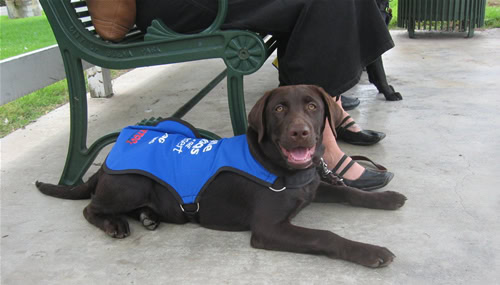
Stetson The Guide Dog Puppy In Training
Stetson is my Guide Dogs of America puppy in training.
My hope is that Stetson will pass all of his training and be partnered with a blind or vision-impaired person as a full-fledged guide dog.\
However, if he does not make it as a guide dog my plan is to certify him as a Therapy dog.
I’ve already taken my first step in preparation by working on Stetson’s training and passing the Canine Good Citizen Test.
Either way, whether Stetson becomes a Guide Dog, a Therapy Dog, or just a pet I’ll be proud of him.
So to sum up Guide, Service, and Hearing dogs are types of Assistance Dogs and are trained to help people with a disability in daily life.
A Therapy dog provides affection and comfort to people in hospitals, retirement homes, etc.
Assistance Dogs are protected by the Americans with Disabilities Act and can go to most places the public can go.
Therapy Dogs are not protected by any federal laws and must be invited in order to enter an institution.
Hopefully, this article helps clarify the difference between Assistance Dogs and Therapy Dogs.
Do you currently own an Assistance or Therapy Dog?
Please tell me about your experiences in the comments area.
Top Picks For Our Puppies
- BEST DOG CHEW
We Like: Beef Collagen Sticks - All of our pups love to bite, nip, and chew. We love using Collagen Sticks to help divert these unwanted behaviors. - BEST PUPPY TOY
We Like: Calmeroos Puppy Toy w/ Heartbeat and Heat Packs - Perfect for new puppies. Helps ease anxiety in their new home. - BEST DOG TREATS
We Like: Crazy Dog Train-Me Treats - We use these as our high-value treats for our guide dog puppies. - BEST FRESH DOG FOOD
We Like: The Farmer's Dog - A couple months ago we started feeding Raven fresh dog food and she loves it! Get 50% off your first order of The Farmer's Dog.
Check out more of our favorites on our New Puppy Checklist.


A therapy dog DOES NOT ASSIST YOU WITH A PHYSICAL DISABILITY! If you need a dog with you 24/7 just to cope then you have big problems that should be fixed, not bandaided with a cute affectionate animal. What will you do when the animal dies? Do you shower with the animal as well? You are not fit for society if you have to look at puppy eyes every 10 minutes.
This response is a bit sad. I used to be like you, people with depression are just whiny children. Then I was diagnosed with hypothyroidism. Besides gaining a lot of weight and taking medicine daily you would not think anything is wrong with me. However, what most people do not know is that hypothyroidism messes with your hormones and is in fact the root of where my mental illness started. I had gotten to a point in my life where I could not go to the store without having a mental break down. It was almost like I was over stimulated. I do not want to talk to people, I do not want to socialize, I do not want to leave my house at all. But, no one can realistically function like this, can they? I am on heavy medication now, but it is still hard for me to leave the house. Call me whiny, mock me, say it is terrible for us to compare the two. But just know that just because you can see the person struggling to open the door because they lost their arm, just remember that other people also struggled with whether to commit suicide today. They struggled to leave their house, to not have a mental break because there is 200 people in walmart with three lanes open. You may think that I do not need a service dog, you may be a person that trolls the internet telling people to go kill themselves because you contemplate it daily, but if my dog is the only thing on earth that keeps me grounded and she is not doing any harm, do not tell me I don’t need her.
I believe that if the dog has done the training to be a therapy dog then they should be allowed to go anywhere just like service dogs. I say this because I had cancer at the age 31 and I got my dog during my treatments and have been going through training with her as well. I want her with me all the time and thought that as a therapy dog she would be allowed to go with me for my emotional support but also for the service she would be providing others as well…honestly a well trained therapy dog should behave and listen as well as a service dog anyways. I have seen the “emotional support dogs” and didn’t want to go that route because my dog is going to be more than that to me and others but I don’t know how to be able to take her everywhere with me without her being classified as a service dog…what should I/can I do?
Thanks for sharing the Service Animal laws in Canada. We just had an expert in Service Animals and accessibility stop by our recent Guide Dog puppy raiser group meeting. I have a few notes and links and I hope to update this page as well as create an updated blog post. Thanks for sharing!
Well …..as a graduate of the Lions Foundation of Canada Dog Guides and a certified service animal handler……..we where drilled for 3 days in class the difference between service animals and therapy animals. Its very clear in the Canadian Legislation; cut and dry. Here in Canada, there are only 3 places a service animal CAN NOT enter. Those are ANY restaurant kitchen of any type, any place that is sterile (meaning a operating room, and includes xray areas) and in a private home ( pending if the owner says yes/no to allowing you to enter). Therapy dogs are NOT allowed in public places as shopping areas, theaters, doctors offices, restaurants) things of that nature. It is up to the owner as to allowing therapy dogs in. But as for the law end of it, it is very clear in this matter. Halo is a SSD service dog and I have had her for a year now. She was also featured on the rick Mercer show. Again .its up to the facility to allow the enter of therapy animals. But by law they can refuse them to enter under the Service Animal act.
While I agree with your points, I feel you may be judging harshly. I have been training dogs since 2007. I will not cert any dog as a TD or SD. Why? because out of my sight, I have no idea how the handler or dog will behave. I direct them to someone else to get cert. Now, I have working in social work for years. So.. with my 2 fields social work and dog training I have seen TONS of TDs passed off as SDs and like you it makes me peeved. I hate it, I hate to see some tiny little purse dog yapping at people, peeing on stuff in the store, it just makes me want to scream at the owner. It is due to people like that who abuse the service dog right , us who have REAL working dog are treated badly. My dog is smaller 25lbs he is owner trained ( as I am a dog trainer) however, his tester, and I hold him to the same rules as any lab or GSD. He doesn’t sit in my purse, or shopping cart, or get all dressed up, or eat lunch with me. He is to sit under the table, while I eat and for the most part be un-noticed by anyone. He is so good I have had people jump and say, “Oh my gosh..I thought he was a toy, purse..” He works with me, helps me with everyday things, like dropped stuff, light switches, wall buttons, and his most important job, is altering me to my low blood sugar. This is a job, no one can “see” him do. This is a huge issue for me, that one can see.. well..unless its to late. This leads me to the other side of your comments. I agree with you. For most, people who just buy a vest on-line, and say “He/She is a service dog.” and have no easily seen disabilities, state its for MH. Well.. here is my issue with that, 1st off how trained is the dog? Could he/she pass the same PAT that “real” Sds have to pass? 2. How does it effect their MH to have people asking, about the dog and what it does? 3. Does it have 3 trained…yes.. TRAINED task he/she can do to help the person’s illness? While we may not agree with WHY someone uses a dog, if they are in fact disabled according to the ADA, and the dog is highly PATed we should not judge. It is the people that look at you with the blank look, when you ask, “What does your dog do?” Or they let the dog walk in front of them (at leisure ) in the store, or any of the other things you would never see a guide dog doing. Those people are the ones we should look down our noses at. Those are the people that make us look bad. If you were to meet me, you would think, “She’s young and healthy why does she need a dog?” My story is a long one and my pain, nerve damage, TBI and blood sugar are not easy to see, however when people judge me I say, “Bring it on!” I have nothing to hide. So, instead of using harsh words, next time, smile and talk to someone maybe you will find their dog is just as trained as yours, maybe they are a Rt Vet with 1 leg, TBI, have seizures, are training the dog for a person at home in a wheelchair… we can’t always assume they are “Those” people who are trying to pass pets off as SDs
Your doctor and you both need to grow up! You worthless crybabies need to stop suckin the government tit and stop comparing yourselves to people who really are disabled!
I am sickened you compare yourself to a physically disabled person who cannot function without the aid of an assistance dog to see for them or pull a wheelchair! Grow up! You cannot go to a restaurant withot a therapy dog??? Seriously! Lose yor sight or a limb and then see how you feel! Either take your meds or get an exorcism but don’t compare yourself with a physically handicap person just so you can take a dog to a restaurant or store with you! Sounds like you need to get your ass out and work and maybe you will feel better about yourself!
I am a manger at a resort and this is a new trend that people with dogs are doing to bring dogs where they are not allowed. I have a blind man that comes to my resort with a service dog every year. His dog is well trained and does not shed. we have had three other people bring in therapy dogs, one was a dog that blows it’s coat and it was everywhere. Another brought in two small dogs and they bark all the time and peed the throw rugs. It is a law that all businesses except a SERVICE DOG but not the law on THERAPY DOGS. We are now charging anyone that brings a Therapy Dog a service charge. But still accept all Service Dogs no charges. There is a difference.
Myself and my daughter train and use therapy dogs in hospitals, nursing homes and in a program called the read program to help children with reading, in schools.. I agree 100% How is it that so many people can not recognize that these dogs are trained and give comfort to many instead of one person only… they help many… also if we are unable to go into public facilities how are we to prepare one for testing…
Obviously there are people out there just wanting to take their pets with them everywhere but I feel if you are a member of an accredited org. that therapy and comfort dogs should have the save rights as service dogs. There will always be people that should not even have pets.. let alone a therapy dog, in public or otherwise…. I do think that therapy dogs should have to wear badges to address that they should meet certain qualifications… and be with an org.
So well explained about the types of service and assistance dogs and thankyou for noting therapy dogs are certified and have:
Been trained, socialized, are required to be clean, washed, brushed, teeth brushed, all shots up to date, with flea and tick treatment e.g. Advantage or other treatment and have certified handlers.
No begging, barking or inappropriate behaviour.
-: Trained, socialized, clean, washed, brushed, teeth brushed, all shots up to date, flea and tick treatment like advantage.
Trained no begging!
‘Read the prior posts and found an area of question’
Therapy or Assistance?
The change comes when a personal therapy dog is providing service in the capacity of one on one emotional need for “special needs person”, then we enter a grey area this is the point the dog is more a service dog than therapy dog. (Training required)
This case is more assistance dog than therapy dog.
He still needs to be clean well groomed, properly socialized and trained; to meet the requirements of a furry companion in public.
please: pardon may spelling
Case of meeting the physiatric needs of an individual. Not sure if it meets the legal requirements for assitance dog.
-: Trained, socialized, clean, washed, brushed, teeth brushed, all shots up to date, flea and tick treatment like advantage.
The change comes when a personal therapy dog is providing service in the capacity of one on one emotional needs for those with special needs; then we enter a grey area this is the point; this case is more assistance dog than therapy dog.
He still needs to be clean well groomed, properly socialized and trained. See prior comment/post on our dogs grooming prior to going out to work.
To meet the requirements of a fury complain in public.
We have as certified therapy dog he in fact goes into nursing homes, community living, has been to fairs, and more at request. They also work in children’s reading programs and other areas.
Our therapy dog was tested and passed for obedience, temperament. He is to behave not beg for food or take treats unless given permission; also as an official handler we are tested and have an extensive police check.
Before each visit he is bathed, hair brushed, and teeth brushed, then dressed with uniform scarf collar and leash handler has also oficial dress shirt and/or idenification pins. In this capacity they by definition are not service dogs or assitance dogs.
We always do our best to keep our guide and service dogs in training clean and well groomed. This older couple should have done the same with their own service dog.
One of our commenters may have brought this up before, but I was just reviewing the Americans with Disability Act Revisions and thought I’d share a little excerpt:
If you’re interested you can read more here: http://www.ada.gov/service_animals_2010.htm.
Thank you for sharing your story.
Recently. I was having lunch at a small restaurant that was white table cloth clean. When an older couple came in with their dog and sat at the table next to us. The dog was an old, over weight poodle that was filthy dirty. The dog did not respond well to commands.
The dirty condition of the dog caused me to lose my appetite . . Especially when the man feed the dog out of his hand and then wiped the slim from his hand on the white table cloth.
I ask the owner of the restaurant about this and he said they showed him the animals service papers. I can’t imagine that poor old poodle ever being a service dog. The owner was being held hostage and felt he would get into trouble if they were asked to remove the dog. How inconsiderate of the og owners who were not all that clean themselves.
The health department might have closed the restaurant as well.
I agree, now this is going to sound rather odd but I suffer from really bad anxiety attaches at the age of 19, I also have an eating disorder which got really bad last year. If I’m in a stressful situation, or it could be something as small as just trying to socialise with a stranger, I freeze up and get incredibly nervous. Sometimes even walking out the door to go to the shops is a task, or even eating out at a restaurant, I hated how I was always so anxious and felt afraid of little things.
I used to feel ashamed and stupid for how I felt, until I got my Therapy Dog Moro. I went back to counseling with my Therapy Dog/Puppy in training and my counselor said she could see a noticeable difference, I wasn’t closed of, and I was more willing to talk and socialise with my Therapy Dog around.
Thanks to Moro, I am so much better than what I used to be, so I really do agree that Therapy Dogs should be given more rites and freedom to accompany their owners to places, and not be restricted or cut of all because someone has a mental problem they need help coping with.
I’m able to function with her around, so the thought of not being allowed to go places all because I need some help mentally is ridiculous. So fare I haven’t come into any situations where I’ve been asked to leave because I need some mental help, but to hear that makes me annoyed.
Therapy Dogs shouldn’t be discriminated from Service Dogs, Therapy dogs are still giving us service and helping people cope with what ever issue they have.
I agree wholeheartedly with you Holly! I am on a list to move into an apt. complex for the disabled and elderly and you can have a dog. However, today while looking at the grounds of the building several of the elderly told me “that dog of yours won’t be let in – there is a weight requirement” Seriously!? So because my dog who is always there for me during my seizures(I have epilepsy) or whatever illness I have we would be shut out. Sorry that isn’t right. And you are also right about the comment you cannot see all disablities on the outside. For years my employers thought I was faking my seizures to get out of work.(why I don’t know – you don’t work you don’t get paid)
I have pitbull and i am bipolar
i wouldnt know what to do if i didnt have them theyre my comfort bipolar is a uncontrolable disease and they know something is going on with me they come to comfort me what are they if they do that ?
I have PTSD and have some really bad episodes I had it all my life. I have a fear f being around men . And not even anxiety meds can make y daily anxiety go away. I am annorexic have depression I am epileptic but that’s not an issue. I have a dog and three living cats would a therapy dog really help? Would a dog be benificial ? I also have people attachment disorder , and aspergers
I find it very disheartening that mental illness is still not recognized as a handicap by society. There are many degrees of mental illness and for many like myself suffer just to start with severe PTSD, bipolar disorder, panic attacks especially when I have to go outside more door. In addition I am 46 years old and do to my lengthy documented history I was awarded SSDI & Medicare Like most applying I was turned down and then appealed and went before a Judge and the courts Medical expert so legally under the law I am disabled. When I was hospitalized for mental illness a therapy dog visited us and the dog owner could see how well I played with and lit up during his visits he suggested when I became more stable think about getting a therapy dog. I take this responsibility very seriously imagine having the help of a K9 to get out of the house without becoming physically sick, shaking just list a few symptoms. Everyone please educate yourself about mental illness you can go to NAMI.org. THANKS CHRISTINE
Hi Christi,
Thank you for all of the information you supplied on this thread. I’m not ignoring you it’s just difficult for me to respond to every comment on the blog. I receive 100’s of comments, emails, and questions on my blog every day and it’s very difficult to keep up. This is not my day job and I often stay up until 3am trying to respond to as many comments as possible.
I really do appreciate the time people take to read, comment, and participate in discussion on my blog. Thank you!
By the way, I believe comments often catch my attention when I see my name. Just like this one and the comment you mentioned.
Thanks,
Colby
Dear Colby,
I don’t know why you are ignoring that I’m posting, when I posted information about the 5 different types of service dogs and then you thanked the lady under me for providing the same information. And then when I posted that the person above me was incorrect, I was just “over looked.” Well, I decided to write this ridiculously lengthy comment with all of my situations to prove that I am correct since I don’t want everyone just telling the wrong information.
Here is the correct law updated as of March 15, 2011: http://www.militaryhomefront.dod.mil/12038/Project%20Documents/MilitaryHOMEFRONT/Troops%20and%20Families/Special%20Needs%20EFMP/Service_Dog_Law_Change_2011.pdf
(This was the best link to prove it all in one place since ada.gov provides it in a more shattered version and a bit more dumbed down)
The reason why the person is wrong above is wrong because of the new proposed sections that clarify what a service animal is and what is does.
“The Department?s final rule defines ??service animal?? as ??any dog that is individually
trained to do work or perform tasks for the benefit of an individual with a disability, including a
physical, sensory, psychiatric, intellectual, or other mental disability. Other species of animals,
whether wild or domestic, trained or untrained, are not service animals for the purposes of this
definition. The work or tasks performed by a service animal must be directly related to the
handler?s disability. Examples of work or tasks include, but are not limited to, assisting
individuals who are blind or have low vision with navigation and other tasks, alerting individuals
who are deaf or hard of hearing to the presence of people or sounds, providing non-violent
protection or rescue work, pulling a wheelchair, assisting an individual during a seizure,
alerting individuals to the presence of allergens, retrieving items such as medicine or the
telephone, providing physical support and assistance with balance and stability to individuals
with mobility disabilities, and helping persons with psychiatric and neurological disabilities by
preventing or interrupting impulsive or destructive behaviors. The crime deterrent effects of an
animal?s presence and the provision of emotional support, well-being, comfort, or
companionship do not constitute work or tasks for the purposes of this definition.??
It is clearly stated above that “emotional support” is not in the definition of a task and therefore is not a service animal. It says above that they must “prevent” or “interrupt” the behaviors they can’t just be there for emotional support they must be tasked to do something.
“One service dog user stated that, in some cases, ??critical forms of assistance can?t be
construed as physical tasks,?? noting that the manifestations of ??brain-based disabilities,?? such
as psychiatric disorders and autism, are as varied as their physical counterparts. The
Department agrees with this statement but cautions that unless the animal is individually
trained to do something that qualifies as work or a task, the animal is a pet or support animal
and does not qualify for coverage as a service animal. A pet or support animal may be able to
discern that the handler is in distress, but it is what the animal is trained to do in response to
this awareness that distinguishes a service animal from an observant pet or support animal.”
“The NPRM contained an example of ??doing work?? that stated ??a psychiatric service dog
can help some individuals with dissociative identity disorder to remain grounded in time or
place.?? 73 FR 34508, 34521 (June 17, 2008). Several commenters objected to the use of this
example, arguing that grounding was not a ??task?? and therefore the example inherently
contradicted the basic premise that a service animal must perform a task in order to mitigate a
disability. Other commenters stated that ??grounding?? should not be included as an example of
??work?? because it could lead to some individuals claiming that they should be able to use
emotional support animals in public because the dog makes them feel calm or safe. By
contrast, one commenter with experience in training service animals explained that grounding
is a trained task based upon very specific behavioral indicators that can be observed and
measured. These tasks are based upon input from mental health practitioners, dog trainers,
and individuals with a history of working with psychiatric service dogs.”
“For example, if a service animal senses that a person is about to have a psychiatric episode and it is trained to respond, for example, by nudging, barking, or removing the individual to a safe location until the episode subsides, then the animal has indeed performed a task or done work on behalf of the individual with the disability, as opposed to merely sensing an event.”
There is more and more information on emotional support animals through out this link. You should read it all. As I explained before they can’t merely go on instinct and react to your situation they have to observed it and be trained to do the act.
“Most animals, including but not limited to those labeled Companion Animals, Emotional Support Animals and Therapy Animals or pets are NOT service animals according to ADA’s Definition, as they have NOT been individually trained to perform disability mitigating tasks. Thus their handlers do not legally qualify for public access rights. Typically these animals also lack the months of training on obedience and manners needed to behave properly under challenging conditions in places of public accommodation.”
“IAADP appreciates the role that an emotional support animal or therapy companion animal may play in the life of a disabled individual. Such an animal can provide unconditional love, comfort, serve as a crime deterrent or perhaps in some way enhance someone’s physical or mental health by their presence. While these benefits will not qualify a disabled handler for public access rights, other laws may apply insofar as housing or travel by air.”
This is from: http://www.iaadp.org/iaadp-ada-training-requirements.html
Which is what I was saying before but this is more dumbed down as it is not the exact law or department.
And finally from the ADA themselves say:
“Dogs whose sole function is to provide comfort or emotional support do not qualify as service animals under the ADA.”
http://www.ada.gov/service_animals_2010.htm
If the person above instead stated “Psychiatric Service Dog” his statement would have been correct. With all of the information I have stated, there are three types of animals you should be talking about:
*Assistance/Service Dogs
*Therapy Dogs
*Emotional Support Animals
Some people don’t understand that an “Emotional Support” animal is not a service dog and should not be treated as such. It is in the law. Therapy dogs is also covered in the IAADP link as well. Just because I don’t have Dr. in my name or I can’t compose beautifully written comments doesn’t mean that I am not correct or that I should be overlooked.
Thank you.
Hi Dr. Al S,
Thank you for sharing this information and thank you for posting the link.
Do you know if there’s been any updates to the ADA since that November 2010 letter (the one you provided in the link)?
By the way, I’m reading through the letter as I write this. Thanks gain for sharing.
Take care,
Colby
Actually you are not completely correct if you are calling it an “emotional support dog” when an animal only provides emotional support it is NOT an psychiatric service dog. A emotional support animal can be any type of animal and it only falls under The Fair Housing Amendments Act of 1988 and The Air Carrier Access Act. An emotional support animal is NOT trained and does not do any tasks. I have both an emotional support animal and a service animal. They are two different things. An emotional support animal give support for a persons with a disability, but is NOT trained to preform tasks. “Helping persons with psychiatric and neurological disabilities by preventing or
interrupting impulsive or destructive behaviors” has to be task driven and not by the animals instinct. This is all in the ADA.
To Everyone: (Colby)
Kindly do not listen to so called “dog experts” rather, lawyers who actively deal with the Americans with Disabilities Act. Read the below very carefully.
http://www.equipforequality.org/resourcecenter/ada_serviceanimals.pdf
Under the ADA, a “service animal” is any dog that is individually trained to do work or
perform tasks for the benefit of an individual with a disability, including a physical,
sensory, psychiatric, intellectual, or other mental disability. Under the new DOJ
regulations, “other species of animals, whether wild or domestic, trained or untrained,
are not service animals for the purpose of this definition.” 28 C.F.R. § 36.104 and 28
C.F.R. § 35.104 (emphasis added).
Emotional Support Dogs fall under the A.D.A. and are in fact deemed a “service animal” since they “perform tasks for the benefit of an individual with a disability.. psychiatric .. or other mental disability.
Service Dogs may do some of the following:
?? Alerting individuals who are deaf or
hard of hearing to the presence of people
or sounds;
?? Providing non-violent protection or
rescue work;
?? Pulling a wheelchair;
?? Assisting an individual during a
seizure;
?? Alerting individuals to the presence of
allergens;
?? Retrieving items such as medicine or
the telephone;
?? Providing physical support and
assistance with balance and stability to
individuals with mobility disabilities; and,
****** Helping persons with psychiatric and neurological disabilities by preventing or
interrupting impulsive or destructive behaviors. 28 C.F.R. § 36.104; 28 C.F.R.
§ 35.104. ********
Hi Dee,
Thanks for the update! I’ll revisit the article and make some updates.
Take care,
Colby
Hi, great article, but you may want to consider revising it because you have not listed all the types of assistance animals. I am a service dog trainer, and for me the term assistance/service dog encompasses:
Guide Dog
Mobility Assistance Dog
Hearing Dog or Signal Dogs
Medical Alert Dog
Psychiatric Service Dog
… you can’t leave out the medical alert doggies or the PTSD doggies! 🙂 Cheers.
Dee
To comment on the article, it’s nice to help people that really don’t know the difference. However, a service dog can also pass a therapy dog test and dog both. Normally in this situation the service dog wears a vest and the therapy dog wears a bandana. But in either situation the dog should not be begging for scraps if it is a service dog. Another thing is that there are 5 categories and not just 3. There are: Guide Dogs, Hearing Dogs, Mobility Assistance dogs, Psychiatric Service dogs, and Medical Alert/Seizure Alert Dogs. So that would clarify to some that service dogs can have to do with mental disabilities. Service dogs also require no registration or certification they just have to preform 3 tasks for their owners disability. (However people do expect them to be trained in basic obedience first) Therapy dogs have to pass a test and be certified to be considered a therapy. Most places won’t allow therapy dogs in unless they are certified. Emotional Support Animal the third type of animal needs nothing at all just a doctors note saying you need the animal for emotional support. (As the name suggests) I hope that clarified it for some. 🙂
Well there is another difference in a type of animal that was not stated in the article and that’s called an emotional support animal, which sounds more of what you have. Only doctor’s can call an animal an emotional support animal. This animal needs no training and does not have any rights other than equal housing (allowing the pet to be with you in a no pet housing). The dog is not a therapy dog as that requires certification and is to help others and not yourself. A lot of people with PTSD have emotional support animals. A service animal however has to be trained whether by owner or program (some states require a program but ADA trumps that). Since you said that you are having the dog in obedience classes your dog is NOT a service dog. They have to be trained and should be able to pass a CGC test easily. The dog must preform 3 distinct tasks that aid your PTSD. A service dog does NOT require a doctors note and should never need one. Though to get the dog from a program the program can make sure you actually need the service dog. (Which in your case you do) So for your dog to be a service dog and not an emotional support animal you would have to teach your dog to react to your PTSD and do three TRAINED (not just done on the animals own) tasks. Then your dog is a service dog with no doctors note needed.
I hope that helps! 😀 I have an emotional support animal and am training a psychiatric service dog.
FIRST IS FIRST, ALL RESPECT TO ALL OWNERS OF SERVICE DOGS AND THERAPY DOGS.
WE HAD AN INNCEIDENT AT THE RESTRAUNT WERE I WORK THE PEOPLE HAD LET THE DOG SIT IN A BOOTH {NOT ALLOWED} AFTERHEARING SEVERAL COMMENTS FROM OTHER GUEST THAT WERE FEELING UNEASY, I HAD APPROACHED THE TABLE AND KINDLY ASKED THE GUEST TO PLACE THE DOG ON THE FLOOR.TO MY SURPRISE THE GUEST FLIPPED OUT STATING HER DOG NEVER GOES ON THE FLOOR. WELL THAT WAS A NO BRAINER THAT WASNT A SERVICE DOG.I DIDNT TELL HER TO WATCH THE VIDEO OF HER COMING INTO THE STORE WITH THE DOG WALKING ON ITS 4 LEGS OR HOW IT WAITED IN LINE FOR 15 MIN. ON THE FLOOR,NOR DID I EVEN WANT TO ASK WHERE THE DOG DOES ITS BUISNESS WHICH DID RUN THREW MY MIND, I KINDLY TOLD HER BY LAW NO DOG IS ALLOWED ON CHAIRS, BOOTHS OR ANY FURNISHING AND REPEATED THAT THE DOG NEEDS TO GO ON THE FLOOR.WELL THEY DECIDED THAT THEY WOULD LEAVE AND MADE A HUGE STINK ON THE WAY OUT. THERAPY DOGS ARE CONSIDERED PETS. SERVICE DOGS WORK. LATER I FOUND OUT THE THE DOG WAS THERE DUE TO RESPITORY ISSUES, WHICH AGAIN IS NOT A SERVICE DOG. NOW IF SHE WOULD HAVE PLACED THE DOG ON THE FLOOR SHE WOULD HAVE GOTTEN AWAY WITH IT, THERE ARE SO MANY WAYS TO GET A SERVICE DOG COLLAR WHICH SHOULD BE ISSUED TO A SERVIVE DOG NOT A THERAPY DOG. ITS SAD THAT DAY I HAD TO PUT DOWN MY DOG A BRILLANT GERMAN SHEPARD WHO I BELIEVE COULD HAVE BEEN A GREAT SERVICE DOG AN HAD MORE EDUCATION THEN ALOT OF PEOPLE. THAT TRULY CRUSHED ME THAT THERE ARE PEOPLE OUT THERE AND MY I REPEAT OUT THERE THAT BELIEVE THAT THING ARE FOR THEM SELFISHLY. I WAS THREATEN BY THIS GUEST THAT THE GOVERMENT WAS GOING TO GET INVOLVED ETC ARE YOU FOR REAL? THEY EVEN CALLED CORPRATE AND GAVE THERE NAME ADDRESS ETC AND IM CONSIDERING TO CONTACT AN ATTORNEY.
I think the argument is more about bringing your dog into restaurants too easily. Some people are sure to abuse the privilege of having a therapy dog. Personally, I can’t see where a well-behaved dog should be a problem in restaurants or elsewhere. They allow them in Europe.
I’m OFFENDED, that people find it OFFENSIVE, to see a therapy dog out and about in public areas.
Yes, I am a therapy dog owner, and my dog does go everywhere with me. He is calm and well behaved, as any true therapy dog should be (what therapy dog begs at a table?). I expose him to as many environments as I can, taking him around the States, Canada and now China. I am not physically disabled, nor do I personally have close friends whom are disabled. While I am healthy and able bodied, I feel a strong need to contribute to society on my free time. I do know many persons, young and old, with problems interacting socially, a need to feel loved or a need love, to feel that despite their medical ailments they can still be responsible for causing joy in another – even if it’s just throwing a ball or a scratch behind a dog’s ear. A person may be bed bound and feel useless but they can be responsible for putting that smile on a dog’s face.
We have worked hard (and spent lots of money too) certifying and preparing to bring joy and comfort to others. Our services are NEVER compensated for financially but rather with twinkle in the eyes of those we meet. My dog is an ambassador for all canines. In public, I can’t tell you how many times people, who tell me they are afraid of dogs, bend down to gingerly pet my dog, smile growing. His quite disposition puts people at ease, whether a toddler in a stroller or senior in a wheelchair. He has helped people free themselves from animal anxiety EVEN when we’re not “on the clock.”
If my therapy dog stayed home alone watching birds, he may get startled or bark in a different environment. Always being around people leaves him at ease to accept anything that comes his way, with a wag of his tail.
He’s also a dog rescued directly of the street, with a budding modeling career. Something that would not have happened if he weren’t out and about in public places.
I was the last post. I came to check for updates. Looks like I stopped the topic. I wish more would chime in….
I don’t know how to take your reply…because I did not say…getting nervous while sitting at a bus stop was “any” type of medical condition. I just explained my conditions…and I am clinically diagnosed in a few psychiatric categories…which is why my dog is necessary…
How you relate a “therapy gun” to a “therapy dog” …is just plain sarcastic…as your gun could kill or hurt other people…and my dog comforts me when sitting at a bus stop next to a gun toting “paranoid” type person and kills no one…
Why did you even waste your time commenting…if it was only to be facetious?
I find that the comments regarding therapy dogs are very ignorant. My spouse is a Vietnam Veteran who has PTSD. Among other ailments. This dog, is very well behaved trained, quiet and meets the NEEDS of my spouse. If any of you know what ptsd as well as parkinsons, I would excpect more understanding for his PAIN for figiting for your country. He is unable to go out, without anxiety attacks, and more. This dog has been a saving grace, and for all of you to state that this dog does not belong in restaurants, or anywhere else is very insensiteve. The only way HE can leave the home is WITH the dog. I think that the laws need to be changed. There is NO abuse in how he and his dog interact. Nor does this dog “annoy cause disruptuion”. This dog should be able to GO anywhere with this Vietnam Veteran. And I DO take him everywhere. I am not abusing anything. The depression suffered from PTSD and Parkinsons is so severe, how can any of you say this is abuse? If others do not train their dogs properly that is one thing, but I TOTALLY DISAGREE. If it were not for this dog, my spouse was on the verge of suicide. Due to the parkinsons, there is a balance issue. This dog who is only 5lbs, when he was 6 months old, after my spouse fell into the pool, came and found me and brought me to him. Again, the law should be changed. I am sorry for the blind, the hearing impaired. But, this dog has saved my husbands life litterly in more ways than 1 and more times than I can count BEFORE training. He was/is a natural.
You know, I’m a landlord that manages a senior / disabled building and believe me when I say most of my residents have legitimate service dogs. However we do have a non service dog policy that states the animal must be 12+ months of age, fixed and utd on shots. We have a resident who has involved HUD because she has a bischon that did not meet the pet requirements, so all of a sudden she was “disabled” and the dog was a service dog. Please understand that I’m a pet lover and a disability advocate so it really burns me when someone is abusing the system. But not only that I have many many units that see the abuse and think we are a bum landlord because they see that the person is not disabled nor is the 6 month puppy a “service” dog. For our state law, the dog must be capable of performing the 3 tasks, not certified through the state, but not behave in a pet manner. This dog barks incessantly at all hours, does not perform any tasks and asks for petting at all opportunities. So please keep in mind that like with anyone else that there are frauds out there that are ruining the opportunities that so many of you desire just because they want to bring their pets into a places that are normally not allowed. That, is what is causing a wall of resentment, not your disability. No different than someone who lives on welfare because they are too lazy to get up and go get a job. And yes, that does happen. I manage a section 8 multifamily housing building as well. Peace out.
We adopted a Staffordshire/Pitbull mix two years ago. She is such a wonderful dog wth people of all ages that we got her certified as a therapy dog. Granted, it does annoy us that people will bring animals into public places with no training but we do have papers and went “by the book”, checking with the local mall management before taking her for walks there with the restriction that any store must approve before we take her in. Jersey has become quite a celebrity and gives a lot of smiles to shoppers and workers – children especially love to be given kisses! It’s been great for me and my husband as well. The dog loves the glass elevator, is fine on the escalator, and hangs out with us at Starbucks (of course, we got their permission first) and we get lots of favorable comments about how well mannered she is. It’s quite amusing how when we are by ourselves we always get asked “How’s the dog?” or “Where’s the dog?”.
Maya,
Go to this website: http://usservicedogregistryaboutus.blogspot.com/. I find them helpful. I too have very bad ptsd as well as 2 years ago today had a work accident, and am permanently injured. I am debating about getting my dog registered here. I agree that not all injuries can be viewed from the public eye. As they state on their website…”they can be a psychiatric disability too”…GOOD LUCK!”
I think that certain people here need to get their facts straight. Mental disabilities are just as bad as physical disabilities. Many times mental illness is over looked as something a person can change and perhaps they should just deal with it. Would you tell someone that is blind to just get over it or deal with it. I think not. I have several illnesses including Bi Polar disorder depression anxiety PTSD. All of these are controlled with a ton of medication and therapy. It doesnt go away. There is no cure! So if a therapy dog is needed to keep someone from having a severe panic attack or other problem (like the inability to get out of bed because depression is so bad) then I think the state needs to implement a training program for these dogs! I also think that people that don’t understand what a mental disability does to someone should learn the facts before they judge
To Susan C: We are all nervous about waiting at bus stops, but that does not fall within the definition of agoraphobia or any other “disorder.” What I do is carry a small 5-cartridge revolver in my coat or jacket pocket. With my handgun, I am able to wait for the bus without the typical anxiety I would endure without it. Luckily for me, I live in Florida, but if I every find myself waiting for a bus in some place like Massachusetts or Chicago and get caught carrying a concealed weapon, I will just explain it is my “therapy gun.”
Yes…I agree with “therapy dogs” and public places…I suffer almost to the point of agoraphobia at times…I have symptoms of anxiety, panic attacks, and social stress…along with the chronic depression and need for “living” …not “laying”;
It is very important to me that I am able to take my dog on the bus…since I do not own a car…and the bus has all types of characters, strangers, seated almost on your lap…causing an uncomfortable atmosphere at times…and not only for me.
With my dog..I am also able to “wait” for the bus without the typical anxiety I would endure of waiting for up to an hour sometimes…alone at a bus stop. I “wait” at the doctor’s office and he diverts my attention from claustrophobic crowds. I always have someone to talk to and who enthusiastically accepts any feeling I may be having as me “giving him” attention.
He is a ‘people person’…loves people over dogs…likes to play and lick…so I warn people that may try to pet him…and he pays attention to me in public places…quietly lying down for over an hour at the doctor’s office…sitting between my legs on the bus, following the cart in the store….but he perks up at any attention given to him and just wags his little tail…
YES…PERSONALITY…THAT IS HIM…THAT IS “BIJOU”…
THAT IS THE SERVICE HE PROVIDES!!!!
I am legally disabled, receiving social security disability for chronic depression for 15 years now. It got to the point where I spent almost 2 whole years virtually in bed or without leaving the house. I wouldn’t even go out to get the mail for up to 3 weeks at a time. I gained 50 pounds and my health went downhill, as so did my ability to do any physical activity without excess pain.
Then my cat of 13 years died… and I looked into the laws of legally maintaining an “assistance dog” in my “no dogs allowed” residence in California. I decided that a dog would (a) require more care than a cat, giving me more responsibility (b) need to be walked at least 3x a day, getting me out of the house and some exercise (c) would provide me interaction and stimuli, to ease my anxiety and depression…and (d) provide me with an enthusiastic display of non-conditional love and affection (rarely displayed by cats) and which lifts the spirit and spoils the black thoughts.
I researched and organized a list of all the state disability and housing laws regarding “assistance, service, companion” animals. I then put it all together in a letter to my landlords in request of permission to have dog on premises…which according to law…they approved.
By law, landlords would be in judgement of breaking the law if they disagreed to my request, since all I needed to provide for approval to both the state housing (Section 8) and my landlords, was a statement from my therapist regarding my disability and how an “assistance dog” was necessary to improve my quality of life, of which I provided.
After getting my dog at the local shelter…and with absolutely no training, except to “sit”…and needing only the letter from my therapist stating my disability required an assistance animal…I was able to get my poodle “Certified” at the local Animal Control Office as a card carrying “Certified Assistance Animal”.
Animal Control pays for his “annual” license fees and tag (since I am disabled), provided a “Certified” tag that he must wear, and took individual pictures of me and the dog and put them on a card that I carry. The card states that my dog can go anywhere I do and warns that denying access to me and my dog is penalty of a misdemeanor and punishable by a fine not exceeding $2500.
I have legally taken him on the bus, into stores, into my doctor’s office, into restaurants, into the library…etc…Of course, I realize his limited amount of training and do not take him somewhere that might prove inappropriate or too much for him or other people. (crowded places, small produce stores with limited room and food displayed, places where children may want to play with him…etc)
The only thing I cannot get…is a $50.00 Welfare Monthly Supplement for “Service Animal” food, upkeep, and care. Out of the four areas required in approval for the monthly funding…the part that I fail in is the “proof of training as a Service Animal”.
Soooo…I am still in confusion as to the laws regarding “service animals” who are trained and provide a service and can go anywhere …versus… “therapy animals” who are not trained, do not provide a service and cannot go anywhere…. Since my dog, by law, seems to be both. And I disagree that he does NOT provide a service…he may not be trained to “walk, grab, open or close” something for me…but he DOES KEEP ME …OUT OF BED….WALKING…AND KEEPS ME FROM COMMITTING SUICIDE…which I think is the greatest service of all !!!
I know this msg is a little old compared to my reply but they do have Mental Health Service Dog definition now which you can fall under.
My Dr. doesn’t like to use that term because she doesn’t see me as mentally ill and that is what most think when they hear that. Schools can not argue with a Dr. note and the Dr. note doesn’t have to say what the disability is.
@Jo, you make a great point about therapy dogs and public places. Thanks for sharing your thoughts with us.
I have an amazing THERAPY DOG! =)
As far as the issues of the confusion between therapy dogs and assistance dogs, and therapy dogs not being allowed in public places is something I disagree with. Right now my dog comes with me to work (I work in a therapy office for people) and places like nursing homes and hospitals, and since she goes to these places with me, shes with me most of the time. I need to get things done in the process of my travels, such as grab something to eat, or run into a store. She is even small enough to be in a dog carrier, & I still can not bring her into certain places. I feel therapy dogs are a different type of dog, one that has great attitude, and has all the traits that someone trusts to have around their children and other family members. I am not trying to put service dogs down at all, they have all of the traits therapy dogs have plus a million more. All I am saying is that I think therapy dogs and their owners should have more credit for what they do by making life a little easier in more public places.
and an assistance dog
I have a therapy dog
@Holly, I definitely wouldn’t consider myself an expert in this area, but two places you might try checking out are first Canine Companions for Independence (http://www.cci.org). They train service dogs, but I’m sure if you contact them they can give you more information on how to qualify your dog as a service dog. A second website that might have some useful information is the Assistance Dog International, Inc website (http://www.assistancedogsinternational.org/).
I have PTSD and my doctor wrote me a letter for my dog to go with me every where I go. But now that I am going back to school I am having issues. The doctor says my dog is a service dog ( I am putting her through obedence training before school starts (sorry for my miss spelling), but the school is saying she is a therapy dog. In the definition of a therapy dog that you have a bove she does not fit.
Also on the comments above, not all disabilities can be seen on the out side.
@Debra, thanks for your comment. I agree with you I think the public needs to be better educated on the difference between a therapy dog and a service or assistance dog. Just the other day we saw a therapy dog sitting in the middle of Ruby’s restaurant. I don’t get too upset about these things if the dog is sitting calmly under the table, but the dog I witnessed was begging for food. It’s unfortunate that these people were:
1. Abusing their privilege as a therapy dog team and
2. Not training their dog to properly behave in a restaurant.
Anyhow, enough of my rant…I’m glad you liked the article and again thanks for your comment.
.-= Colby´s last blog ..Is My Dog Trying To Manipulate Me? =-.
Thank you for clarifying this for people. There is a lot of confusion between therapy dogs and service or assistance dogs and the difference is very clear. I find it very disheartening when I see therapy dogs in restaurants or in places that only service dogs are allowed to enter. I liken it to parking in a handicap parking place when you are physically able and are not handicapped in any way. Stronger legislation needs to be passed to protect the rights of individuals with service or assistance dogs. The public also needs to be better educated on the difference.