
How To Stop A Puppy From Barking In His Crate At Night
This post may contain affiliate links. We may earn money or products from the companies mentioned in this post.
Crate training a puppy is an exercise in patience (with Stetson it certainly was).
If there’s one thing I’ve learned as a guide dog puppy raiser it’s how to crate train a puppy.
More importantly, I learned how to stop a puppy from barking in his crate at night!
I’ve been raising puppies now for over 19 years and I’ve now raised seventeen total puppies (I’m currently raising my 18th puppy!)

Stetson, my first guide dog puppy was very stubborn and hated his crate.
Needless to say, Stetson almost ended my guide dog puppy-raising career just as it was getting started.
If you’ve been following my blog for a while then you already know that it took Stetson over FOUR WEEKS to get used to his crate.
In fact, he did not let me sleep more than two hours in a row during those four weeks. 🙁
The good news is he prepared me for parenthood. My three daughters have all been better sleepers than Stetson! 🙂
QUICK RECOMMENDATION: There are many different types and styles of dog crates. If you haven’t decided on a crate then check out our article on which crate is best for your puppy. FYI, our favorite crate is the MidWest LifeStages Crate.
How To Crate Train A Puppy
QUICK ACCESS: If you’re having puppy training problems then you should join our Puppy Training Tips email list and get instant access to our New Puppy Owner Checklist PDF. To get started CLICK HERE.
When it comes to crate training a puppy every pupper is different.
Stetson was an extreme case and after those first 4 weeks of pure torture, much to my joy he went totally silent and would sleep in the crate all morning without a peep.
Dublin was on the other end of the spectrum and only had a couple of nights whimpering before he began sleeping through the night.
Over the years I’ve learned many tips and tricks for crate training puppies.
Today we’re going to first share with you the basics of how to crate train a puppy and second, give you our best tips and tricks for those of you who have a stubborn puppy who doesn’t want to adjust to his crate.
QUICK TIP: We prefer the wire crates over the molded plastic crates for several reasons.
- Our wire crate is collapsible making it easier to store and travel with.
- The wire-style crate circulates air better and gives us an option of either leaving it open or covering it with a blanket to make it more like a den***
- Longevity! We’re still using the same MidWest Life Stages Double Door Crate w/ Divider that we had when we brought home, Linus, over 17 years ago.
***We have covered our wire crate, but several sneaky pups have grabbed and chewed the blankets we’ve used to cover the crates. Tread with caution when covering your wire crates.
As guide dog puppy raisers, we are given exact steps on “how to” crate train our puppies.
Here’s what we learned from Guide Dogs of America about crate-training puppies:
A crate is a wire or molded plastic kennel that simulates a nest or den environment. A crate can become a puppy’s safe place, not to mention a house saver.
When properly used, the crate becomes a security blanket, a place where the puppy can retreat to escape the household confusion and feel secure.
Never use the crate as a form of punishment!
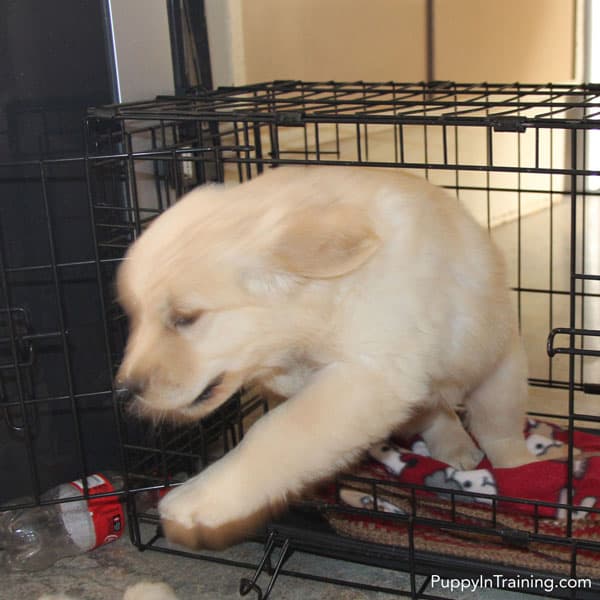
The dog crate should offer a positive, secure environment, and a calming zone.
The crate can be effective for in-house training.
Confined to a crate, an unattended puppy cannot destroy or soil anything.
Do not crate the puppy during the day for more than 3 hours. We don’t crate our young pups (8-10 weeks old) for more than 1-2 hours during the day.
Start crate training your puppy on his first night.
Place the crate in your bedroom where the puppy can still see and hear what is going on.
Put a blanket or towel in the crate for bedding.
QUICK TIP: We’ve been using the Calmeroos Puppy Toy w/ Heartbeat and Heat Pack to help our puppies get used to their crate. It worked great with our most recent golden retriever puppy, Charlie.
A pup will rarely soil the crate, however, if he does, try removing the bedding.
A crate should not be too big, but large enough for the puppy to stand stretch, and turn around.
When placing the puppy in the crate, use the word “kennel”.
If he should happen to fall asleep somewhere else, pick him up place him inside, and quietly shut the door.
Do not hesitate to periodically use the crate, even while you are home. During the first few weeks, we crate our puppies while at home quite frequently to not only give us a break but so our pups will get used to the crate quicker.
PRO TIP: “You may feed the puppy in his crate and give him some favorite toys, to keep the experience positive.”
QUICK RECOMMENDATION: We feed all of our pups Wellness Core Puppy Food.
How To Stop A Puppy From Barking In His Crate At Night
Now that we have the basics of crate training down. Let’s talk about the reason why we’re all here…a barking puppy and tips to remedy said barker…
Over the past 17 years we’ve learned quite a bit about crate training starting with:
- Crate training our first puppy, Linus who we rescued from the animal shelter
- Crate training litters of puppies as foster parents
- And finally, crate training over a dozen service dog puppies
As you might have guessed over those 19 years we’ve learned many crate training tips and tricks.
In Episode 1 of Puppy In Training TV we talked about some of the first things we do when bringing home a puppy.
We also talked a little bit about how to crate train a puppy and Dublin’s first night in his crate.
Lucky for us there weren’t too many nights of Dublin howling in his crate although we did catch a little bit of whining on video – see below.
Take a look at some of the basics in our first episode of Puppy In Training TV:
22 Tips To Stop Puppy Barking In Crate
Here’s our comprehensive list for those of you with a stubborn pup who whines, whimpers, barks, yelps, cries, and pretty much any other disturbing noise a pup can make in his crate:
1. Get The Scent Of Your Puppy’s Littermates
If you get to meet your puppy’s litter mates then bring a plush toy (our new favorite plush toy for puppies is the Calmeroos Puppy Toy w/ Heartbeat and Heat Pack) or blanket to rub all over his littermates.
When it comes time to put your pup in his crate leave the toy or blanket in the crate with the scent of his litter mates this may help your pup sleep better at night. This worked well with Dublin.
2. Take Your Puppy Out For A Potty Break
If your pup wakes up crying in the middle of the night take him straight to his potty spot to relieve himself.
As soon as he finishes up his business take him straight back to his crate without any playtime or other distractions.
3. Feed Your Puppy Early
Make sure you feed him at least an hour and a half before bedtime. We keep all of our puppies on a strict feeding schedule. Check out our puppy schedule.
Also, it’s been suggested to cut off water an hour and a half before bedtime so he won’t have to pee in the middle of the night.
We don’t cut off water for our puppy because it’s so important to keep your puppy hydrated.
4. Play With Your Puppy Before Bedtime
Play with your puppy for an extended period of time just before bedtime to tire him out. A good game of fetch always works well with our pups.
5. Cover Your Wire Crate With A Bedsheet
If you have a wire crate try putting a sheet over it to make him feel more cozy and enclosed. Be careful because I’ve had pups pull and chew on the bedsheet.
6. Put Your Crate Next To Your Bed
Put your crate near the bed (we swapped out our nightstands for crates) where your puppy can see you and if he starts crying hang your arm down so he can smell your scent. and if that doesn’t work then…
7. Sleep On The Floor Next To The Crate
You can try sleeping on the floor next to the crate. This worked with my rescue puppy, Linus. I slept on the floor next to the crate in my sleeping bag and Linus stopped barking.
8. Feed Your Puppy’s Meals In The Crate
We recommend feeding meals in the crate from day 1. This will make your puppy more comfortable when he enters the crate.
9. Give Your Puppy Different Textured Toys In The Crate
Put different textured toys in the crate to keep him company but be careful. I’ve had pups chew, destroy, and swallow plush toys when unsupervised.
Super durable toys like the Nylabone DuraChew and the KONG Extreme have worked well for us in the past.
10. Get Your Puppy Used To The Crate Before Nighttime
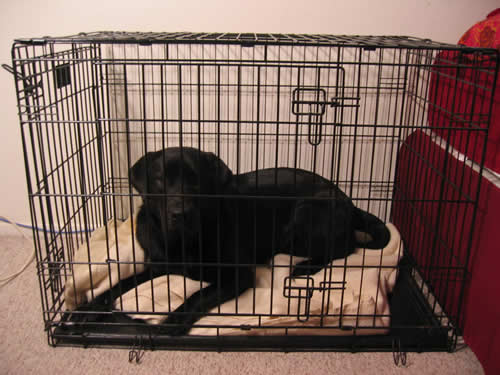
If he takes a nap during the day move him from the floor into the crate. Try doing this with the door open and closed.
11. Lie Next To The Crate With The Door Open
Try leaving the door open but lying down across the doorway of the crate as if to nap with him, to make him feel more comfortable in the crate, and at the same time make your body block the doorway.
12. Praise Your Puppy When He’s Good
When he’s in the crate and being quiet make sure to give him lots of praise.
13. Put A Heartbeat Toy In Your Puppy’s Crate
Try the heartbeat toy.
I’ve heard of a toy that simulates the mom’s heartbeat and helps the puppy sleep. We haven’t tried this one yet, but if we have another stubborn pup it will be on our wish list.
UPDATE: We used the Calmeroos Puppy Toy with Heartbeat and Heat Pack with Charlie and his first night in his crate…not a peep!
14. Put A Ticking Clock In Your Puppy’s Crate
Do you have a ticking clock lying around the house? You might try that instead of purchasing a Calmeroos Puppy.
It may help soothe your puppy to sleep and save you a few bucks.
15. Put A Stuffed KONG In Your Puppy’s Crate
Try putting a stuffed KONG (we like the KONG Extreme which is better for heavy chewers like our Lab puppies) in the crate with your puppy.
We’ve tried peanut butter (make sure the PB is safe for dogs), but you can try adding other treats like bananas, rice, chicken, and yogurt to help get your puppy accustomed to being in the crate.
16. Put Your Puppy’s Favorite Chew Toy In The Crate
You can also help your puppy get accustomed to the crate (and stop the barking) by giving him his favorite chew toy, one of our favorites is Beef Collagen Sticks.
Just make sure you monitor your pup if you give him a consumable chew like a collagen stick.
17. Comfort Your Puppy When He’s Quiet
This one that worked for me and Stetson – I was a wreck and I thought Stetson would never get used to his crate.
The only way I was able to get him to sleep was to talk to him for 5-10 minutes, telling him what a “good boy” he was when he wasn’t crying (if he did cry I would keep silent until he stopped). To try and quiet him down I’d either say “quiet” or “Shhh”.
18. Put A Heated Toy In The Crate To Simulate A Littermate
Try a heated toy. There are many different toys that are designed to help your puppy get used to the crate.
We’ve seen one that you can heat up in the microwave before putting it with your puppy in the crate. This makes your puppy feel like he’s with one of his littermates.
The Calmeroos Puppy Toy w/ Heartbeat we mentioned earlier comes with both a heartbeat and three heat packs to last you through the first few nights.
19. Use A Warm Water Bottle To Simulate A Littermate
You’ll have to purchase extra heat pads for the Calmeroos Puppy Toy after the first night.
Why not try filling a water bottle up with warm water and putting it inside a thick comfy sock (extra points if you rub the sock on littermates and mama to get their scent)?
Hey…you do what you can with the things you have around the house. 🙂
Again, safety first. If your puppy is destructive make sure he can’t chew and consume the water bottle.
20. Play Soothing Music For Your Puppy
One of our readers had a great suggestion:
We now have a new furbaby, another Golden. He is 8 wks and boy has he reminded us how much older we are now. We use the same nighttime method with the soothing music and it’s worked like a charm again!
K.Y,
We play soothing music for our older dogs when we leave the house.
It never occurred to us to use soothing music to help our pups get used to their crate and new environment.
I’d suggest Alexa play some soothing classical music.
Thank you K.Y. for the suggestion.
21. Tire Your Puppy Out Mentally With Basic Obedience Training
Tire your puppy out mentally by working on his training right before bedtime. It doesn’t take much to tire a puppy out mentally.
Try working on some basic obedience for 10 minutes right before it’s time to go in the crate.
22. Establish A Routine With Your Puppy
Just when I thought I knew everything we were presented with a new puppy challenge. It’s now the year 2025 (over 20 years since I brought home my first pup) and our current puppy, Wish has been having accidents in the crate.
Our solution was to establish a routine with our puppy. That is feeding, playing, and training are all scheduled at specific times. This way we can plan exactly when Wish has to pee and poop. This has helped us avoid accidents in the crate.
As she gets older and has better control of her bladder this should not be an issue, but for now, we stick to a routine.
FAQ’s Puppy Barking In Crate
Should I Ignore Puppy Barking In Crate At Night?
ANSWER: Yes and No, it depends on your puppy. One thing we’ve learned over the years is that puppies will bark for different reasons while they’re in the crate. In general, if our puppy is barking we’ll ignore him for at least the first 10-15 minutes. Most will calm down after that time. As soon as our puppy is calm we give him praise.
However, as I said it depends on your puppy. You do not want to ignore your puppy if:
- He’s experiencing anxiety in the crate. In this case, we try to take a slower approach to introducing our puppy to the crate.
- He has to go potty.
- He’s experiencing some kind of health issue.
If you’re having problems with your puppy barking in his crate then leave us a comment or even better contact a local certified professional dog trainer.
How Long Do You Let A Puppy Bark In A Crate?
ANSWER: If we don’t notice any other issues (see above FAQ) then we’ll let our puppy bark for 10-15 minutes. Most puppies will calm down and stop barking within this time frame. We’ll extend this a bit longer if we notice that it’s just attention barking.
It’s very important that you don’t let your puppy out when he is barking. Wait until he stops for at least a split second before you open the door.
If you open the door and let him out while he’s barking then he’ll associate barking with getting out of the crate. No Bueno.
What Should I Put In My Puppy’s Crate At Night?
ANSWER: We start all of our puppies off with two items in the crate. A Calmeroos Puppy Heartbeat Toy and a blanket. We then monitor our puppy to make sure he does not destroy the Calmeroos Puppy and/or blanket.
However, the long answer for what should I put in my puppy’s crate is it depends. If we have a destructive puppy then we may not want to have anything in the crate.
If our puppy is having potty accidents in the crate then we take out the blanket.
If our puppy is having trouble getting used to the crate then we’ll sometimes use different types of toys like Nylabones, KONGs, and even chews like Beef Collagen Sticks.
If you put a toy or chew that your puppy could potentially destroy or swallow like plush toys and/or a collagen sticks then be sure and supervise him while he’s in the crate with said toys until you’re sure he’s not going to swallow or choke on anything.
How Long Does It Take For A Puppy To Stop Barking In The Crate At Night?
ANSWER: Over the years we’ve crate trained dozens of puppies. In our experience, most puppies stop barking in the crate at night after the first 5-7 days.
However, there have been outliers.
Our first guide dog puppy, Stetson took four weeks before he stopped barking in the crate at night.
On the flip side, our English Cream Golden Retriever pup, Charlie never barked in his crate at night.
Puppies will often adjust to their crates based on past experiences.
A responsible breeder may have already started crate training puppies before going to their homes.
A puppy rescued from a shelter may not have known anything other than the kennel run he grew up in.
I said it before and I’ll say it again. It depends, every puppy is different.
Conclusion
Those are my best tips and tricks for getting your puppy to stop barking in the crate along with answers to some of the most common questions we get about puppies barking in their crates.
How about you guys?
Do you have any tips or tricks on how to stop a puppy from barking in his crate?
We’d love to hear about your experiences with crate training your puppy.
Is this one of your first nights at home with your new puppy?
If so, check out Stetson’s first night home and read about what we did to ease him into his new home.
ONE FINAL NOTE: The Calmeroos Puppy can be ordered with the heartbeat and heat packs or if you’re looking for a more basic version (less expensive) then there is also the option for the Calmeroos Puppy with just the heartbeat.
Also, we recently put together our New Puppy Checklist detailing all the products we recommend for new puppy owners.
Now that you’ve reached the end of today’s blog post have you ever thought: My dog hates her crate! Are there alternatives to crate training?
Save To Pinterest

UPDATE: This post was originally posted on July 11th, 2011. It has been updated with new information based on our experiences over the years.
Top Picks For Our Puppies
- BEST DOG CHEW
We Like: Beef Collagen Sticks - All of our pups love to bite, nip, and chew. We love using Collagen Sticks to help divert these unwanted behaviors. - BEST PUPPY TOY
We Like: Calmeroos Puppy Toy w/ Heartbeat and Heat Packs - Perfect for new puppies. Helps ease anxiety in their new home. - BEST DOG TREATS
We Like: Crazy Dog Train-Me Treats - We use these as our high-value treats for our guide dog puppies. - BEST FRESH DOG FOOD
We Like: The Farmer's Dog - A couple months ago we started feeding Raven fresh dog food and she loves it! Get 50% off your first order of The Farmer's Dog.
Check out more of our favorites on our New Puppy Checklist.




So I am new to kennel training or having a puppy in general (it’s been years). A little back story, 2 days ago my fiance left early in the morning before work to get some coffee and when he was coming back home he noticed a plastic tub on the side of the road at the end of our apartment complex (wasn’t there when he left) but he noticed movement and realized someone had dumped a puppy there thankfully he stopped and got the puppy before anything bad happened to it considering that road is busy once the morning goes on. So we decided we are keeping him cleaned him up and fed him he seems to be anywhere from 6 to 12 weeks old and a golden retriever or yellow lab or a mix of both. He is adorable. The first night we did not have a kennel but tonight was his first night in a kennel which he did good for awhile but at about 4:30 this morning he started howling and barking so I got up and let him go potty. I let him play a little bit to tucker himself out a bit and when he fell back asleep I put him in the kennel again and tried to go back to sleep but he began to howl and bark again and it did not stop after 10 or 15 mins. He just seems to continue to bark and howel uncontrollably. Should I not have let him play before hand? Note to add we did put his food and water in the kennel and a blanket and toys along with pee pads in case of accidents the only thing we haven’t done is putting a blanket over the kennel. I just want to do things right for him. I’m not sure the life he had before he was dumped but he seemed to have been taken care of because he wasn’t badly emaciated when he was found I feel like who ever had him just didn’t know how to take care of him properly or he was to much for them.
Advice welcome..
We have a pup who’s now 10 weeks. At 8 weeks on first arriving he slept in the crate at the bedside – first night very barky, then settled.
At 9 weeks, moved the crate to the landing. VERY Barky first night then calmed completely.
At 10 weeks we’ve not left the crate downstairs. Awful barking night one, trying again with calming music and tv time for us next door so he can hear people.
It seems the change of location triggers barking but it’s completely covered. Any advice or understanding of why this is happening?
Thank! Super helpful tips already
We just got our puppy and put the crate in my room for the time being. It’s 1am and he will not stop barking. So I did what I usually do, put a blanket over the crate and waited a few more minutes before deciding to look up other ideas. Read some of these and ended up laying next to the crate…he continued to whine and bark. So i talked to him and opened the crate just enough for my hand to fit, pet him for a bit then closed it and hummed to him. He’s been quiet ever since, thank you for the ideas! 🙂
Our Welsh Springer Spaniel puppy is now 5 months old and we have had only a hand full of nights when he hasn’t barked in his crate at night. We have tried all of your tips and although he is happy to go into his crate (located next to our bed) of his own free will, he starts barking as soon as the gate is closed. Usually he will stop after 10 to 15 mins of firmly telling him to settle and praising him when he lays down. This happens even when he’s really tired. The same thing happens during the day. He is happy to eat his meals in the crate and play with toys but when the gate is closed, he kicks off. Please can you help?
We adopted a puppy at 8 weeks old. He’s now 17 weeks and still barks and howls excessively at night. We were responding to it each and every time—every two hours, but by now I’d think he should have more spans at night where he sleeps for longer lengths. I do feel it is attention. We take him for long walks, we play, he has chew toys and a stuffed king or bone. Nothing is working!
Hi, I just came across your post and everything is so informative. We just adopted a 3 month puppy and trying to crate train her to sleep through the night. At the pet store (when we went to buy food) they recommended we put her outside our room. We tried and she was barking and getting aggressive and lunging towards me when I went near her crate. We then loved her in our bedroom and close where she can see one of us, and she calmed down and went to sleep. How long do you recommend her in the bedroom? Also how do we go about leaving her in the crate while we go out shopping for an hour? Also do would you suggest or have any experience using those night time treats (natural one no meds)? We live in an apartment so I do not want to get any complaints from the neighbors. Thanks for your time.
I can relate to this issue as I have been dealing with it myself. My puppy also hates his crate and he wakes up a lot throughout the night and barks non-stop. I’ve tried all the usual methods, like using treats or toys while placing him in the crate and establishing a consistent bedtime routine, but nothing has worked so far. After I read your post, I discovered that puppies need to be able to feel secure in their crate for them to properly rest at night. So, I decided to try putting a cozy blanket over the crate and some comforting items inside it like his favorite toy or treat and I always talk to him at night to say goodnight and even give him a good night kiss, and it works! I can finally sleep at night!
Puppies usually bark loudly when they are hungry, cold, and want to poop. We should pay more attention to it and understand its needs more
We brought home littermates thinking it was going to be easier to train together, well now we know about littermate syndrome after the fact. They have been sleeping in a makeshift pen in the bedroom and have done fine, I am waiting for the two large crates to arrive before we get them separated at night. Any tips for crate training littermates in separate crates? Thank you!
💛
We have a 10 week old Springer Spaniel who they had unfortunately not begun toilet training with and it appears to have been a veritable free-for-all on the linoleum! We have started weight training immediately with irregular schedule and taking him out of the crate every 2 hours at night which is following the the minimum one hour of howling; needless to say I am on the verge of complete exhaustion but understandably the puppy isn’t. I have him in the room with me with chew toys, bedding etc. We have done the one night of diarrhoea horror which included inside the crate. If anyone has any tips as to when the humans are meant to sleep as the puppy seems quite happy to do that during the day despite trying to include lots of exercise but he is clearly too exhausted from his nights of howling to want to participate. We don’t have the luxury of napping all day plus he still needs a bathroom break at least every 2 hours.
#exhausted
Don’t see why not!
Our puppy is 4.5 months old. She’s a German shepherd mix from a rescue. She’s crate trained and really pretty good… except getting up at night. She wakes us up barking at 3:30am and again at 5 and is up-up at 6:30. When she wakes up at night we get up and take her outside to go potty. In the snow. In 20 degrees in the middle of the night haha. It’s worse than a newborn. After she goes potty she goes right back to sleep. Sooooo do we need to keep getting up with her bc it’s a potty thing, or should we turn up the white noise and try to get her to stop waking up in the middle of the night?? Any advice would be greatly appreciated 💛
Hi there, my pup is 7 months, so a little older than for the intended pup-audience. We were told he was crate-trained, and did well at night. We eventually let him sleep in his dog bed outside the crate, and that has been great.
We leave for work early, early morning, and don’t come back till 2:30pm. We leave at 5:30am, and my roommate let’s him out and roam at 7am. Apparently he barks the entire time. Insistent barking for 2 hours. I had no idea, because I don’t hear him when I shut the door, and leave out the front.
I tried everything. Lights off. Blanket over the kennel. He has his favorite toys. Leftover breakfast, and water. Kongs. Nothing really works. I’m getting CBD treats, but what else can I do to keep him occupied?
How do you take a slower approach to introducing the crate x please x doesn’t appear to be another option of containing a young pup overnite x
My pups second nite was 100%worse than his first night x he is crated outside our bedroom door next to his adult companion who is calm quiet and sleeps through the night x which I thought would help and influence him x I put him in a crate by my bed but behaved worse x so I put him back in the crate outside the bedroom door next to his companion x he is 16 weeks old x thank you for your advice x
Will these tips work for adult dogs? We are going to be having a baby soon and want to break our dogs of sleeping in our bed 🥴
Struggling with crate training 3 nights in an no success. Barking crying whimpering we have given him a blanket with the scent of his mother ,tried different toys and a Kong. All not successful. Tried putting him in when he is a sleep wakes up and barks. We have let him bark for 30 minutes just keeps going we try talking soothingly. When he does get out of the crate he sleeps but often has accidents. This our 3rd dog and have never had these problems. He is our first black lab. We love him very much but need some help.
Is it big enough for a wee pad ? My puppy has one in there and he does two wees a night
We set our alarm and wake our puppy up and take him out before he starts crying. Make sure you don’t take him out when he’s crying, try to get him to stop for a few seconds before opening the door. Be patient, consistent, and persistent. Some puppies can take a while to adjust to the crate. Good luck with your training.
My puppy Champ hates his crate. He wakes up a lot throughout the night and just barks. I’ve used everything in this article every night so far to help him sleep. I try to put him in his crate when he gets into a deep sleep but the moment he wakes up he cries. I need so much help.
this is my life right now
This post just came through at the right time, my neighbors dogs do this a lot, and I’ve been looking for ways to help them with this issues.
I’m reading this after a night of only two hours of sleep, and it’s a godsend! It’s comforting to hear about your experiences with Stetson and that they did get better. Our puppy did not like her crate upon first arrival at home, and had issues being inside in general (breeder left dogs outside). After about 5 days, she understood that crate was sleep time. One month in, she came on a trip with us to visit family and go camping. She did not take naps in her crate as usual (although slept fine at night), and after one night in a tent with us, she refuses to sleep in her crate at night. She is mixed with Great Pyrenees and we knew there was a chance at her being nocturnal, but the second she’s out of her crate, she plops on the kitchen floor. Needless to say, my back can’t sleep on the kitchen floor anymore.
We got our new pup yesterday and he slept in his crate last night at first with no problems, he was so tired he curled up and went right to sleep. Then around 2am I took him outside for a wee and when I put him back in he went crazy and cried, after about 25 minutes I went back in the room and sat with him until he calmed down and fell asleep. Are we doing something wrong? Should we stay with him until he falls asleep before leaving him when we put him in the crate? How is that going to help when it comes to us going out in the daytime when he’s awake?
We got an aussiedoodle puppy from the same breeder as our 3 year old Aussie doodle this weekend. This one sleeps nicely in crate during day for 45 min or so, potty, play, eat, potty again, repeat. He sleeps from 10- midnight, but then cries 6-8 hours constantly at night and I mean constant. Aside from a couple of minutes every couple of hours. We do not respond except every 2 hours or so when quiets down open door and carry him outside to try to potty. If he does we praise if he doesn’t it’s no talking and back to crate. Constant barking again. We have crate in our room. We’ve tried covered and uncovered. He has a snuggle puppy, my nightshirt, a blanket that smells like dog mama, has been fed and watered an hour or so before bed. I teach all day and am currently goin on 6 hours of broken sleep over 2 nights. Please help.
Hello!
Wondering if you have any advice please, our 10week pup has been crated since we brought him home. He no longer cried or barks and goes in his crate happily. However every night he pees in his crate. Alot. I’ve tried letting him about a couple of times etc but still wake up to pee in the morning. I have also removed his bedding.
TIA! 😊
Try putting one of your used t-shirts in the crate with your puppy. Having your scent close by will help comfort them them.
I am sleeping on the couch with the crate inches away from me. My puppy does ok. He whines a bit, but sleep until he has to pee (usually around midnight), and then he’s back to sleep after just a minute or two of whining. My issue is during the day. He will play with a toy in the crate and even nap if I put him in there, with little complaint….with the door open. If I put him in there with a few treats and tell him “good boy” and then shut the door, he goes NUTS. Barking is an understatement. This is shocking because he was adopted and we were with him at the adoption event and ALL of the other dogs were going nuts and he was silent. Do you have any advise? I’m trying to put him in and let him “cry it out” – which takes about 10-15 minutes, and then he settles. Then I try to leave him for that long. If he is awake then, and not making noise, I will open it up and praise him with a treat. My issue is that I have not left him alone in a week! I have to be able to leave the house and I’m worried he’s going to 1) make himself sick and 2) annoy my neighbors! I have to be at an appointment in a few days which will mean he has to be home alone, in the crate, for about 90 minutes. I am desperate for anything to do to make this as smooth as possible! We do have a soft toy he loves and a teething T-bone in there, with a bed that fits him and the crate perfectly.
PS – he’s 12 weeks, 6.5lb, and appears to be a terrier/chi mix.
Thanks in advance.
Jennifer
Congratulations on your new puppy! Unfortunately, some puppies take longer than others to get used to their crate. We listed quite a few ideas in our post but I would guess you need to be patient and give her more time to get used to her crate and make sure you follow the number one rule and don’t let her out when she’s barking. Good luck with your training.
We have a 12 week old Lab. We got her at 8 weeks.
She sleeps in a crate in the living room during the day in 2-2.5 hour intervals. She usually does well with that.
At night – we’ve done all the tips above. We also have a snuggle puppy, my shirt, let her out right before, she’s had dinner, water, played, done training, usually gone for a short walk, etc. Last night for example- she barked in her crate for close to an hour before falling asleep. We went upstairs to go to bed and I laid in bed with my hand by her crate so she could smell and lick my hand. Still barked. We let her out again in case she had to pee. She didn’t. So we put her back. Eventually she fell asleep but it was a long time of barking/whining. Some nights she’s great so I don’t know how to change the routine or what to do to make her realize that she needs to be in her crate at certain times etc. Sigh. Any suggestions welcome.
I leave the shirt I’ve worn all day in her crate with her at night and wash it in the am. It’s helped with the whining.
I like how you mentioned that it is important for your puppy to have a blanket for him to feel secure. Last night, my best friend informed me that she plans to get a puppy for my nephew’s birthday next week and asked if I had any recommendations for the best alternative. I’ll be sure to tell her that she should go to a trustworthy puppy breeder who can answer all of her queries, thanks to this excellent article.
Hi Trisha
We recently got a puppy too. Sitting in front of the crate while puppy is falling asleep has helped us. As soon as he starts barking or crying in the crate, we go sit silently in front of crate. Hopefully this will help you too.
So our pup never cries in his crate.
It’s barking only.
I’ve done everything!!
Really.
We have a 5 month old new fella. We ended up with 2 crates. One upstairs for bedtime and one downstairs for if we leave for work during the day or if we need him to be in for a short shopping trip or just for him to feel comfortable to go in and out.
I am going through the same thing with a 5 month old Labradoodle ! Same story. They said he was crate trained also. We both work and we are in a condo and can’t risk our Gus barking all day. I am a wreck ! I would love all suggestions. I use a Kong you stuffed with a snack. His favorite toy. I have tried music. Ugh.
We just got our first puppy 4 nights ago. She is a 6 month old Boxer mix. Her previous owner said she was crate trained. However, she hates being away from us; she freaks out if even one of us leaves the room. We put her in her crate for only an hour while we ran errands, and when we came back we could here her whining outside the building. I’m not sure if it’s just because everything is so new and we can just wait it out, or if she has some serious issues we need to take into account. We’ve been feeding her in her crate, giving her bones in the crate, letting her walk in and out on her own, giving her lots of love while she’s inside and quiet, and also the crate is in our bedroom so she sleeps during the night in there. She stayed in there quietly for 4 hours chewing on a bone with the door open, but only if we were both in the room. My husband and I work full time but opposite shifts, so the puppy is alone in the apartment for only 4 hours everyday. We don’t have any time left to gradually introduce her to the crate during the day, so I feel so bad leaving her alone for 4 hours in it. We were told she was fully crate trained, so maybe this is just the adjustment period?
So my wife and I have a newborn on the way and our dog cries to be let out in the mornings. Hes a 6yr old terrier/kleekai mix and overall is a good dog.
He’s incredibly food driven so when its time for us to wake up, he barks/yelps/cries/goes crazy until we let him out/feed him. (Sometimes we them sleep in our room at night as well) I feel like we’ve missed the window on training while a puppy, how do we correct this behavior in an older dog?
We also have a 9 yr old pit/lab mix who is a great dog ( no issues) so we want to keep them consistent with bedtime routines because the little one hates being separated from the older one.
We can’t have the little guy crying/barking all morning as we fear this will naturally wake our newborn as well. How do you break this habit in an older dog? Side note: he also barks and gets excited when its time for dinner also.
We’re lucky and live in a single story house. However, we’re about to move to a two story house. When we move to our new house we’ll use two crates, one upstairs and one downstairs. If you have space for a play pen area downstairs that would work too. The only problem I see with the play pen area is a puppy will more likely have an accident in the play pen area which means it will take a bit longer to nail down potty training. Good luck with your puppy!
Hi. We have a 10 week old goldendoodle. Day 5 for us. We are struggling because we have a 2 story house. Do you do two crates? Or could we feed and pen downstairs and crate and sleep upstairs?
Puppies bark and needs training. You should have thought of that BEFORE you got a puppy that you probably now just gave separation anxiety. Congrats.
We have a 10 week old (actually nearly 11 week old now!) German Shepherd puppy that we’ve had for just under a week. First 3 nights were heartbreaking listening to her whines (not howls, she wasn’t going out of the mind in the crate at night, but not happy either), but we decided to stick to the rules and not let her whining and crying become a tool for her. After the 3rd night we made it a bit easier for her and ourselves by darkening the living room about an hour before her bedtime, then when we’re ready to go upstairs to bed too, leave the telly on a timer for another 30 mins after we’ve left the room, to eliminate the shock from ‘it’s light and there’s people and noise’ to ‘suddenly everything’s dark and quiet’. It worked like a charm, usually by the time we’re ready to go upstairs she’s already fast asleep in her crate and with the telly still on for a bit longer, she doesn’t even notice us leave the room. Last two nights have been wonderful, barely heard a peep out of her.
Maybe we were just blessed with a very obedient, easier to train puppy, but if I were to give anyone any advice it would be to stick to your guns from the beginning, and if you’ve fed your puppy sufficiently throughout the day, watered, played with, pee’d and poo’d your puppy just before bed, and you’re confident you’re not neglecting any of your puppy’s basic needs and letting it howl in a crate hungry and dehydrated for hours on end, and if it’s quite clear that the whining and crying is just a call for attention, then I would suggest not letting that whining become a tool they can use everytime they want your attention. Even in the morning, if our puppy whines as I’m about to open the crate to try and get me to open it more quickly, I step away for a few moments until she stops and then the crate doesn’t open until she’s nice and quiet, and it’s worked and we’ve already seen the difference in just under a week.
But again, not to raise anyone’s hopes too much, we might just have been blessed with a particularly easy to train puppy!
We are experiencing same with our 6 month old lab, slept great through the night for last 4 1/2 mons now up 2-3 times a night! Following
We have a detailed article on crate training on our sister site LabradorTrainingHQ. Check out this article on how to crate train a puppy. There’s a section in the article that covers how to slowly get your puppy used to staying in the crate when you’re not in the room.
Hey, I have a three-month-old who I guess has never been crate trained before I got her. I’m having an issue she doesn’t bark in the cage while I’m there because I’ve been giving her treats when she quiets and goes in on her own, but she will go absolutely insane if I leave the room for 1 second with her in there. If I’m not in her line of vision she loses it. I’ve only had her for 6 days now so I don’t think it’s separation anxiety. Not sure what to do, any help would be greatly appreciated.
when I was right outside the crate (on the floor all night) my 8 week old lab puppy cried nonstop – and literally SCREAMED whenever I would turn over or move in any way. I moved the crate to just outside my bedroom door (my bed is just INSIDE the same doorway) and played a Harry Potter audio book all night… she slept straight through! lol! it’s now part of the bedtime routine… guess she just likes to read before bed!
We’re also going through this with our 5 mo old lab/hound mix. She’s been sleeping great in her crate at night with minimal fuss. The other night she cried for two hours before we took her out. Is sleep regression a thing in dogs? We’re starting over with crate training but dread night times. She is well exercised during the day. Very confusing.
Hi Charlene, did you get any advise on this? We are going through the same thing with our 6 month old fox terrier… it’s exhausting…!
Going to take my puppy to humane society
Barks all night in crate 4 months old
Congratulations on your new puppy! We included 21 tips in this post that might help your puppy get used to his crate. Every puppy is different, some may work, some may not. It also takes time for most puppies to get used to the crate. Most of our pups usually take between a few days and a week. Good luck with your training.
My 9week old cavapoo sleeps in his crate on his own during the day no problem. He will take him self there and fall sleep. However at night he cries and barks which awakes our four year old up who gets upset cause the pup is crying. We have tried sleeping down stairs with him right next to us but he continues to cry and bark. Any ideas on what we could do.
We have a blanket with his mums smell on it, we have heated one of our tops and put it in with him at night, we cover the crate with a blanket.
If she’s having some problems crate training during the day then take a look at our guide on our sister site: crate training a puppy. Hopefully that helps. Good luck with your training!
Our 4 month old puppy sleeps in her crate all night but barks, whines and carries in if we put her in during the day. Any ideas? We’d love her to go in the crate when we have to leave…
Our puppy Beau has just started barking. At nite after 8 months sleeping happily in his CAGE! Two hours last nite! And the nite before was the same! I think the crate is big enough! He is an Australian shepard are mix brindle coat. We rescued him, and we are 72 & 73 years old not real active! But he has a back yard to run in! Could lack of exercise be his problem?
Don’t think you should have a puppy !,
Our golden retriever has recently started as well. We have had to take him on a small walk and play with him to get him to stop barking. You could try that maybe it will work for him.
We naively didn’t crate train out pup straight away, and now at 7 months trying to get him into it overnight is an ordeal! He cried and barked for 2 hours last night until I had to let him out! He likes his crate and will go in there by himself regularly, and is left in it when we go out with chews and toys, but had peed in it a couple of times now and I don’t know what to do with him! He just doesn’t seem to want to sleep in there!
I am currently on night. 5 with my puppy – I’m laying outside her crate and trying to reassure/shh her and praising anything more than a 3 second silence – she’s been crying/screaming/barking Pretty much continuously for 2 hours now – don’t feel I’m making any progress…….
I am having this same problem
You sound like a horrible person.
Our golden retriever puppy likes his crate. He calmly walks in and out, plays with his chew toys in it and is even fine with door closed 10 minutes at a time and he sleeps next to the crate. But he never sleeps in the crate. We carry him into the crate when he was napping but he would just whine and only sleeps once he is let out. We tried sitting by the crate too but he doesn’t like sleeping next anyone.
We picked our puppy on Friday 23/10/20. The first night we put him in his crate in the kitchen with the door shut and he screamed. He sounded so distressed so went in to check on him he had dioreahed everywhere over his bed toys blankets. So we cleaned it up and left the crate open and let him have free rein of the kitchen. He cried for 15 minutes and went quiet and pooed everywhere throughout night. The second night same thing we cried throughout we let him out for potty he didn’t go but pooed everywhere including all over the walls. 3rd night we crated him and he cried for 15 mins settled and cried a few times throughout night. He has his meals in his crate, we treat in crate, play in the crate, hide treats in the crate and chill in the crate stroking and reassuring him with gentle quiet good boys. He slept calmly in the crate yesterday while we were cooking dinner and he got lots of praise.
I would not recommend petrifying your puppy in fear to get him to be quiet. While it may work it would not be good for your relationship with your puppy.
I’ve found that the most effective method for keeping the puppy quiet in its crate is to scream at it, the one-syllable word “quiet”, deafeningly loudly, repeatedly, until it shuts up. As soon as it does, stop yelling and break off strong eye contact and start babbling to it in baby talk again now that it’s being a good little puppy-wuppy.
If the cause of the animal being quiet is that it is simply petrified in fear, then so what, it doesn’t matter: The puppy obeyed the command, which is the final goal, and after repeating this a few times it will know the meaning of the word, uttered softly, for the rest of its life. The training will have worked.
It’s a simple and elegant method.
Well we took the cushions out of our couch and made a makeshift bed for my husband. He slept next to Austin’s crate and Austin did not bark. (We still used the clock ticking on the Alexa for background.} Then at about 3 hours maybe two and a half, he took him out to potty. After that they went to sleep again and after Austin was truly asleep my husband came to his real bed. He took him out at 4 AM and again at 6:30. Austin might have slept longer but I knew no matter how quiet I was he would hear me getting up and ready for work. Thank you so much for the idea of having him sleep alongside as that stopped the barking and we all slept decently and I am sure our neighbors appreciated it. We put his toys in the crate in the afternoon so that he could go in and out to get them and when it was nighttime it was not a problem to get him into the crate. THANK YOU ever so much for your help. I will be a devotee to your blog from this point forward. THANK YOU THANK YOU THANK YOU!
Congratulations on your new puppy! When we feed our puppy in the crate we have the divider in as well (we put the divider in so our pups only use about 1/4 of our 36 inch crate). We only put one food bowl in the crate and start by letting our puppy eat the food with the door open. When they are done we let them come out immediately. Over time we’ll start closing the door and again as soon as they’re done we let them out. If he’s in the crate and being quiet you should let him out at different time intervals so he knows he gets to come out when he’s quiet.
Unfortunately, crate training can be a tough road sometimes. We’ve had puppies that immediately have no problem with the crate and others that didn’t let us sleep for more than 2 consecutive hours for 4+ weeks. The good news is every puppy we’ve crate trained eventually learned to sleep in their crate. Good luck with your training!
We just got our Goldendoodle that my husband wanted for so long. He is 9 weeks old and we got him Saturday 10/3. We figured that the first night was bad because it was new and probably he barked because he did not know we would come back for him. However, last night was his second night and he barked squawked whined and howled all night (again) with rare exception and we can’t go on another night like this. I just found your website and I am reading through. Sent my husband to lay on the floor next to the crate and that seemed to help, but we wont be able to do this all night for many nights. I told him to take Austin to the crate this afternoon whenever he falls asleep outside of the crate. I can’t fit the bowls for food inside the crate if we have the divider in. I was told to have the divider so that he did not pee on one side and sleep on the other, since the metal crate is large. We take him out to potty every two and a half hours but we didn’t want to take him out after barking as that just reinforces that behavior…except there really was not a lull that would have worked. I don’t think my words can describe how bad it was. While I write this he is quiet while my husband is next to him, so I think this is the only thing for now…our neighbors will kill us!
I have the same issue as Liza above. I understand not to force the dog, but he has to sleep in the crate at night. He’ll go in the crate initially at night but after middle of the night potty breaks, I have to force him in there or he won’t go back. I’ve tried treats to get him in. That doesn’t work but even if it did, wouldn’t it enforce his bad behavior barking in the middle of the night? He literally barks continuously from his first potty break at 2 am until we get him out of the kennel at 5:30 am. We are going through your 20 step process during the day and have made it to step 8.
It’s important not to force your puppy into the crate because this could make it worse. I would try starting over from the beginning with his crate training and slowly progress through his crate training. I would start by not using the crate and rewarding all positive interactions with the crate. I have a blog post I’ve been working on that goes over a crate training process that might work for your puppy. I’ll try to get it published in the next few days.
Our twelve week old Chesapeake has not taken to crate training even during the day. He’s been with us 3 weeks and howls, cries, barks so much he salivates all over his bed. He’s pulled the crate cover into the crate and shredded that. I’m hesitant to bring him to our room as my husband is now working from home full time. Any suggestion?
Why on earth would you want to do that? Did you want a guard dog? Are you proposing leaving the dog in an outside kennel summer and winter? Cruel and definitely not how to treat a pet.
I recommend you put her crate in your bedroom, not the living room. That way when she wakes up she can see you. Puppies are pack animals and they want to sleep with their pack. My husband lay beside the crate until our mini doxie puppy got used to being in her crate at night; it’s important not to traumatise them by letting them cry all night. The tips on this website are good and worth trying; my puppy hated the snuggle puppy with the heartbeat, but apparently it’s a hit with most dogs. She still sleeps with it after we removed the beating heart.
Congratulations on your new puppy! If she can only sleep in the crate when it’s in the bedroom then you might start practicing her crate training in the living room. Start from the beginning and make as many positive associations with the crate when you are in the living room. Try having her go into the crate for only a few seconds then letting her out. Then start increasing the amount of time she’s in the crate making sure each step she is successful. Over time she should get used to the crate in the living room.
Hi! We have a ten week old mini dachshund. She’s doing really well sleeping through the night in her crate and doesn’t cry unless we get up. The only problem is that she can only sleep if the crate is in the bedroom. When or how can we transition her to sleeping in the living room where we plan to keep her crate permanently?
During the first few nights home if my puppy wakes up at night and starts crying I will always take her out to go pee. Remember to wait until she stops crying before letting her out. I take her straight to her potty spot and after she pees/poops I take her straight back to the crate. After the first few days if you keep a potty schedule and pay close attention you’ll start to learn whether she’s crying for attention or to go outside and potty. Good luck with your puppy!
FYI, our most recent puppy, Elsa stopped getting up in the middle of the night after the 4th night home which is fairly average for the puppies we’ve raised.
Hi! We’re eagerly awaiting the arrival of our adopted 9 week old Bluetick Basset mix next week and are in full-on research mode. One thing I’m wondering: how do you know when puppy needs to go to the bathroom at night, or when puppy is just crying? Are you waiting for some kind of down-time (hopefully sleep!) in between initial cries and then a reprise? Thanks for advising!
Have you had any success??
We have a 9 week old rescue border collie mix that we are trying to crate train. In her 3rd night she was great! But that’s it. She cries, howls, barks endlessly. Gets soaked by her water dish. We are using a crate big enough fir her to turn around and stretch, have the top covered with a blanket, are right in the room with her, she has toys/treats.. we tried to let her cry it out., but after two hours it was just too much! A big no no I know, we took her out, put her in bed with us.. slept no problem. I left for work, crated her, cane gone at lunch she was almost hoarse from barking so much. We need help.
Thank you for sharing the tips. I sometimes do something similar to relax my puppies. I’ll put my puppy in a cradle (lying down on her back between my legs), talk to her while I gently pet her. This usually gets her very calm, relaxed, and she’ll often go right to sleep. It works great with some puppies and no as much with others. FYI, cradling is something we learned to do with our guide dog puppies and it’s something we practice with them every day from the time they get home.
This is what’s really helping us with our two puppies (7 & 8 weeks old)… I hold one in my lap, give them loves, and a gentle talk, they go lay right in their bed. Rinse and repeat with the second puppy. When they whine at night I lay outside their crates and chill until they’re settled.
Why would you ever do that? They are pack animals and want to be with you! You’ve already had them inside with you so why kick them out now? I think that’s rude
Hello! I have a 10 week old puppy who has already gotten accustomed to being in my bedroom at night with me and my older dog. He is getting better at not crying through the night thankfully but I don’t want to have all of that progress reversed. (The room is heavily puppy proofed btw) I would like to crate train but I’m worried there will be extra steps to making him be able to enjoy the crate that I’m not informed of given his situation.
If you haven’t had a chance try some or all of the 21 tips listed in this article. Every puppy is different so while some of these tips work well for some dogs they don’t always work well for all dogs. Keep trying and be patient, persistent, and consistent with training.
We train all for our puppies to be indoor dogs and haven’t taught them to stay in an outdoor kennel.
Every puppy is different. Some will take a lot longer than others to crate train. When you have a moment try some or all the tips listed in this article. We’ve tried most of them with our first guide dog puppy, Stetson and what worked best was talking him to sleep. Good luck with your puppy!
I feel your pain. Stetson was the same way for his first 4 weeks home with us. If you haven’t already try some of the tips from this article. We tried most of them with Stetson and the only thing that worked for us was talking him to sleep.
One thing you might try is giving him a stuffed KONG while he’s in the crate. I’d first try doing this while the door is open. If that works well you might then try closing the door for maybe 5 seconds and see how he does. Slowly increase the time he’s in the crate with the door closed. One thing to remember is never let him out when he is barking. Do what you can to get him to stop barking before you let him out of his crate. Good luck with your training!
Hi!
I just got an 8 week old corgi puppy. She did really well the first few nights crate training. She would only cry for like 10-30 min at a time then sleep until around 3-4am with no accidents in the crate. Shes started crying through the night and we aren’t sure what changed. We take her out when she cries and put her back but she just won’t stop crying regardless. We just want sleep…
Thanks in advance!
Our 12 week old has been with us for the last month and has been inside our apartment. We are now moving to a house and would like to get him to stay in an outdoor kennel. The problem is he is now too accustomed to having us around and being inside that he cries constantly outside.. How can we re train him to stay outside?
Hi, we’ve had our 10 week old mini dachshund for two weeks, we’ve been trying to get her to sleep in her crate at night in the main living space. She cries and if we leave her in there her cries turn into howls and barks. We started going out there every time she woke up to take her to the bathroom, but she wouldn’t calm down afterwards so we were lying beside tHe crate with the door open and often she will get out and lie beside us and as soon as she starts to calm we put her back in her crate. We did some reading and spoke to a trainer and they said to let her cry it out and to set ourselves an alarm to take her out to the bathroom. First night she has barked and howled and not calmed down. I have no idea what to do, we are at our wits end and just want to her and us to be able to sleep at night!
We have a 14 week old puppy that we brought home at six weeks old. We began crate training the first night and within a couple of days she was able to sleep from 10:30 pm – 6:00 am until this past week. We are now on 5 straight days of her waking up 5-7 times a night yipping and whining in her crate. She’s relentless. It goes on for hours and hours. When we go to her she doesn’t go to the bathroom and when we return her to the crate the crying worsens. We have also tried “gutting it out” with no success. Any suggestions?
We are in the same boat with our 13 week old Goldendoodle. He did the same thing – fine in the crate For 2 weeks and then suddenly hated it and cried for 2 nights straight. With positive reinforcement and consistency we have gotten him to sleep most nights in the crate but not all! And if we do have to go anywhere he cries and cries in the crate when we are gone (we set up a baby monitor app to watch him). We do all kinds of positive things with the crate (including all meals) but the minute you close the door he has a panic attack. 😬 if we are consistent will he eventually get over this? I feel like he has separation anxiety already!
Congratulations on your new puppy! We setup our crate right next to our bed and during the first week we take our puppies out to potty every time they wake up. Every puppy is different, but in general our pups usually get up about two to three time their first few nights home. However, some wake up more often while others will sleep through the first nights home just fine. Good luck with your puppy!
Hello we just brought our English lab 8 week old puppy home today. She is currently sleeping in her crate downstairs. We can hear her whine every now and then and then quiet down. She went in around 8pm. What time should we take her out to pee through the night?
Congratulations on your new puppy. I usually take my puppies outside in the middle of the night during the first couple weeks because usually they don’t have control of their bladder to hold it through the night. As they get older I start trying to get them to sleep through the night rather then let them get in the habit of waking up midway through the night. If you don’t think he can make it through the night then I would continue taking him out and bringing him straight back to his crate and let him go back to sleep. You could also try one of the tips in this article to help him go back to sleep after his potty break. Good luck with your training!
I just got a 8 week old pit/cane corso. Dream dog, almost fully potty trained after a couple days and the puppy biting is ready starting to ease up…however at night he wakes up and cries to use the bathroom so I take him outside (he actually does pee every single time) but then when I put him back in his crate (which is only a few feet away from my bed) starts to whine like crazy. I dont want to cave and let him sleep with me to quiet him down but this sleep deprived puppy momma is at her wits end.
I have the same issue. I have a almost 12 week old puppy who was great at night for the first week and a half ( at 10 weeks). Last night she would bark and bark in her crate. She does not want to be in there. When I open the crate she comes out and lies down. I am not sure what happened. We are trying all the praise, treats and such. I am at a loss.
Congratulations on your new puppy! My wife is a teacher and regularly wakes up around 6:30am every morning and therefore Stetson would wake up every morning at 6:30am. However, in the summer my wife wanted to sleep in until 8am every morning, but Stetson still woke up at 6:30am. In the summer we would ignore him until we were ready to wake up at 8am. It would take about 2 weeks before he understood the new wake up time was 8am.
Your puppy is still pretty young so I’m not sure if it’s a good time to start ignoring him in the morning yet. However, if you think he can stay in his crate past 4:55am then I’d try ignoring him until you’re ready to get up. I usually wait until a puppy is closer to 16 weeks old when I’m pretty certain he has full control of his bladder.
We have a 11 week old Golden Pup who is excellent in his crate at night, but unfortunately wakes up every morning at 4:55a, 7 days a week regardless of when he goes to bed. We’ve tried letting him out in the morning, placing him right back in without play as well as feeding him and then placing him back in but neither gets him to fall back to sleep for another 2 hours……how do we break this cycle?????
Congratulations on your new puppy. Since your puppy was confined in her cage at the pet store and also probably allowed to soil where she slept you’ll probably have to do some retraining with the crate. I’d start from the very beginning and take it slowly. Our friends at Labrador Training HQ have a great post on crate training that shows how to take it slowly. Take a look at this post when you have a moment: https://www.labradortraininghq.com/labrador-training/how-to-crate-train-a-puppy/
We got a 8 week old bernese mountain dog who originally slept in a cage at a pet store waiting to be adopted. However, once we started crate training (same size as her cage at the store) she would throw these huge tantrums. I’m not sure what to do other than wait it out but she makes such a loud noise and panics and almost hurts herself however she apparently did just fine in her old cage.
I am in the same boat as you. I have an 8 week old puppy with the same issues. I dont know what else to do.
Hi, I have a 10 week old Cockapoo who sleeps in my room on a night. Sleeps through the night, no accidents.
I’m trying to crate train him for the daytime only, with the crate being downstairs. Will this work if he’s not sleeping in it on a night? He sleeps in it during the day with the door open if I’m working nearby. If I close the door and leave him, he cries. I’ve tried doing this repeatedly for shorter times but I don’t seem to be making any progress. I don’t want to persist with this if the sleeping with me on a night is holding him back on the crate training. Help!
Thank you for this.
We have a 9 week old puppy and he’s been great in the crate at night but the last two nights he has cried, whined and howled, whether we were in the room or not.
I don’t know what happened, why he’s suddenly got nervous or hated going in there at night.
He will happily eat his food in there and today we trained him more with the crate and he knew that walking out and back in again would get some lovely turkey.
I’m really anxious too because I don’t want to upset the neighbours.
I’ve started tapping the cage tonight when he whines or goes to bark which has helped reduce the noise but not the issue that he’s not wanting to be in there.
September will be the first time he’ll be alone on his own as my daughter will be going to college and assuming me and husband are back at work, so I want him to get used to being in the crate during the day too but I’m anxious if that’s the wrong thing to do while he’s acting up at night.
I can deal with the puppy biting and toilet training but this is the most difficult part.
Any advice would be greatly welcomed.
Congratulations on your new puppy! Our friends at Labrador Training HQ have a great post on crate training that goes over a detailed step-by-step process that might be helpful. Here’s the crate training post. Hopefully that helps. Good luck with your training.
I got a Saint Bernard puppy and she has some great nights but I can’t let her cry it out due to the fact I live with people, what should I do. She’s usually good about going in and when I’m near she’s fine but when I close the door then go lay down three feet away she starts barking. Please help!!
It sounds like she has learned that whimpering gets her a spot in the bed. If you think this is the case then you need to ignore the whimpering and only let her out of the crate when she is quiet.
If you haven’t tried all 21 tips listed in this post you might start trying and checking them off your list. Every puppy is different so you really never know exactly what will work best. Also, our friends at Labrador Training HQ have a comprehensive guide on how to crate train a puppy that might be helpful. Good luck with your training!
Congratulations on your new puppy! Every puppy and situation will be a little different. Since he already goes into the crate with a stuffed bone for around two minutes I would work with that. Try using the stuffed bone and extending the time he is able to calmly stay in the crate. Make sure you let him out before he starts barking/crying. If he does starts barking in his crate you always want to wait until after he stops barking before letting him out. Good luck with your puppy.
I have a 2 yo female jack russell who until now has slept in a crate in our lounge room at night. 3 nights ago we had bad weather and she was whimpering so I took her into my bed. (5-7am). The next night the weather wasn’t as bad but she started whimpering again and I let her sleep on the bed all night. Last night we decided that sleeping on the bed is not what we want so we spent the whole night listening to her whimper in her crate. How do I get her to sleep in her crate again?
I just recently got a Yorkie poodle mix. I’m trying to crate train him and because he was barking so loud we decided to put the cage down in the basement because we’re not getting any sleep. I’ve noticed that when I’m taking him downstairs to be put in the crate his heart starts racing. I’m just trying to get him crate trained the best I can put him in our room really isn’t an option because my partner needs her sleep for medical reasons therefore that’s why we won’t put them downstairs. I play soothing music for him I give him a treat when he goes in the crate and try to do great training with him where I have treats thrown in and see if he can get them. He’s been being trained for about 7 days now as I got him about 8 days ago. He’ll whine and cry and it has less than greatly but I don’t want him to be afraid of the crate any suggestions would be great as I just would love a happy healthy puppy.
Hi!
I have a few questions about crate training during the day. Just starting to crate train our 9 week lab. I have gotten him to the point where he will explore his crate, eat treats in there and sit and lay down for short periods with the door open (as long as there’s treats involved). Occasionally he will enjoy a bone filled with something for about 2 minutes calmly. But he won’t nap in the crate. If we put him in there he will get up after a little and move elsewhere. Also, I have tried closing the door and he cries. Should I just let him cry for as long as it takes for him to settle down?
Thanks so much for any advice! And thank you for all the work you do training service dogs to help our communities 🙂
It’s tough to tell without actually being there to witness what’s going on. If you’re still having a problem with the crate after this isolation is over you might try getting a certified professional dog trainer for an in-home evaluation.
A few of my thoughts:
1. I’ve noticed there’s a bit of a balance when I’ve crate train my puppies. Puppies that spend too much time in the crate will sometimes have behavioral problems like barking and chewing. On the other hand sometimes when a puppy’s only time in the crate is at night they too sometimes end up not so happy in the crate. The balance we have found is using the crate about twice a day for about an hour (not more than 2 hours) each session plus sleeping in the crate at night. Everyone’s life situation is different, but I’d try to stick as close to this type of routine as possible.
2. Make sure going into the crate is always a positive experience. You might try giving your pup a stuffed KONG or something to do when she goes into her crate.
3. Regarding the barking earlier in the morning unless you think it’s for an urgent potty break I’d recommend ignoring it until you’re ready to get up. My wife is a teacher and would wake up for work at around 6am to feed the dogs. When summer rolled around she’d wake up at 8am, but the dogs still wanted to wake up at 6am for breakfast. It usually took about 2 weeks to re-train them to sleep in until 8am.
4. You might try exercising your dog mentally (by doing a 10 minute training session) and physically (play ball with her) before bedtime.
5. We do notice most of our pups rebel when they are around 6-8 months old.
Hopefully that helps. Good luck with your puppy!
We have an 8 month old cockerpoo. She has been fine sleeping in her crate in the living room until recently. We usually put her in and cover it with a blanket. Over the last few days she hasn’t wanted to go in it. We changed the bedding but I think it’s just that she would prefer to be on the bed with us. She barks when we leave her. She also barks earlier and earlier in the morning – a good couple of hours before we would like to wake up. I don’t like the thought of confining her to the cage if she doesn’t like it and not sure what to do. The weather is hotter at the moment and I wonder if that has anything to do with it, or if she is just pushing the boundaries now she’s 8 months!
Congratulations on your new puppy! It’s a good idea to get your puppy to crating in different locations. Our friends at Labrador Training HQ have a great article that covers moving the crate to different locations. Hopefully that helps. Good luck with your training!
It’s tough to tell without actually being able to observe your puppy’s behavior. When the covid isolation is over you may want to have a certified professional dog trainer come by to observe your puppy’s behavior.
Like I said it’s tough to tell based on a comment, but one thought I had: when working on his training try to start with smaller steps. For instance, try leaving him in his crate alone for 30 seconds. If he does well give him praise and reward him. By the way, he probably knows your routine for leaving, anticipates it and start to get anxious/bark before you actually leave so you’ll want to change your routine for leaving the house. If he does well with 30 seconds then try increasing to a minute. Small increments and take it slowly.
Our friends at Labrador Training HQ have an extensive article on crate training a puppy that includes an easy to follow step by step guide. Hopefully that helps. Good luck with your puppy!
I have a very sweet very stubborn 10 week old Australian Shepherd/Border Collie mix. I had several growing up and know how smart and active they are. My little one doesn’t like his crate. I feed him in there, and we play games where he goes in and out for treats, but when he doesn’t no go in willingly at night. I pet him for a while but have to kinda hold him in while I pet and then close the door. He’s very stubborn. I don’t really put him in there during the day while he naps, only at night. He self soothes pretty quickly once he is in. I have the crate in my room, but am finding that I may have be allergic to dogs. I was hoping to move his crate one room over to give myself a little relief at night but don’t want him to associate his crate with separation from me and be afraid to spend time there. I want to be a good dog parent without suffering too much from allergies. Any tips? Thank you!
We have a 6mo old lab and he hates his kennel. We have tried it all, when we are home and he needs to go in it he will bark for a few min and then settle down but when we leave its major separation anxiety and he will bark for hours. We do 3 hour stints when we are at work with a dog sitter that lets him out at lunch. My son is home from school around 3, so its no more then 3 hours then a break. He will bark excessively and destroys the dog bed every time. We had to switch kennel to plastic kind instead of metal because he bites it and lifts up the bottom and chews the floor/carpet. We also had to move it from the main living area to the basement because the neighbors can hear him bark. He will not chew on the toys we put in there either. He will not adjust. Its been 3 month and its awful. What do we do? Now with covid we are all home so its like a time we can start over time. We are doing 30 min every day like at dinner time but if we even put him in it for us to go on bike ride he freaks out the whole time. We need help!
Thank you for rescuing! It is important to get your puppy used to their crate in many different locations. We don’t have an article on how to do this, but our friends at Labrador Training HQ have included a section on how to crate train your puppy in different locations. Hopefully you find that helpful. Good luck with your training!
Congratulations on your new puppy! Make sure you try the tips in the article. Also, be sure to stay consistent, persistent, and patient when training your puppy. Finally, make sure you never let your puppy out of the crate when she is barking/whining/crying. Make sure she stops for at least a few seconds before you let her out otherwise you may reinforce the behavior making her more likely to bark next time. Good luck with your training.
Congratulations on your new puppy! We have some basic instructions on how to crate train a puppy and we recommend trying as many of the tips on how to stop your puppy from barking. Also, our friends at Labrador Training HQ have a very thorough article on how to crate train a puppy. They have a very detailed step by step process that you may find helpful with your puppy. Good luck with your training!
Congratulations on your new puppy! Our friends over at Labrador Training HQ have a very good article on Separation Anxiety in Dogs and what you can do. Hopefully you find that helpful. Good luck with your training!
Hi, we have our very first dog, a chihuahuah mix rescue puppy who is about 6 months old. She was left as a puppy with her rescue mom, who told me she was crate trained. However, she barks ALL NIGHT LONG in her crate in the laundry room. We tried leaving the crate door open and giving her the whole laundry room, but that did not help. It seems that everything I read says to keep the crate near my bed. I am happy to do that for a time, but my goal is to get her to sleep in her crate in the laundry room. Any advice on the process I should go through to get to that goal?
This website is great! We have a 14 week old Poodle mix. She has slept great in her crate up until now. The past two nights she whines and barks. She is near our bed, we cover the crate on 3 sides, I even play white noise to help. Usually the white noise calms her down, but now she’s just getting louder.
I have a 9 week old boxer that has been home for a week. The first few days went well with the crate. Now he won’t go in to sleep; Ive tried putting him in after he’s fallen asleep but he wakes up and wines and barks continuously until I let him out. I’ve tried giving him treats to go in. I’ve tried leaving the door open. He’ll come out and go to sleep on floor. I’ve been sleeping near by on the couch since he came home. Any help would be appreciated.
I am home all day with my dog right now because we are teaching from home. He is a 7.5 week old golden doodle and we have had him for a week. How do we prevent separation anxiety? We put him in his bed when he is napping, and he wakes up and we take him outside. But we want to leave him alone for 20,30,45 min during the day and go to another room to prevent separation anxiety. However, when we put him in his crate his whines like crazy! He will whine for 5-10 min till he whines himself to sleep. How can we help prevent separation anxiety when we are home alone all day everyday?
Congratulations on your new puppy! This is excellent! I never thought about trying something like this with any of our puppies. As I’ve mentioned before if your puppy is not loving his crate and barking then you’ll do almost anything to get him to calm down. I hope everything is going well the past few days. Good luck with the rest of your training!
Thanks for the tips! Every puppy is different and it’s definitely good to have different options for crate training just in case one method does not work for you. Thank you for sharing your experience.
Thanks Rudy! I’m glad you found my website helpful. Something you might try is gradually moving further away from the crate while you still lie on the floor. Eventually you can make your way to the bed. Every puppy is going to be a little different so you’ll have to decide on your own how long you think your pup needs you sleeping on the floor next to him. Good luck with your training!
Congratulations on your new puppy! Those first few nights can be tough and if a puppy is not loving his crate you’ll do almost anything to get her used to it. I’m glad you found a tip on the list that is helpful. Another thing to add is since you can’t rub the Snuggle Puppy on your pup’s litter mates you might try rubbing it on yourself so she’ll have your scent in the crate with her. Good luck with your puppy!
So, We picked up a 9 week old Cavachon (” Riggins”)this afternoon. He is definitely a physical touch personalty., May have been a lap pup at breeder’s.
Put him in his crate at 9:00p.m. He whined and barked for 15 minutes. I let him out but somewhat ignored him. I then put his crate in my lap, put him in it and held his chew stick while he gnawed on it and petted him with my other hand.
When he crawled out of the crate into my lap i dropped the chew stick and stopped petting him. After about five minute I put him back in the crate in my lap.I petted him and held the chew stick. Followed the same pattern two more times. He finally went to the back of the crate, laid down and fell asleep. I shut the door to crate, set it on the floor and turned out the light.
He has been asleep for about an hour and thirty minutes.
He has woke up twice and whined a little. Each time I just stuck my finger through the crate gate. He nibbled on it for a few seconds and fell right back to sleep…just wanted the comfort of knowing I am still around. He is a sweet guy for sure.
I will update in the morning to let you know how things went through the night.
With my 3 and a half month puppy (Chihuahua mix) I have prevented crate noise by simply giving NO reaction or stimulus when she makes noise. In the past I tried many of the suggestions above, but I found that coddling them rewards and encourages the behaviour. Even shouting “QUIET” is a reward because they’re making noise to get attention and yelling is attention. When I first adopted her a month ago she was not crate trained and cried when I put her in the crate. Now she seldom makes any noise, and if she starts I just ignore her and leave, and she stops quickly.
This is my approach:
– I don’t subscribe to the notion that young puppies should be crated in a busy area of the home. They sleep a lot and should be encouraged to sleep and not overstimulated. You don’t put a baby’s crib in the living room. When they are housebroken their crate can be moved to a place where they can go in and out as they please. In the meantime my pup’s crate is in a walk in closet in a quiet bedroom.
– I don’t make a fuss when putting her in the crate. No cooing “bye bye sweetie!”, no cuddling, I just quietly put her in the crate and leave immediately. Sometimes I will add a small treat like a biscuit to make the experience more positive. I also give her food inside the crate, and she gets her water right outside the crate before she goes in. She also gets a variety of toys which I rotate regularly.
– If she makes noise I DO NOT do anything to stimulate or reward her, positive or negative. I just quietly walk to the closet and close the door. I don’t even look at her. That way she can’t see me anymore and has nobody to cry to. I never yell at her or try to calm her with my voice, because that would be a reward which would stimulate her to cry even more. About 90% of the time she will stop making noise within a minute or two.
– If she’s really stubborn and barks or won’t stop making noise, I silently reach into the closet and shut the light off, then close the door again. This works like a “timeout” and serves to calm her down. Most animals and birds stop or slow down in darkness. If you don’t have a closet with a light, a heavy blanket will do to create darkness in the crate.
– During crate time I stay out of the bedroom as much as possible to let her have her quiet time. I take her out every two hours, then she gets lots of play time to tire her out for the next crate time. I always take her outside just before she goes back in the crate.
– If they suddenly start making noise for no apparent reason, it’s important to check on them just in case.
– If you adopt this method for a problem “crier”, be warned that they will cry a lot longer and louder at first because they’re expecting you to come running. Eventually they figure out that nobody’s coming and will settle down.
My 9 week old Double Doodle sleeps in his crate but most times I need to sleep on the floor next to him until he falls asleep. If I try to sleep in my bed (which is right next to his crate) he cries and barks etc. How long is “too long” for lying on the floor next to his crate?
By the way, with COVID-19 and not being able to visit a trainer, your website is REALLY appreciated!
Wow! This article is amazing! This helped a lot. It is my puppy’s third night home. She’s an 8 week old husky. Put her to bed tonight and she cried and cried and cried and wouldn’t stop. I decided to go lay on the couch closer to the crate thinking this would put her at ease, meanwhile she could still see my boyfriend in the chair further away. But none of this was working so I tried your other advice and laid down infront if the door of the crate, close enough that she could actually reach her paws and touch me if she wanted. She cried for about 2 mins, then went silent, laid down, and passed out. So far so good. Thank you for the advice. I am planning on buying the Tory with the heartbeat too to see if that soothes her as well. Thank you!
Congratulations on your new puppy! Every puppy is going to be different. One thing you have to always remember is not to let your puppy out when she is crying/barking/whining. Make sure she stops for at least a short period before taking her out. You might try taking crate training slower and make sure your puppy is successful in her crate without crying for shorter periods of time and then increasing the amount of time she spends in the crate. To answer your questions:
How long is an appropriate time for a puppy to “cry it out”? – we usually don’t leave our puppies in the crate to cry out for more than 20-30 minutes.
Are you ruining the training if you don’t keep her in the crate the whole night? – No, you don’t have to crate your puppy the entire night.
Are you able to take her out of her crate after so much time crying to smooth her and then put her back in? – You can take her out of the crate, but make sure she’s not crying/whining/barking when you let her out.
Should we take her out every four hours even if she’s asleep or let her sleep until she wakes us up? – We don’t usually take our puppies out of the crate at night unless they wake up on their own or unless they’re having accidents in the crate without alerting us. Some puppies even as early as 8 weeks old can sleep all the way through the night without having to potty.
There are currently 21 tips in this article for helping your puppy get used to the crate. Make sure you look over and try as many as you can to help your puppy adjust to her new environment. I hope that helps. good luck with your puppy.
Hi,
We brought home our 8 week old puppy from the breeder this week. We are crate training starting from the first day/night one, however, she becomes very upset in the crate. I mean full on howling and screaming upset.
How long is an appropriate time for a puppy to “cry it out”?
Are you ruining the training if you don’t keep her in the crate the whole night?
Are you able to take her out of her crate after so much time crying to smooth her and then put her back in?
Should we take her out every four hours even if she’s asleep or let her sleep until she wakes us up? – tonight we woke her up from her sleep since she had not been out in four hours but putting her back into the crate after resulted in louder screaming than before.
Thanks for sharing your experience. I left a more detailed response on the other blog post you commented on.
I’m sorry I don’t have experience with deaf dogs so I’m not sure if that could be the cause of the problems. Here are a few things based on my experience:
1. How long is she staying in the crate during the day? At her age I probably wouldn’t crate her more than 3 hours during the day.
2. She’s at an age when she should be close to sleeping through the night in her crate. You might try letting her go back to sleep at 2:30 rather than taking her out.
3. When you take her out to do her business make sure you take her straight out and straight back to the crate.
4. Make sure you don’t let her out of the crate when she’s barking and whining. Try to get her to calm down for a little bit then let her out.
5. If you do let her out of her crate a second time you can try taking her back to her potty spot then bringing her back to her crate again. I wouldn’t bring her into bed with you.
Hopefully that helps with your training. Good luck with your puppy!
I’m glad the article was helpful and that you were able to find a solution to getting Charlie to sleep through the night. Thanks for sharing your experience.
This is great advice!
I was reading this post while we were driving 2 hours to pick up our 8 week old pup. Of course, I did not have time to buy the puppy kit or stuffed animal. Instead, I made a decision to relinquish my long sleeve cotton shirt to the cause. While we were picking out our puppy, I rubbed my shirt/sleeves on the litter mates and mom.
When we got home, I bought a stuffed animal, crate, and towels. I set up the crate with the towels, stuffed animal, and my cotton shirt. Lastly, I got an app on my phone that plays the sounds of a mother dog’s heartbeat all night long (You Tube also has heartbeat sounds). I put my phone on our bedroom floor right next to the crate.
That night she slept for over 9 hours in her crate with NO crying/barking!
We have had her a week and every single night she sleeps in her crate, at least 8 hours, with zero sounds.
Thank you for the advice!
Hi,
I have a 3 month old mixed breed that is deaf. I’m not sure if this is why I’m having difficulties. I’m trying to crate train her. . She does well going in and coming out. Stays in it during the day. In the evenings around 10:00pm she goes in for the night. Around 2:30 she wakes. I let her out to do her business. She comes back in, gets in her crate and I go back to bed. Then it happens. She starts whining, barking and yelling. I let her go as long as I can stand it. Then I get her, put her in bed with me and she sleeps the rest of the night. Please help! I’ve never had this much difficulty crate training.
I am so glad I came across this article. I have a four month old Water dog (similar to a retriever) that has only started whining and barking over the past couple of weeks. Her crate has always been in the family room. We moved her to my room hoping that it would be more soothing to have her close to me because, even though she is a family pet, she has become my dog. A few things I have noticed are:
1) she won’t settle for the night before 9:30pm &
2) she has to have stuffed bear
But there are still nights she won’t settle. I stumbled across this article looking for reasons why sometimes she doesn’t settle and tips to try and the heartbeat bear / ticking clock made me realize I didn’t have my white noise app turned on yet. I turned it on and Charlie settled within 30 seconds. So now I know the third thing my pup needs to settle in at night and learned a lot of others as well.
Congratulations on your new puppy! Stetson took us about a month before he stopped whining in his crate and we’ve talked to other guide dog puppy raisers who’s puppies have taken as long as 2 months. Yikes! However, if you’ve tried all of the tips mentioned in this post and still not seeing any positive results then there could also be some other problem and it might be a good idea to have a certified professional dog trainer come by for an in home evaluation.
Hey, I have a Malamute Puppy who is 10 weeks old. We’ve been following your crate training methods. But nothing is working. I can let him out a million times in the night. He isn’t having it. He will howl and whine all night. What do I do? He’s even starting to soil his crate now…… I’m at a total loss.
Hi. My daughter has a 9 week old shih tzu. She brought him home from the breeder at 8 weeks. She has started crate training by introducing him to walk in and out and he fine- then started the 5 min with door closed and sheet over the top . She has not been able to graduate after the 5 minutes- he literally screams as if he were being tortured. She finally HAD to return to work today and left him for 2 hours and rushed home only to still hear him screaming AND he had soiled in the crate. obviously feeling guilty but doesn’t want the puppy to get separation anxiety either. Please help! She needs to work but also wants a happy /healthy dog.
Congratulations on your new puppy! The best thing is to stick to a schedule as closely as possible and pay attention to your puppy’s behavior. In your situation of your puppy waking up when she hears you stirring is most likely her whining for attention rather than to go out and potty.
When our puppies wake up in the early morning we’ll put them back in the crate and sleep an extra couple hours. I hope that helps. Good luck with your puppy!
How can I tell if my new nine week old puppy is whining because she needs to go to the bathroom or just because she’s by herself? The first few nights I had her she slept six hours straight with very little whining, but I’m nervous about ignoring her whining all together and potentially neglecting her need to “go.” As soon as she hears me stir, she starts whining, and then I can’t let her out so as not to reinforce the whining. What should I do?
Also, is it ever acceptable to put her back in her crate in the mornings after going to the potty? I haven’t tried this yet because I know she will bark and wake up my roommate, but I’d like to get more than 6 hours on the weekends if at all possible.
Congratulations on your new puppy! If you haven’t already try going through the 20 tips on this list. Hopefully there’s something in this blog post that might help. Good news is most of our puppies get used to their crate in about a week. The bad news is we’ve had puppies take as long as 2 months. Good luck with your new puppy!
I have a 6and half week puppy (pitt bull) I’ve tried everything suggested to stop her from whining in her kennel at night, and nothing is working I even put one of my t shirts with my scent on on it. It’s been 4 nights since we got her and 4 nights with very little sleep. What can I do? Should i just let her whine until she gets used to it.? I try not to hold her alot during the day so maybe she will be better in kennel. I’m lost on what to do.
Hi Courtney, Congratulations on your new puppy! I think your older dog will be fine moving down a bit. With our dogs sticking to most of the routines works well. For instance, sticking to feeding schedules, walks, playtime all seem to make my dogs happy. We always keep the crate in our bedroom mainly because this is how we have to train our Guide and Service dogs. It is not necessarily something you have to continue. It’s up to you and how you think your puppy is doing with her training. FYI, we still have two crates in our bedroom and only one dog (Raven) right now. Raven is crate trained, but we let her sleep wherever she wants including our bed. Every morning we wake up and she’s sleeping in her crate.
Hey Colby,
Thanks so much for all of the tips. Ive got a few questions hoping you can help. We just got a puppy and have moved the crate to our bedroom as she was hysterical for a week. She still fuses a bit when we put her in but we managed to get a whole 5 hours of sleep last night! We have another dog too and had to move her bed to make room for the crate. Was this ok to do? Our older dog is still in the room with us too just moved down a bit, she slept fine last night but I’m feeling so terrible about it. Any tips on keeping our older girl happy? Also do you keep the crate in your room for a certain amount of months or is it meant to always stay in there? Thank you sooo much for this website!
In this situation it sounds like your puppy is having more trouble with separation anxiety then the crate training. My guess is he would do the same thing if you left him alone outside the crate in the bedroom or kitchen. We don’t have an article on separation anxiety that would be helpful here. We do follow another site called Labrador Training HQ that has a pretty good article that might be helpful. Check out: https://www.labradortraininghq.com/labrador-behavior/dog-separation-anxiety/
Hopefully that helps. Good luck with your puppy!
Thank you for rescuing! How exciting for you! Thank you for leaving the kind comment. Good luck with your new puppy. Let me know if you have any questions.
Congratulations on your new puppy! I usually feed my puppy in the crate with the door open. When he is done eating I take him straight outside to go potty.
I have a 4 month old cocker spaniel who sleeps in a crate by the side of my bed very happily, he will also sleep in the boot of my car (for up to an hour) if I am out so he can be left alone, but he won’t be left in his crate in the kitchen – he goes crazy, howls and cries. He is fine if I sit by him and have a cup of tea, or even move around the kitchen. But if I am out of his sight for more than a few minutes he starts to whine and then yelp and then full blown howling. I have tried his crate upstairs too and he is the same, fine if he can see me but panics if he can’t. I am trying to take it very slowly but am getting conflicting advice on whether I should leave him to cry or not?
Thank you
We are getting our first dog, a rescue puppy. I am 54 and have never owned a dog, and your website has been INVALUABLE – I’ve been up all night reading and taking notes. I LOVE your tone and perspective and detail. Thank you SO much! Wish us luck! Valerie in Vermont
Our puppy is 12 weeks, before we got our crate he slept with us, in our bed. I noticed he wouldnt stir or need to go out to potty for about 3.5 hours. Tonight we got a crate. I am confused. Do we feed him INSIDE of his crate, wait 20 minutes and then take him to potty?
Congratulations on your new puppy! If he hasn’t been having accidents in his crate at night then you can probably get by with only letting him out once at the most. If you’ve been working on his crate training for about 2 weeks he should be getting close to sleeping through the night without having to go outside.
Regarding where you want him to sleep at night that’s up to you. We are required to have our service dog puppies sleep in our bedroom next to our beds. If you think your puppy will be comfortable in another room and it’ll help everyone else in the house sleep better it’s worth trying. Since he’s still going out at night if this were my puppy I’d probably set the alarm once a night to let him out and after about a week try to get him to sleep through the night without having to go outside.
Every puppy is going to be different so you’ll have to try different things to see what works best for you, your puppy, and your family. Good luck with your training!
Congratulations on your new puppy! Good question. From what you’ve written it sounds like your puppy is waking up at 6am because he wants to eat. We haven’t had a puppy since we had kids so we let our puppies cry it out and after about a week our pup’s have gotten on our schedule. Today, even with kids I’d probably do the same and possibly disrupt my kids sleep for a week to get my puppy crate trained. The good news for me is my kids are heavy sleepers. Good luck with your puppy!
Where do your pups sleep at night? During the day our 10wk old beagle/blue heeler naps in his crate in the living room. In the evening he “sleeps” in his crate in our bedroom. The problem with him in our bedroom is that I’m a light sleeper, so I hear all the noises he makes. He whines and we take him out to the bathroom, but that seems like it’s once a night or 4-5 times a night. Never consistent. Also, he hears us when we get up in the morning too, so he’s usually ready to start his day at 5am. Should we keep him in our bedroom or move him to the laundry room, which is upstairs near our bedroom. Or do we just keep all his sleeping in the same place downstairs in the living room? Then do we anticipate his bathroom needs and wake him to go out? Sorry, I’m overwhelmed and don’t know where to put him to keep everyone pleased.
Hi we have a 12 week old Labrador puppy. We are crate training him and he seems to love his crate! He will cry sometime between 4-5am and my husband or I will take him out to use the potty. Then we will put him back in the crate and he starts whining around 6am. My husband thinks he has to go to the bathroom again. But when I’ve taken him out he just wants to sit outside and I think he’s just hungry. I’ve suggested to my husband that we need to let him cry it out in the crate at 6 AM but we have kids and we are afraid that the dogs escalated barking and wake the kids up. So we’re really confused about what to do around 6 AM. Get them up again to pee, or is he hungry, or just let him cry it out and risk waking up the whole house?
Congratulations on your new puppy! Here’s a post on raising a puppy while working full time: https://puppyintraining.com/what-do-you-do-with-your-puppy-when-you-work-full-time/. If you absolutely cannot get any help during the day I’d recommend creating a play area with an x-pen. While we don’t do this with our puppies we’ve seen others have success by creating a small area for their puppy. I would highly recommend not crating your puppy for 8 hours as you mentioned.
Congratulations on your new puppy! It’s tough to tell without actually witnessing what’s going on, but your puppy could be having some anxiety. If this were my puppy I’d probably try to ease him into crate training a little more slowly. Try to make every interaction with the crate positive and don’t force him into the crate. Our friends at Labrador Training HQ have a very detailed post on crate training that might be helpful: https://www.labradortraininghq.com/labrador-training/how-to-crate-train-a-puppy/ It also might be a good time to bring in a certified professional dog trainer for an in home assessment. Good luck with your training!
We are picking up our Miniture Dachshund this weekend and will be crate training. We have raised other dogs but its been several years since we had a puppy. We both work during the day and he will have to be in his crate for about 8 hours until we get home. I seen where you wrote not to keep them in the crate during the day anymore than 3 hours at a time. What do you recommend when there isn’t another option. I plan to leave him out of the crate as much as possible when we are home.
Hi we fetched our new puppie 8weeks home last night. Put him in his kennel at bed time & he cried & pooed everywhere. 3 time I got up & cleaned up. Took him out in the garden (where he pee’d) in between. In the end I got up & slept on the settee with him curled up on the floor at side of me. How do I get him not to poo.
Congratulations on your new puppy! Check out this article when you have a moment: https://puppyintraining.com/my-puppy-pees-outside-then-pees-inside/
Congratulations on your new puppy! We keep our crate next to our bed like a night stand. You might try this with your puppy to see if it helps him sleep through the night. Good luck with your training!
I have a German shepherd part dingo hes a 8months he s super hyper all the time he pees constantly in my apt hell go outside and come inside and pee again how can i stop these things ??help hes stinking my apt up!:(
I have an 8 week labrador. He is lovely and relaxed and wants to sleep most of the time he goes into the crate himself but won’t sleep in there at night. If we shut the gate or leave the room he barks and howls until we come back into the room. He doesn’t mind the crate but seems he wants to be with us all the time if only to sleep on us. Do you have any advise please?
How much are you using your crate during the day? If she’s able to stay calmly in the crate for a short period of time you might try putting her in the crate for 5-10 minutes and letting her out while she’s still calm. We’ve done this with our puppies and slowly built on the time our pup could stay in the crate until she was able to stay in throughout the night.
We have a 3 month old puppy that we got from a rescue about 4 weeks ago. She is still crying at night in her kennel. We do feed her in it and also try getting her to go in, out and sitting in it while praising with treats. We have also tried blankets and the heartbeat puppy to no avail. She will quiet down for periods of time at night, sometimes only like 10-15 min, but seems to start up again. Is that a good sign that she isn’t constantly crying anymore, that maybe she is starting to realize that this is where she has to be at night. It kills me to hear the sounds she makes while in the kennel.
Dogs are pretty clever. They can often figure out what you’re going to do before you do it. There are a lot of tips in this article that you might try. One thing I would try to avoid is forcing him into the crate. Try to associate as many positive experiences with the crate and try to use the crate when he’s not expecting. You could try giving him a frozen stuffed KONG in the middle of the day and let him chew on it for 15 minutes in the crate. Then before he’s done let him out. That makes the entire experience positive. Hopefully that helps. Good luck with your puppy!
Hello, about 5 days ago we adopted an 8-month-old lab/beagle mix. He’s stubborn, smart and loving. Because of these characteristics he’s able to guess when we’ll put him in his kennel, which he really doesn’t like. He runs away from us and no matter what treats or incentives I use to get him in, I always end up having to physically place him in the kennel. He has begun barking for a few minutes after he’s in. We have placed a blanket over the top, put him in our bedroom, and given him peanut butter treats. What can we do to help him learn to love his kennel?
Awesome! Congratulations! I love it when my puppies sleep through the night. Good luck with the rest of the week.
We just brought home 8 week old puppy and we were extremely lucky! She slept from 9:30-7:30 and we were expecting her to whine but not a sound! Except for little crying at 3 am but nothing major. We used the warm heated pad wrapped in a blanket method.
Congratulations on your new puppy! Try resetting and starting from the beginning with crate training. Take it slowly and only associate positive things with the crate.
Congratulations on your new puppy. We crate all of our puppies at night. 4 hours in the crate during the day might be a little long for a 8 week old puppy. Here’s another article that on raising a puppy while working full time that might be helpful: https://puppyintraining.com/what-do-you-do-with-your-puppy-when-you-work-full-time/
I the whole article and all of the tips sounded fantastic!! My Wife and I recently got a puppy, he’s really great and we love him very much. The only concern we have right now is his anxiety. Specifically with separation, At first we unfortunately used his crate as punishment when we first got him unknowingly making things worse… do you have any suggestions to make things better?
I’ve raised a few pups but these last two… I have a 1.5 year old husky border collie mix. Potty trained but has selective hearing. Barks at everyone even has snapped at people and the vet. Still won’t walk well on a Leash. We just got an 8’week old pup who pees in her crate outside and in the house. I’ve been home trying 3-4 hour increments in the crate. Sometimes success sometimes not. When we go back to work she may be in longer than 4 till my husband comes to check on her at lunch. We will try not to but sometimes… at night she sleeps in a bed not the crate. For the most part she does better that way. We get up maybe about midnight then 4 am. And she does pretty well. She drinks tons of water and we take her out .. then after a bit pees in the house. She’s only been here two weeks tomorrow. Do u suggest we put her in the crate at night as well?
This is my exact situation except 3 cats instead of 4. She is 5 months from the pound and is very hard to get to sleep at all.
Hi! We have a 9 wk golden. She has been crated since night 1. When we first put her in around 9pm she barks/howls/whines for maybe 5-10 min (she’s tired) and then is quiet until the 12am potty break. After we put her back in she barks for at least 30 mins. Same after her 3am potty break. Sometimes in between if she wakes up. We ignore her barking (thank god for headphones w/white noise!) but we’ve been in this pattern for probably 4 days. We’ve been putting treats in there and we leave the radio on her for at night. Cover her kennel at night too. Think this bark time will reduce at some point or do we need to do something more proactive?
Wish I stumbled al ok ng your article sooner. Any suggestions on how to have a puppy be quiet when you work from home and live in a condo so he has to be on a leash at all times? He also likes to hump my leg and bite at 5 months old. I got him Monday. He has 4 cats siblings too.
Congratulations on your new puppy! It’s still very early, but try to find out what your puppy’s favorite things are and you can try to give him those things in his crate. A few things we have tried are stuffing a frozen KONG, bully sticks, himalayan dog chews, and of course the snuggle puppy. Also, if our pup’s aren’t following a treat into the crate then we will use higher value treats like cheese, sliced hot dog, hamburger, etc. We had a really stinky salmon treat that worked best with Linus. Hopefully that helps. Good luck with your puppy!
Congratulations on your new puppy! You should be able to get your puppy to start sleeping in her kennel at night. Yes, you can start from scratch with your puppy. It might be a little bit tougher road since she got used to sleeping in the bed, but in time she should adjust. Also, during the day try not to put her in the crate for more than 2-3 hours. Too much time in the crate can lead to behavior problems and may make it more difficult to get her used to sleeping in her crate at night. Good luck with your new puppy!
We brought home an 8 week old baby this past Sunday. He had been working on crate training but in short increments. The first night he slept about 4 hours and then we took him out but when he went back to his crate he woke the entire house. To keep from waking my kids and hubby I moved him to another part of the house. This is where he has stayed. He seems to quiet down fairly quickly and stays in it all night. However he does not like to get in it. Even coaxing with treats I have to put him in the crate. I’m hoping to spend some time with it than weekend. Any suggestions I might try
So I believe we made the ultimate mistake in taking our welsh terrier out of her crate and allowing her to sleep in our bed with us. I became the heartbeat snuggler for a short time. Is it possible to get her to start sleeping in her kennel at night? Our other dogs (not puppies) slept at the foot of our beds … so we just thought it would be ok for her too. I’m losing sleep because she doesn’t sleep sound and I take her out only to lay with her on the couch or the other bed. Please, what do you suggest .. starting from scratch? She does kennel up when we go to work. Thank you. Welsh terrier mom in need of help.
Congratulations on your new puppy! When you have a chance try some of the tips in this article. Every puppy is different. Some things may work with your puppy while others will not. Hopefully you can find something on our list that works for your puppy. Good luck with your training!
My wife is a teacher and during the school year she wakes up around 6:30am and in the summer around 8:30am. When summer comes around my dogs stay on the same schedule and continue to wake up at 6:30am. We have to ignore them for about 2 weeks before they realize that in the summer they don’t get fed and let out until 8:30am. You might try ignoring your puppy when she wakes up at 4:30am in attempt to get her to sleep in longer. As I mentioned it takes my dogs about 2 weeks to get used to their new schedule in the summer. Hopefully that helps. Good luck with your puppy!
Our 19 week old puppy was doing great sleeping in his crate. He would go in his crate on his own and was sleeping from 10 pm to 6 am with no accidents. The past 2 weekends he has started to refuse going in his crate at bedtime and once in his crate, he barks and cries.
What can we do to reverse this? We need to crate him as we have a small house and are worried about his safety.
Thanks for your post & experience. We’ve had our puppy home for 3 weeks. She’s now 19 weeks & wakes everyday at 430… She’s been in the crate for day since day 3 (her original was too small) but night only for about 2 weeks. She barks every night for 20-40 min & then at 430. The question, how do we extend the wake up. It’s seems more habit & missing us than a need to go out.
Also we have an indoor Expen too…she loves that but can’t be trusted (can push it around the room when she wants to get out). I was thinking of eliminating the Expen so she would be more in the crate…hope that makes sense.
Stetson was tough to crate train, but he was an awesome dog for the past 12 1/2 years (he passed away last month). Don’t give up on your puppy. Stay consistent, persistent, and patient. He’ll eventually figure it out. Good luck with your training.
Congratulations on your new puppy! Something you might try is getting him to sleep straight through the night. While some puppies could have trouble holding it through the night some of our puppies will go through the night without having to potty at as young as 8 weeks old. I remember sleeping on the floor with Linus like it was yesterday. One thing we did was to practice crate training with Linus during the day and at night. That way if he were to bark, whine, cry while we were practicing he didn’t wake up everyone in the house. Also, I think it helped him learn to settle in his crate much quicker by working at all times throughout the day. Good luck with your training!
We brought our puppy (German Shepard mix) home almost 3 weeks ago; he is now 15 weeks old. We have been having a really hard time at night and have tried a handful of your tips (covering the crate, sushing [even resorting to an app that we let run while he sleeps], keeping his crate next to our bed, tons of praise when he goes in there, attempting to feed meals, etc. etc). We’re actually having more difficulty getting him back to sleep after his 2am potty break (all business, just taking him out and go back in the crate). The one tip we keep going back to is laying on the floor. We know we can’t do this forever (and frankly don’t want to have to!) but it’s the only way to soothe him and get him to sleep. Any guidance on how to break this (for us and the pup)?
I think we have a Stetson. This is my fourth puppy and fifth dog. We got him three weeks ago at 9 weeks old. We have tried most of all your tips except his crate is in the family room. We do not release him when he is barking but he still barks for 20-40 minutes before he settles down every time he goes in his crate day or night whether we are in the room or he is alone. I even had a trainer out the other day to help and she said he doesn’t act like it’s anxiety but more like a temper tantrum. I can’t take much more of the barking and lack of sleep. I’m about to give up!
Thank you for these wonderful posts!
I will be bringing home a 16-week old pup next week and will plan on crate training. How do you know when the pup is crying because she needs to go potty v. crying because she doesn’t want to be in the crate – especially in the middle of the night?
Hi!! We recently got our 7 week old puppy and are teaching her to be potty trained. The past two nights I have been waking up every 2 hours to take her out. Although, after reading this we are indecisive. Would it be better to continue with the 2-hr alarms or to stop having alarms and just wait for her to wake me up? Thank you!
I had never thought of lying next to their crates😊 I was wondering what to do when my puppy has walked into the other room and potted on floor. How do they understand that this is not correct??
Your advice really helped! I am currently lying next to my pupper with calming music playing – I may look insane but he is lying in his crate sleeping on his first night
Puppy looks hunched over in every picture, which means the crate is too small. Crates should be just big enough for an animal to stand up fully and turn around, which I know can be a challenge with a growing puppy. I’d recommend getting a large crate for the anticipated size of the adult dog and partition off the crate so they can grow into it. That is what I’ve learned doing rescue for the last two decades. It’s a learning curve. Congrats on your pup and best of luck.
No problem! Don’t worry about buying through the affiliate links I just hope the site has been a little helpful to you. Good luck with your new puppy!
Congratulations on your new puppy! Every puppy is different. If you have a chance try some or all of the suggestions on this list and you might find something that helps keep your puppy from barking in her crate. Yes, sometimes you need to take your puppy out at night especially one as young as yours. We’ve had to set our alarm several times at night to let our puppy out to potty. The most extreme case I’ve heard is one of our puppy raising friends who set her alarm every hour at night to let her puppy out and slowly added time between alarms until her puppy was sleeping through the night. Good luck with your training!
Thanks so much for taking the time to answer these question, I love your site and will buy as much as I can for the new pup from your affiliate links!
Hi-
I just brought home an 8 week old small breed puppy and she is doing well except she won’t stop crying in her kennel at night. I take her out to potty right before we put her to bed yet every night she goes number 2 in her kennel but never number 1. I’m not taking her out in the middle of the night but do I need to? Also, how do I get her to stop barking and crying all night? I put her a soft blanket in her kennel along with a toy and a rawhide stick but it seems like none of helping. I don’t want to put her in bed with me because she won’t ever get used to her kennel but I’m not sure where to go from here.
We usually get our puppies at 8 weeks old and after about a week they are usually sleeping through the night. If you’re puppy doesn’t come home until he is 12 weeks old then I expect he should be able to sleep through the night without having to go potty. However, every puppy is different so it’s a good idea to talk to the foster family to find out what they think is the best scenario for your puppy.
It’s crazy, but eventually you will know the difference. I don’t think it’s always about the sound they make. You may notice other things they are doing with their body or even just knowing that it’s time for them to go potty.
Sorry for the late response. Hopefully you found a good solution for your puppy by now. Here’s an article we wrote on raising a puppy while you work full time: https://puppyintraining.com/what-do-you-do-with-your-puppy-when-you-work-full-time/ The main point is you should try to get some help while you work during the day. To answer your questions. When a puppy is 8 weeks old I do not confine him/her more than 2 hours during the day. I usually notice my puppies holding it through the night around 10 weeks old, but until then I usually let them out once or more during the night. I wouldn’t allow him to explore the house on his own during the day it will take much longer to get him potty trained and he may damage something or even swallow something he’s not supposed to.
Hopefully that helps. Good luck with your puppy.
It is amazing how you held two points in your blog. First, is the implementation of crate in training dogs. Since the nature of a dog is easy-going and wild, they don’t want to be put in a place where they can’t do anything they want. But you propose a solution wherein an environment is a home and a playground at the same time. Making the crates elastic is a genius and very convenient idea. Nice one!
Secondly, giving tips on how to silence puppies are very useful. Barking at night signals two signs – to give warning or to just annoy. The said tips are precised. They are accurate and applicable to everyday life. Great reading!
Also, should I wake up once or twice a night and take him out even if he doesn’t wake up himself. It’s been a long time since I raised a puppy, but I did raise kids, and I never woke up a sleeping baby! This is a 12 week old mixed breed small puppy, I don’t have him yet, but will bring him home in a month or so. He will have been raised in a house with his littermates but sleeping in a crate and in the owners bedroom.
Hi–
How can you tell the difference between a “I have to pee” whine/bark and a “I just want some attention” whine/bark?
Hi Colby, I remember the first time that I started having a dog, sleeping at night is very challenging because he won’t stop barking while being in crate away from me. When I transfer the crate in my bedroom, he still keep on barking, so all I have to do is to bring him out of the crate and sleep with me. The other nights are struggle, but suddenly, he learned and accept that he should sleep in crate. I wish I had read this article earlier so I could train him properly. Next time, I’ll surely use this article as a guide. Thanks for this!
Hi, our family just adopted an 8 week old puppy from the humane society. Tonight is our first night, and here I am at 1 am, trying to sleep next to his x-pen, which is located in the living room, and he whines if I’m not next to him. Attached to his x-pen is his crate and I have his puppy pads for whenever he has to go (husband and I both work full time, so pup will be home for 4 hours until he gets a potty break). So far it’s been hit and miss on the pads. After reading your story, it sounds like I have the set up wrong, but I did it this way thinking that pup may not be able to hold for 4 hours while we’re at work?
He is a pretty mellow dog, but what do you do about the peeing every 10 minutes? Will he hold it during the night until we take him out to do his business? What about during the day when we’re home and he’s exploring the house? Do we just follow him and clean up his messes?
Thank you for any tips and advice you have to offer!!!
Congratulations on your new puppy! Every puppy is different. We’ve had some take several weeks to crate train while others learned after the first night. How long is your puppy in the crate during the day? Also, when we work with our puppies we don’t allow them in the bed or on the furniture until they understand all the rules of the house.
We just added an 8 week old Plott Hound to our Family. We crate trained our first Plott Hound easily. Our 1st Plott cried all day the first day she was crated while we went to work (she got breaks) but after the first day she was fine. Our current pup is crying all day long in her crate without stopping. She gets breaks but as soon as she is back in her crate the crying/barking starts all over again. We are only on day two of constant barking and crying but I feel bad for her. Should I continue to let her scream in her crate all day every day while I am at work (again she gets breaks). It will break at some point right?!
I must say we do have the pup in the bed with us at night, she goes out every 3-3.5 hours at night to use the bathroom and then quickly goes back to bed. The first weekend we had her I would put her in her crate when she napped, first day with the door open, second day with the door closed and that was fine…
Hi! We are the proud owners of a beautiful Golden-Lab puppy!! Two of our favorite breeds since we have 4 kiddos 🙂 Her name is Nala and she just turned 11 weeks old!
Two questions I have about our sweet girl are;
1) She chews and chews and chews. She dives for our hands, feet, clothes we are wearing, shoes etc. we have tried multiple toys, chew toys, chew sticks. Nothing is working. How can we help keep our bodies bite free and give her the teething she needs?!
2) Potty training. We are crate training and we also take Nala outside right after eating and drinking. We take her out once every hour and any time she starts whining or barking. She pees outside but then keeps having accidents inside. I feel like I don’t read her cues or sometimes doesn’t give cues. I know she is still young and I don’t expect a perfect accident free day everyday. Anything I can do to decrease accidents? I heard putting a bell on the door handle so she can alert us. Does that actually work?
Thanks,
MK
Help! Have a 3 month old Australian shepherd puppy and he barks/whines constantly through the night in his crate and still has accidents in it during the night and during the day when we are at work. We have tried everything! Currently he is in the laundry room away from us with a blanket over the crate (that he pulls in from the inside and chews on). He only gets fed in his crate. He gets toys and a stuffed kong during the day when we are gone. I come home on my lunch break everyday and let him out. We’ve tried the snuggle puppy which he destroyed, we tried classical music, we tried him in our room, we let him out during the night and put him back in the crate and he goes ballistic. We are at our breaking point.
How long is too long for a puppy to cry it out? Our 10 week old lab hates his crate and will bark for hours. We have tried the snuggle puppy, a blanket or shirt with our scent on it, tiring him out before bedtime, music, laying next to the crate, treats, all to no effect. This has been going on for two weeks and we are beyond exhausted. It seems wrong to let him bark for so long. He is currently on Hour four of barking (with two potty breaks just in case). This cannot be helping him think of his crate as a sanctuary. Help!!!!
Congratulations on your new puppy! If we know our puppy can sleep through the night then we let them stay in for a couple extra hours until it’s time to wake up. We had this problem with Stetson when he was a puppy. He was waking up earlier and earlier to go out and wanting breakfast. We eventually started ignoring him until he started sleeping in for a couple extra hours. It took about a week of restlessness, but he eventually got on our schedule.
Congratulations on your new puppy! You could try luring back into the crate with treats. Something you may or may not want to try is give him something to do in the crate by giving him an indestructible chew toy. Hopefully that helps. Good luck with your puppy!
Congratulations on your new puppy! Sometimes our puppies don’t adapt too quickly to the crate. We do anything and everything we can think of to get them to be quiet in the crate including talking to them for 10-15 minutes to help them sleep (yep, I might be a little crazy). We have always continued to use the crate and do our best to work with our puppies at night. Good luck with your puppy!
Hi,
Help!! Our 3 month old puppy sleeps well in her crate at night but wakes up too early. She’s up between 4:30-5:30 am. We take her out to potty but she’s screams in her crate when we try to put her back. Should we let her cry it out? Help, we’re exhausted!!
Thank you
We have a ten week old puppy that has been with us since seven weeks. He has been in his crate since night one and does well sleeping through most of night except for potty breaks. Although we struggle getting him back into his cage as we have to pick him up and almost push him on. He then will bark for about 10-15 minutes. Any tips on getting him in by himself and to stop the barking.
Hi guys,
We recently got our puppy about a week ago and we are trying to crate train her. She won’t stop crying at night even after being taken outside to use the bathroom. We have decided to leave the crate in the living room so there’s easier access to let her out at night, however she is alone. I need some help to say the least. After looking at these tips, should I not crate her at night until she’s used to napping in the cage? should I begin sleeping in the living room with her? Please please help
Congratulations on your new puppy! Take a look at this article when you have a moment: https://puppyintraining.com/what-do-you-do-with-your-puppy-when-you-work-full-time/. Basically, we recommend getting help if you work a regular 8+ hour a day full time job. Hopefully that helps. Good luck with your new puppy!
Hello, recently got married and our wife and I are expecting a new puppy in our lives(shipoo)! I have never had a dog and have been reading your blogs trying to lean as much as I can in week before we can bring him home.
I am somewhat minor concerns about the puppy (i.e chewing up various things) but my major concern at this point is potty training. I plan to crate train him from day 1 and plan to use your recommendations but one thing I need some guidance is the amount of time you suggest leaving the pup in the crate. You stated no more than 3 hours but with our work schedule, it will be very tough to stick by that. I commute an hour each way during the week; my wife works nearby but may be tough to come by the house during her lunch break every single day of the week. Do you have any suggestions for us? Thanks in advance!
I’m sorry to hear about your last Golden. We lost our Linus last year and we’re still grieving. Congratulations on your new puppy! I love the suggestion of the soothing music! We actually do that with our older dogs when we leave the house, but never tried it to get our puppies used to their new environment. I’ll have to add that to our list. Yep, we also use the kibble to entice our pup’s into the kennel. We haven’t tried spraying vinegar on the potty spots. I’ll have to look that up to see if it’s effective in neutralizing the smell of urine. We have had success with enzymatic cleaners and as we mentioned Rocco & Roxie Stain and Odor Eliminator is our favorite. However, Rocco & Roxie is not the only enzymatic cleaner out there please look around and find a odor eliminator that works best for you in your home. All the best to you and your little Golden boy!
You may want to consider bringing in a certified professional dog trainer for an in home evaluation. When we first bring home our puppies our number one goal is crate training. We basically work on it day and night. Sometimes we get lucky and our puppy adapts to the crate almost immediately (Charlie) other times it has taken over a month of working with the crate day an night (Stetson). One thing we’ve done with our puppies during the day is make sure our puppy is successful every step of the way. Starting with training crate training sessions as short as 5 minutes and slowly working toward getting our pups to stay calmly in their crate for several hours. Hopefully if you can work on getting your puppy to calmly stay in his crate during the day he will have more success at night.
Our first Golden Retriever puppy, we crate trained using calming nature sounds and soothing music at night. He was 7 wks when we got him. Sadly, last week we had to let him go due to liver cancer. We now have a new furbaby, another Golden. He is 8 wks and boy has he reminded us how.much older we are now. We use the same nighttime method with the soothing music and it’s worked like a charm again! I read your article because we are having the whole pee outside and then inside issue. Trying to be patient as we understand he really can’t help it. I appreciate the tips about feeding him in his kennel and placing him there when he falls asleep elsewhere. Never thought of that. Read somewhere else about enticing him into the kennel with a kibble.or two. It works, but still have to get his rear end in and the close the door. Also read somewhere that spraying vinegar o. The pee spots would help. He just rolls.in it. Ugh Gonna move onto an enzymatic cleaner as you have suggested.
hi. I have a 12 week old havanese. he goes into his crate peacefully at night but when he wakes up between 1 and 3 he just wants to play and he barks and howls. I have tried sleeping by his crate..well lying by his crate, I’ve left him to cry but it can go on for hours. I’ve tried the thundershirt and I’m ready to give up
please help
Congratulations on your new puppy! I’m glad you found something that’s working with your puppy. Yes, 9 weeks old is still very young. Keep working at it and remain consistent, persistent, and patient. Good luck with your training!
I’ve read a couple of your blogs. I’ve read this one and the one about puppies peeing in the house after you’ve taken them outside. I’m glad I’m not the only one struggling with these puppy things. I’m glad that my puppy isn’t a “bad puppy”.
I will say I read through all your tips and I’ve tried many of these prior to reading this, but the one tip that worked for me was laying by my puppies cage and talking softly to him telling him he was a “good boy” and then ignoring him when he would cry. I may be sleeping on my floor tonight, but I know it will be worth it in the long run.
I have a Great Pyrenees pup and this breed is already hard to train because they are naturally the dominant. I mean they have to be dominant if it’s in their breed to hunt wolves.
Next step is to get him to quit peeing in the house. I just have to stay calm. He just turned nine weeks today!
Congratulations on your new puppy! From your message it sounds like your puppy has some separation anxiety. You might look into bringing in a certified professional dog trainer for an in home evaluation to offer you some advice. One thing I didn’t mention in the post that might help is a Thundershirt. The Thundershirt wasn’t a miracle cure with my dogs, but it did help them when they were anxious. I’ve heard some say it worked wonders while others said it did nothing for their dog. It is something worth looking into. I’m not sure if you were able to try all 19 of the suggestions in this post, but hopefully a Thundershirt or one of the other tips will help. Good luck with your puppy!
Hi. I have a 12 week old teddy bear puppy. Because I’ve had puppies in the past I knew what to do to crate train them
My new puppy wants nothing to do with her crate. I’ve done everything recommended and tried everything. There’s no amount of time where she doesn’t bark and howl anytime she’s in her crate. I’m afraid my neighbors will start complaining.
Any suggestions for how to get her to stop this behavior? She also poops each time she’s in there. She also follows me everywhere I go so it may be a bit of separation anxiety and I’ve tried on with her as well.
Help…….
I’m glad you found the tips helpful. Good luck with your training!
These tips are really useful. Great stuff.
I am a Guide Dog Puppy in training – almost qualified now.
Yes! We love the Snuggle Puppy toy and we would recommend bringing it with you to rub on the litter mates and mom. If you don’t have a snuggle puppy toy then any plush toy or blanket will do. In an ideal situation we would bring our snuggle puppy toy and a puppy blanket to rub all over litter mates and mom.
If you have an older dog I’d be more cautious with something like the snuggle puppy toy or any plush toy (although you should be cautious with anything you leave in the crate with your puppy unsupervised) mainly because an older dog may destroy and consume parts of the toy which can be dangerous especially the beating heart and heat pads. I think a better option might be to start with something like a blanket or even your own t-shirt that might have your scent on it to make your dog a little more comfortable when in his crate at night.
That Snuggle Puppy toy sounds great!! Would you take that toy when you go and pick up the puppy to rub on his litter mates and the mom? Or would you suggest taking another toy so the puppy has options when he comes home?
If we have a older dog that we want to crate train…would getting the Snuggle Puppy work for him too? Maybe put our scent on it since we can’t get his litter mates?
Two months with no sleep..I can’t even imagine what that’s like. Thanks for the info!!
Congratulations on your new puppy! I’m glad you’re finding the tips helpful. Most of our puppies took a week or less to get used to the crate. Good luck with your training!
We have just got a 8 week old dalmatian. He isn’t taking to well to his crate. Thank you for these awesome tips looking forward to trying some of them in hopes that Max will let the household sleep for more then 5 hours at night! Wish I had found this website earlier love the rub a toy on siblings idea.
Hi! I have a 15 week old royal standard poodle puppy. He hates going into his kennel, I have to pick him up, 35 pounds and put him in! Hes fine once he is in. Also, when he wakes me up to go out at night, I have had to start putting him on leash, he would play hide and seek with me to not have to come back insidevto his kennel. He is growing by leaps and bounds and i wont be able to carry him much longer!
Rosey Young
Something you might try is start keeping a potty schedule. Take a look at this post when you have a moment: https://puppyintraining.com/my-puppy-pees-a-lot-is-it-normal-a-puppy-potty-schedule/. Try to track when he eats, drinks, sleeps, poops, and pees. If you do this for a while you might see a pattern on the days he has accidents. Also, try to stick with the same routine every day when feeding your puppy. Hopefully staying with a routine and tracking your puppy will help you figure out why he’s having accidents at night. One last thing, there’s also a chance he may not be feeling well so you may want to take him to see your vet for a health check.
I have a 16 month yorkie that has been create trained but every ones in a while he poops and pees in the create during the night. He is trained to go on pee pads due to cold wheather but in warm wheather he goes outside. Does anyone have any idea why this is happening. His eating schedule has not chaged
Awesome! I’m glad it’s working!
2 nights with no accidents!!! I have set the alarm for 2:30, then she makes it to 6:30!!!
Good luck tonight…or I guess that was last night. I hope everything went well 🙂
Thank you so much- I read your blog all morning- VERY helpful!! Wish us luck tonight!
Congratulations on your new puppy! One thing that you might try is setting your alarm a few times during the night so you can get your puppy outside to potty before she has an accident. We’ve had friends set their alarms every hour to make sure there were zero accidents. Over time they had the alarm go off fewer times per night until the puppy would get through the night without an accident. Hopefully this helps. Good luck with your puppy!
We just got an 8 week old shorkie (shih tzu/ yorkie mix). We are crate training. She does not cry in the middle of the night, to ask to go out, but does pee (and has pooped) in the crate. I thought maybe the crate was too big (although it’s pretty small), but it’s not like she’s going in one corner, and sleeping in another. I think she has just laid in it. We have removed any blankets, that would absorb any mess. Should I be concerned, or try another potty training method??
Thank you for rescuing your puppy. My Linus was a rescue from the animal shelter and we think he may have had some Husky in him. Unfortunately, it’s tough to tell what may be causing a sudden change in behavior. You might consider bringing in a Certified Professional Dog Trainer to assess your situation. A few questions I would have for you are:
1. Has anything changed in your routines or your puppy’s routines recently? Routine changes sometimes cause behavior changes. We recently had twins and around the same time our Golden started chewing shoes and other items around the house.
2. How much exercise is your puppy getting every day? – lack of exercise could cause behavior problems. I see this sometimes when I have a few busy days without getting my puppies 3x a day walk.
3. How much time does your puppy spend in the crate every day? – too much time in the crate could cause some crating problems. We try not to crate our pups for more than a few hours during the day if at all. We’ve seen some puppy’s display behavior problems when spending long periods of time in the crate during the day.
Those are a few off the top of my head that could cause some behavior changes.
Don’t usually do this but I’m at a bit of a loss!
My husband and I live in Nunavut, Canada. We arrived in August and rescued a husky puppy the first week of September (found her at the local dump). There was a vet clinic in town that spayed her and gave her shots etc., and aged her at about 10 weeks. We started crate training at about 11 weeks, but were using the front porch as her “bedroom” from the first day we got her (she was approx. 8 weeks when we found her). When we got the crate, we set it up and she was good to go.
Initially, she accepted her bed and her crate no problem. We taught her to “go to bed,” and she jumps right in her crate. Since September she was totally fine to sleep alone in the porch: door closed, lights off, in her crate.
Fast forward to the last week of December. She’s now almost 6 months and has started crying instantly and incessantly when we put her to bed in her crate. She scratches and paws at the floor, bangs on the wire crate, and cries loudly non-stop.
Things we’ve tried since this started:
-ignore the crying (not a great solution for two working people with a roommate and neighbors, but we have given her hours to quiet and she keeps crying)
– taking her for “boring” pee breaks when she’s crying and putting her right back to bed
-kong at bedtime
-feed meals in her crate
-move the crate to the living room
-radio in the room
-crate door open, porch door closed
-porch door open, crate door closed
-move the crate to our bedroom
-lay beside her while she’s in the crate
– let her sleep in our bedroom, no crate (she scratched at the door)
-strict bedtime schedule
-lights on
The thing that works: she WILL sleep outside in her dog house without a sound. Not an ideal solution since it gets as cold as -50 Celsius, not to mention frequent windstorms and the slight risk of wild animals/stray dogs wandering about. She is a fluffy husky and keeps warm in her house, but we won’t live in the arctic forever and the dog house is only a bandaid solution to a pup that refuses to sleep inside. Someone suggested that maybe she’s too warm, but the front porch stays quite cold and she had no trouble in previous months.
ANY other suggestions welcome!! Or even commiseration from fellow husky owners. We just don’t understand why this aversion to her crate started so suddenly.
Thanks for the help!
Really?
we have a 8 week old german shepard. She only barks and howls very loudly when we leave and we don’t think our neighbors appreciate it! Do you have any tips on how to calm her down or not bark as much?? We put her in a play pit before we leave for work since she is kenneled at night.
Thank you so much for the information. Turns out we decided to put his crate in our room and now that he can see us all is well. No barking. Yay! Good luck with your new puppy!
I’ve read on several of the informative sites that placing the crate next to your bed is a good choice for a little while until the puppy has adjusted to his/her new home, new family and routines. At bedtime when the crate is within arms distance you can reach over to touch or let the pup smell/lick your hand for comfort. You probably will appreciate some quiet and sleep yourself….unless of course he needs to go outside for a potty break. Sounds like your pup is extremely smart and realizes that he is alone in another room even though the smells are present from his litter mates and Mom. He needs a little re-assurance that you are there when he wakes and needs a little comforting touch or a few gentle words. Give it a try. I’ve read that it’s NOT advisable to put the dog in the bed with you unless you want to start this as a habit. As a little more time passes and he is settling in, you could move the crate back into your preferred room. Hope this helps! We pick up our new puppy the day after Christmas. Wish you good fortune and years of happiness with your new puppy.
Hello, 4 days ago we got Patrick, a 16 week old golden retriever. The kennel allowed the older pups to stay together and have free access to outdoors. We are fortunate that Patrick is learning quickly to be let out to do his business, we use bells on the door, but he has still had a couple of accidents which is understandable. The breeder concentrates on health emotional and physical and behavior. All of her goldens have sweet personalities and eager to please. Everything was going well…..we put him in our den for the first couple of nights with his bed and toys, he barked but settled down……. THEN …….we bought a crate. A 16 month old golden puppy suddenly turned into a barking nightmare at night. We have only had him since Sunday this past week, and started him in the crate 2 nights ago. He is hysterical …….. we bribe him with treats to get him in there. He has his favourite toys and one which has the scent of his mother and sisters. . We use calming spray. He got a little better last night, but his bark was still very high pitched and stressy. The crate is covered. We tell him “quiet” and “SHHH” it works for 5 seconds and he starts again.. My question is how do we crate train a 16 week old puppy who is much more aware than an 8 week old. Thanks Cheryl
Did you solve the problem!? I’m having exact same issue. He’s waking my human kids now 🙁
Having a similar issue with the 1 1/2 year old dog we just got. At first he was really good, and now he just will not settle down at all. Jumping, nipping, barking like mad in the crate and if we leave him in the yard.
I would like some advise on my 2 year old dog that we have had for 2 months – he doesn’t like the crate at night but this is new. We have just introduced it after several different ways of the whole house getting a good night sleep. He goes in his crate, it’s cosy with blanket and soft teddy in. He just wo t settle, if we aren’t in the room with him. He howls, whines, barks and doesn’t stop. If we go to him and lay on the sofa he settles. Is this separation anxiety? And if it is, how do we overcome this is it a time thing or is there a product that will help.
Send them to Paris without a return address tag, like Paddington Bear in London. Just kidding, but this actually made sense to me for the last two weeks at three A.M., while waiting for him to do his business in the yard during a two-inch snow storm with winds blowing at thirty miles an hour and the dog biting my ankles, my pajamas, tripping me, and eating gravel and wood chip mulch, worrying about the $3000 vet bill for intestinal obstruction surgery.
My puppy is almost 4 months old, a very small breed. We know he can hold his pee for up to 6 hours, and will if he is in one of my kids beds or directly with us. However, if we crate him, he will undoubtedly pee in his crate within 2-4 hours ( we have followed all the protocols for crate training with proper sizing, making it a nice place, ect) and then start in with his ear peircing barking. I will often put him in one of the kids beds so he will stop barking and go back to sleep, and he does and then usually sleeps through the night without incident. Placing him in his crate in our rooms does not stop the barking. What should we do?
Our puppy is fine in the cage overnight, but as soon as we get up in the morning (or she hears our alarm go off) she starts barking. It’s hard to wait until she’s quiet because we’re moving around the house getting ready for work. We also put her in her cage during our dinner time and she barks like crazy. Any suggestions?
Desperately trying to get some advice on my 5 month pup. He has been crate trained since day one. The first couple of months, he would whine and bark and screech (it sounded like he was being murdered) when we put him in at night but then would eventually settle down. After that, he would go to sleep quietly, and stay quiet through the night (occasionally would wake up in the middle and bark for 15 minutes or so, but then settle back down). Then in the last month, he has become a middle-of-the-night terror. He goes in for bed quietly and settles in fine, then at about 4-4:30am he’s up and barking/screeching endlessly. This past week, it has gotten progressively earlier and earlier, until last night when it was a 2:30am wake up call and he would not settle back down. NOTE: he does not have to go to the bathroom, and I don’t think it’s separation anxiety because when the 4:30am wake ups started happening, I got up and let him out and he would curl up on the main floor and go right back to sleep (I would go back up to bed myself on the second floor) and he would be out until I woke up a few hours later. It seems to be a crate issue – he wakes up in it, and does NOT want to stay in there. He has never been destructive, so I’m not really concerned about leaving him out (if it meant both of us sleeping through the night, I would just let him sleep on his bed outside of the crate every night), but we want to be able to crate him when we have to leave the house and am worried we’ll undo ALL of the training so far if we start leaving him out at night. Any insight into what could be going on and what we could do?
Hi – We’re looking after one and don’t want him wandering out in the night – is it ok to shut the door and leave it shut all night? Thanks
THis has been great for me! Thank you so much. My puppy is 9 weeks and sleeps well in the crate since we got her a week ago thanks to this website! At present I am sleeping downstairs with her near the crate that’s rthan bringing the crate upstairs so as not to wake the whole house. She only wakes once for the toilet in the night and settles well after. But… what do I do now? How do I transition from sleeping near her to her sleeping downstairs in the crate by herself? Many thanks !
I just took home two yellow labs at 8 weeks. Is it recommended to sleep them together. In the crate or separately in individuals next to each other.
I want to start out right.
One cries and barks for a short time then settles.
I noticed they did owe innit in a towel. I feel bad leaving them in on the tray. It doesn’t seem comfy.
We also have a 12 year old lab that hates the puppies. He barks at them and runs away from them. How do I deal with that as well?
Hi! My boyfriend and I just got a samoyed puppy like 2 days ago.
We did all your tips to crate train our pup. We closed the door and didn’t lock it first night, and he whined a couple time then went back to sleep. And the second night we closed the door and locked it. We tried to ignore when he was whining or crying but he peep in his crate about 4 am and cried louder. Now, he doesn’t want to sleep in the crate, he only gets in the crate to eat then comes out.
He seems like hate crate now. How should we do to make him like his crate again?
I just got a Maltipoo puppy and she is 7 weeks old and I am doing crate trying now, her first night i put her in the kitchen with music and covered her up took her sometime too fall asleep but I feel it is like having a kid. Second night I found dog music on my phone and that seemed to work better, she did wake up at 2am to go potty see just like a kid but back to her bed and not up again till 6ish am. She does sleep in the day time off and on but like i said just like having another baby just NO Diapers or Bottle etc…But I am going to stick it till she gets it. And thank you for the pointers. We did have a Miniature Schnauzer but we put her to sleep for medical reason she was 14 years old, so it has been awhile.
Well….after my 8 week old miniature dachshund peed on my pillow and hair last night , I will definitely be trying out these tips!!
My up sleeps through the nite no accidents. But if I crate her during the day she whines and cries til I take her out of it. I wait til there is a break in crying before taking her out but there are times I have to go out and consistently she pees in the crate. Any advice.
I have had my new puppy for 4 nights now and to get her to calm down I also have to lay down with her until she falls asleep. I also do not want her to expect this all the time. Is there a way to transition out of doing this? She does not stop whining and crying long enough to use positive reinforcement and she does not respond to Shh or quiet.
Have 2 pups 3months ,one irish,one lab/hound mix rescue.how do I start create training? Have large double w/devider wire create.they chew everything, furniture,rugs,pee pads.built a place in garage to keep them while at work. Do I put them both in the same create? Help
This was extremely useful for when I brought my new puppy home a week ago.
I do have one question, at night my puppy will go in his crate in his own and will only whine in the middle of the night so we go out to pee and he is fine again.
However, when I leave for work on any time other than night when he is in his crate he barks and whines and all around hates it. Any advice??
Words can’t describe how thankful we are to have found this advice!!! Our baby husky would NOT stop crying.. he got louder by the minute every single night. We caved and let him in our bed only to wake up every hour to him peeing somewhere. I laid a pillow beside his crate and “shhhh”’’ ‘d him softly until he fell asleep (5 minutes), abandoned the pillow and tip tied to bed. Slept like babies- all of us!! THANK YOU!!
This sounds exactly like my daughters situation. Great at night in her crate, crazy upset during the day.
Hi, I’m puppysitting/crate training my daughters 3 month old puppy. She and her boyfriend live in an apartment and both work during the day. I’m a teacher, do this works pretty well for all of us. The puppy barks 80% ofvtge time in the kennel. I’m currently leaving her in there 3-4 hours. No potty accidents, but she can’t calm down. She has toys, a treat kong, soft music and the wire cage. I think it’s going to take time. It’s only been a few weeks. Any suggestions. It’s hard to listen to 4 hours of barking.
I’m having the opposite problem of most people I’ve spoken with.. My puppy is 4 months old and has been wonderful in her crate at night since day one but during the day is another story… She barks,howls,thrashes around and just won’t settle. She will go in when I ask her,as I said she sleeps in there all night quietly,she gets praise every time she goes in,I’ve tried special toys,I’ve tried filled kongs,food puzzles and she just ignores it all and goes crazy,I’ve played crate games with her,tried short periods but moment I’m out of sight she starts and won’t stop.. I’m just not sure what to do 🙁 She can’t be left out and I’m not able to leave the house..
Thank you for all the help in this article. We rescued 2 puppies and one if then is what I call a hellion. The highest energy I’ve even seen. She is like a tornado destroying everything in her path. She digs, chews and more. BUT the biggest problem is the crate at night. Both puppies have thier own wire collapsible crate. They were taken from thier mother way to soon. The hellion pup will not stop barking and whining at night in her crate. The other pup lays down nice and goes to sleep. Both pups are fed, have water and went potty.. both crates are next to each other in my 17 year olds room. He loves to take care of them. I put a blanket over the crates without blocking air flow and so she cant get to it but she can still see out. That helped a little. Just ordered the heartbeat toy from Amazon. Not exspensive. Great reviews. I hope this helps. None of us are getting any sleep.
Thanks for the advice, it worked great! My puppy had her first night with us yesterday and she barked when we first put her in the crate. After putting my hand next to her she slept through the entire night without even whining!
Did you have any luck solving it? Our new brindle pit mix is doing this as well.
What size crate do you recommend for the puppy? We just brought home a 10 week old havanese. The breeder told us to do a large 4’x4′ crate so we can put a puppy pad in the crate with the puppy so that the dog won’t go on his bedding. This sounds like it could be setting us up or problems to me. She told me once the puppy goes on his bedding you won’t be able to break him from peeing in his bed. He has already peed his bed and we haven’t made it through our first night. Do you suggest a smaller space? What size is ideal? He only wieghs3 or 4 lbs and should be around 15 I think when full grown. Do you just wash up all bedding and crate if there is an accident or would you throw away any linens that get tee tee or poop on them so they don’t “catch the scent”?
My life exactly. Hopefully things have gotten better since April. Let me know what worked please! Thank you!
Was this just the first couple of nights or how did this end up? We have a new golden and he was doing so well for about a week (just happy to be in our room with us), now he HATES when he wakes up in the crate, and hates when we put him back in after a bathroom break. 🙁 I don’t want him to expect me to lay on the floor with him whenever he cries and barks but would love to be able to get him to chill out and sleep. Thank you!!!
I seem to have no problem getting our 9 week old puppy in her crate before we go to bed but it’s when I get up in the night to take her out, she just wont go back she shoots out the crate and goes hysterical. …. I’ve been sleeping downstairs with her next to me… I’m at a loss
I am wondering if there are any tips on getting a pup acclimated to an outdoor kennel? Ours is 10×15. Our lab pup will periodically be outside when the weather is nice vs being in a crate in the house when we are gone. My fear is that he will bark the whole time.
Just wanted to comment to say THANK YOU so much for this advice! We had been going crazy trying to get our little corgi puppy to sleep in her crate. I tried the suggestion of laying down next to her. Our wire crate has a little side opening door so I was able to pet her and talk to her until she was calm and eventually fell asleep. Worked wonderfully. Thank you for the advice!
This just saved my new pup and me on our first night together!! Had her crated around the corner from my bed and it was not-stop whimpering and barking. As soon as I brought her into my bedroom she was silent and quickly fell asleep. THANK YOU!
does this work when you 7 pups at once? Any advice? my momma had pups and now they 7 months and extremely unruly and apredictive so we decided to start using crates for all of them since it works for the adult dogs.
I am soon to be getting a pup. We sleep on the 2nd floor. You mentioned keeping the crate next to our bed. Our first dog was crate trained and slept on the first floor while we slept on the second. It’s been awhile since we’ve crate trained. If the goal is for the dog to sleep on the first floor should we start the crate on the first floor night 1? Or eventually wean the dog down to the first floor?
I have a 12 week old pup who doesn’t soil her crate at all. She stays in her crate for 5 hours at a time now without any issues. She even goes in throughout the day to nap, but when it comes to the night she is good for a little bit and then she ends up waking up every hour. She usually starts at about 3 am. I take her directly outside for her to potty and then go back in. I can’t let her “whine it out” due to our older dog sleeping. I’ve tried putting my hand down and letting her sniff me, but it doesn’t help. We also put her plush toy and rubber tire for comfort. Nothing has seemed to help her. Any advice will be greatly appreciated.
I need some help! We have had our golden retriever puppy nor for almost a month. She will be 4 months on 3/27. She did fine the first 2 1/2 weeks we had her. I mean had her whining in the cage but started sleeping pretty good. As of last Friday (3/9) she now just cries when I put her in there for bedtime and started getting diarrhea. I take her out a few times throughout the night but then still ends up having diarrhea in her cage. Last night was the absolute worst. She cried from 10:45 the minute I put her in her crate until almost 5:45 am with hardly any sleep. I again took her out several times and she had diarrhea as well as in her cage again. I did get some diarrhea medicine from the vet. Could this be bad anxiety to her crate? She does go in it during the day when its open and grabs her toys out and also tries to catch her tail in it as well as plays with the towel or blanket I have in there. I have it covered with a blanket, I put toys in there, I give her treats and also have a noise machine on for her. I am just at a loss of what to do and getting extremely frustrated with this. Any suggestions would be greatly appreciated..
we started to put our puppy in a crate the minute she came home. we did buy a pet play pen
from Amanzon which works out beautifully. she only goes into the crate at night. she is now 10 months old.
Did you ever figure this out or have anyone reply? Having same issue with 10.5 week old pup. She goes to sleep fine in the crate but after we let her out around 2-3 to pee & poo and put her BACK in the crate she barks. Like SCREAM barks. Neighbors are not happy. I’m fine to let her cry it out, but over an hour seems like a bit much.
Hi,
Can you help? We’ve been following all of your advice on puppy training, and this question is in regards to separation anxiety forming while in the crate.
Our puppy (12 week lab “double doodle “) is starting to have separation anxiety anytime he is crated or can’t see me. He barks and whines/howls until someone stays near him. I’m worried that it’s because of the advice to keep him on a leash with me around the house or on the down chain wherever I am.
On one hand, it’s fantastic that he is bonding strongly with me because our hope is that he will be my service dog someday. On the other hand, he has to learn that it’s ok to be alone or not in sight of me/someone else on occasion.
Can you give me any advice? We only use the crate for nap times and overnight, but do you think that maybe more sessions are needed to help him get comfortable being alone? He’s fine in his crate if I am in the room (or another family member), but if he hears me in another part of the house it’s all over.
Suggestions?
Thanks for sharing your tip about the snuggle puppy toy. I’m going to get one for my next puppy and I’ll let you know how it goes. Thanks again for sharing!
Thanks for your tips. Good luck with your new puppy!
Our dog Linus has separation anxiety and used to bark and whine when we left him home alone (he still does sometimes). We first started working with him by only leaving him alone for short periods (5-10 minutes) and then coming back when/if he stopped barking. We continued these training sessions and as he improved we lengthened the time we left him home alone. He does better today, but still not perfect. I’ll see if I can get a blog post together with more details. Good luck with your training.
I took my puppy from a dog foster home about a year ago. I love him to bits; he has a great personality, and I feel that he loves our family so much. BUT he barks and whines A LOT. . So, leaving home is always a challenge for us.
My husband and I were thinking about taking him to ‘doggy school’, but then again, it’s extremely expensive, and the nearest ‘doggy school’ is far away from us. Maybe you have some advice? THANK YOU!!!!
Sounds like she can hold her potty if she want to and maybe you can just ignore her crying through the night until she figures out it won’t give her what she wants (out of the crate).
I’m crating a new 8-week-old Golden Retriever for the second time in my life. I had a successful first night and, after reading the excellent advice on this blog, I have some more tips: 1) Before you bring your new puppy home, get the crate ready. I put my puppy’s crate in the breakfast nook just outside my bedroom and next to where my two other dogs sleep. I filled the crate with bedding, safe chew toys, a large plush toy, and a few items he grew up with that smell like his littermates (wash cloth, stuffed toy). 2) Try to get your puppy in the morning time, if possible. Ignore all crying in transit to your home. Immediately show him the potty spot and walk him on leash around the areas he’ll get to explore later. 3) Tire him out with games and toss some treats in the open crate to introduce him to it. 4) Take him out to potty again and then do a quiet activity nearby the crate with the puppy on leash (wash dishes, read a book, play on your phone, etc.). When the puppy lays down to sleep at your feet, then carry him to the crate, place him inside, and close the door. He will assuredly protest! 5) Here is the critical moment – DO NOT LET HIM OUT! Wear ear plugs, play loud music, but just continue whatever quiet task you were doing before. My puppy did 20 minutes of gut-wrenching, ear-piercing screaming, before he let out a sad cry and a big sigh and relaxed. Note that at one point my puppy jammed his mouth in the crate wires. Crate biting is dangerous, so make sure you supervise at all times and be alert if he does this behavior. But unless you think he’ll be harmed, do not let him out! 6) As soon as the puppy relaxes, you can calmly go open the door and walk away from the crate, taking care not to excite him during your approach, not even with praise. When he emerges from the crate, bring him immediately to the potty area and make sure he relieves himself before going back inside your home. 7) Rinse and repeat! I was able to repeat steps 3-6 again with my puppy on day one. This second time, when he finally relaxed in the crate, I waited one or two minutes before opening the door and taking him to potty. 8) Feed him dinner in the crate with the door open. 9) Before bedtime, tire him out as much as possible until he doesn’t want to play anymore. Repeat step 4, preferably without the leash this time. I couldn’t believe it, but at this point my puppy put himself in his crate to sleep. If you’re not so lucky, then place your sleeping puppy, or lure your awake puppy with a treat (last resort), into the crate, close the door, and go quietly to bed. 10) Make sure everyone in the house was given a set of new ear-plugs and knows how to use them! My puppy still protested after I closed the door, but only for 20 seconds or so. 11) Plan to arise in the very early morning so you can let your puppy out before he cries, if possible. Potty him and enjoy the dawn together. My puppy went to sleep at 11pm and never cried until I released him at 430am, which I thought was pretty good. Note: Anytime you absolutely must release your puppy while he’s crying due to time constraints or because you think he will soil his bedding, my advice would be to wait until he’s quiet, even for just a moment, before you enter the room and release him. Of course, if he is hurting himself, fix the situation immediately.
I’m contributing to this blog with all the free time I have this morning while my puppy sleeps by my feet . And I plan to repeat this process today and hope it all goes as well! Good luck and enjoy your new ball of fur!
Hi there! Great tips! Just wanted to give an experience with the ‘heart beat toy’. Our breeder actually gave us a Snuggle Puppy(brand name) when we picked up our new baby and gives them to every family who gets one of her pups. The Snuggle Puppy also comes with a long lasting (12hr) warming pouch so the Snuggle Puppy beats like a heart and is also warm like Mom’s body or a little mates body. We used those hand/boot warming pouches you stick in your mitts or boots which were way cheaper than the replacement warming pouches that are made for the Snuggle Puppy. The Snuggle Puppy absolutely helped Charlotte in her crate! We did have to take out the heart beat device and the warming bags when she was just over 3 months old as she started chewing her Snuggle Puppy and damaging the heart and we didn’t want her injecting the warming packs but her Snuggle Puppy is still her fave snuggle toy!
This was great! It’s our first night with our new puppy, and I wanted to get started on crate training right away. Our last pup didn’t take to the crate too well and I wanted this to be a better experience. When I tried putting our little guy in the crate for bedtime, he was not thrilled! Then I read this article and laid with him with the door open and he fell right asleep. I closed the crate door and he looked at me for a second then went to bed. 🙂
Lets hope the rest of the night goes just as well!
Thank you for helping out us novice puppy owners get them off to a good start!
Our puppy it was pretty rough the first week but as time went on she seems to grasp the fact she is to go into the crate. We got her at 8 weeks and she is not almost 4 months old and it’s like something clicked with her and she is like she was when we first got her. When it’s time to go to bed, I have her got potty and she will go into the crate with no issues but she is now waking up at least 2 sometimes 3 times in a night. I have got to the point where I know it’s not her wanting to go potty. So I try to ignore her and when I do, she will cry for long period of times and will finally be quiet.. UNTIL the next time. It’s like she went back to being 8 weeks old and its driving the house crazy. I thought we were in the clear because all was going so well. Why do you think she went backwards and wakes up 2-3 times a night and wont be quiet? I could see if any one of those times she had to go potty but I have got up with her before and she will just outside the crate and that is all. I tell her to go potty and she just looks up at me. Lol At 3:00 in the morning that is the last thing I want to do is have a staring contest with her. lol She has learned to hold her pee for longer period of times so that is how I know she is not wanting to go potty. I need help and some insight as to why she went backwards and how can I change it up where we are progressing instead? Thank you in adavance..
Try using a bell on the door. Every time you take her out ring the bell or get her to do it having her nudge it or hit with paw. I’ve used this method with several dogs and they learn it quick. Also you can hear the bell around the house. My one dog would get frustrated if I didn’t get there soon enough and go crazy ringing it repeatedly until I got there.
When are you putting your puppy to sleep? I find my if my puppy goes to sleep to early, he wakes up early and starting whining. He usually goes in the crate around 11-12 & will wake up around 7ish – depending on when I get up.
Thank you! We just had our first night with our puppy and it was horrible. I finally gave in at 5am and decided to get up with her and start our first full day with her in her new home. I read your post at 6am, I fed her in her crate at 7:30am. Directly after that, she took a nap in there for almost 2 hours with the door open! It’s 4:30pm and she is absolutely comfortable with her crate, and loves it. She’s been going in and out all day to nap and play!
Help. Our American Bulldog/Shepherd mix is 8 was old; only sleeping quietly till 3:30….entire family AWAKE!!! What was your solution
Hi Andrea, our pup is 11months old, we have blankets and vet bed in his crate and a soft dog basket in the sitting room. Works fine.Jeanx
Hi i have a 2 month old mini schnauzer. She is pretty good with her crate now. At first it was hard because she would cry all the time but now she just cries for 5 min or so and then quiets down and plays with he toys then goes to sleep. However, my question to you is, should my puppy have her bed inside her crate all the time? Or just at night? And during the day take away the bed and put like a little blanket instead of the bed?
I recently just got a shih-tzu puppy, and she’s drving me insane. She barks SO much when she is put in her crate, and I feel the crate has turned into a place she doesn’t want to be in. When she gets in trouble, I usually just bop her on the nose and say “no.”
The thing I’m struggling with is that I feel Molly, my puppy, is turning into a very disobiedient pup. She barks back at all the time, and even keeps doing the naughty things when I already told her no.
PLEASE HELP………..My parents told me if I can’t control this puppy soon, then I have to give her away!!
Hi, we got our 8 week old golden retriever pup three days ago and he was raised outdoors/indoors with his mum and litter-mates not housetrained. We take him out frequently for potty breaks but he rarely pees/poops outside and instead does in the house. I know the training will take a while, but how can I help this? He seems to be too young to understand praise or commands although he does sit and wait patiently if he wants attention (sometimes). ALSO, we have decided to keep him in a crate at night for sleeptime as we decided we did not want him upstairs. He does cry/whimper/bark and then fall asleep, but wakes up crying a few hours later. I took him out for a 4am potty break and he still cries in his crate. Is it good to ignore the crying and let him in and is there a way we can make him not cry as much? He’s very clingy when there are people around and he bites at pants/shoes a lot. Any help would be much much appreciated! 🙂
Ive seen litter mates who wind up needing to be separated because in some cases being together is detrimental to them becoming functional individuals. I’m curious about how this has been working out. Any updates?
Hi, I have an 8 week old morkie puppy and she is having severe separation issues. She is so attached to me and won’t fall asleep unless next to me or in my arms. She will fall asleep at night after eating and playing either on a pillow or on me and will go in the crate no problem and fall asleep. But wakes up 3-4 times a night to go potty. That is where the problem starts! She will not go back in her crate to fall asleep! she will cry and torture herself until I have her fall asleep on me again. She is extremely small runt of the litter and I am worried this intense whimpering is harming her little body. Her crate is next to my bed and sometimes if I put my hand down she will feel comforted. But in the mornings she will throw herself at the couch and coffee table until I pick her up and hold her. How do I break this? Should I try sleeping on the floor instead of taking her in the bed to fall asleep to go in the crate?
Into second week, first week I slept in same room and she has been rest and quiet in her crate. Now that I’m not there at night sleeping in my bedroom she is not having it. I have done the taking her outside to relieve herself with no reward and also a “quiet!” Without her seeing me so she knows I’m there but she still goes on and on for hours.
14 week old lab retriever.
Sleeps fine and has all her toys and treats in her crate during day and night. she’s in there all the time.
Any ideas?
And she’s continuing on and off every 15 minutes now. This is new for me. Our boxer mix adjusted fairly easily (so much so that I don’t even remember it being an issue).
We just rescued a 3 1/2 month old lab/Weimeraner mix. The first night, she went into her crate and slept with only 2 min of barking/yelping. Last night, 5 min. Tonight, 25 min! We’re giving treats in there, plush towel, toys, it’s covered, and it’s in our family room. We go to bed and close our door with our 11 year old boxer mix in our room on his bed. The new pup is not having it! Help! Her barking is waking my two children.
That’s exactly what you don’t want to do, try keeping them separated because it is much harder to train them when you get them together. Are you experienced with dogs?
So I got 9 month old pup a month ago and I have done everything I know to get her to sleep in the crate but she is constantly barking and crying and she’s pulling at the wire in the crate and scratching at the floor. Now I have another dog and he was in there when he was a puppy and he cried for the first week but that was it. She is driving me insane. I don’t know how much longer I can take it.
We have a 5 month old Italian greyhound. He was a rescue (not completely sure about his situation). We’ve had him for a little over a week now. We are trying to crate train him and associate it with good things. But anytime he goes in his kennel he cries and whines relentlessly for hours. We cannot get any sleep because of it. We have gotten him a calm collar but it doesn’t seem to help either. How Can I get him to stop crying and barking at night?
As a professional dog trainer and crate training advocate myself I found this to be a great and informative post about crate training. Thanks for sharing.
Okay so I looked at more comments on here and thank you all for sharing experiences!
We kept doing everything above and added a warm rice sock and a blanket over his crate.
Now he’s been sleeping from 9:15-9:30pm to 5am!
Which is perfect for our schedule, with no accidents!
Hello all,
We just adopted a 7 week young male pitt bull puppy. I’ve read and expected I need to learn patience, I’m getting the potty training down by letting him out ever 15-20 minutes during the day. As suggested- I also have stopped food and water 1 hour and a half before bed time (crate).
He will sleep for a few hours then need to potty outside.
*Our issue is after I wake up About 11-12 at night to let him outside to do his business, I go to put him back in his crate and he cries and cries. I’ve tried holding him until he falls asleep then he will start puppy barking so loud it pierces the ears. I’ve tried “shhhh”, saying “lay down” and this morning even putting a handful of food in his crate thinking he may just be a bit hungry. He’s still whining and crying and I was hoping someone had advice for me.
Should I place the crate in another room so my husband can sleep for work? I’m a first time puppy mama and would I’ve any feed back we can get so our little guy feels good and safe enough to sleep after his first morning potty. Thank you all
Thank you thank you thank you! We have been struggling with or new puppy for 4 weeks to get him to sleep in his kennel without crying (more like screaming!) and waking everyone in our building up. It was so bad that we had animal control called on us bc neighbors thought he might have been being abused. (The lady came out took one look at him and said he’s not abused hes just a baby! And gave us some tips to try) Tonight I brought his kennel into our bedroom and placed it at the end of our bed.. I put treats in there and praised him for going inside and when he stayed in there I closed the door and laid down in front of him in the floor . Once he stopped whimpering for about 10 minutes and curled up I got in to bed and he whimpered for just a second before curling back up and going to sleep. Usually he will just bark and cry for HOURS!! Until we let him out. I will continue to work with him, but even just tonight it’s been so much better. He’s been sleeping soundly for 3 hours and he NEVER does that!! You’re my sleep hero 💜
I am sure the pup was missing his mum and litter mates. 6 weeks is too young to be leaving Mum! Still learning things off Mum and siblings at that age. Training takes a lot of patience and understanding. They are just babies and have to learn off us which they don’t understand at first. Takes a lot of time.
I have a 4 month old Rottweiler who weeks and poos outside but comes into the house and in front of me will wee or poo also. She is used to her crate but i cannot stop her doing her weeks and poos in the house. She never asks to go out. Even if the door is left open she will still do this…. any help out there
We adopted a chi mix from the shelter. I’ve only had mastiffs and Danes my entire life.
We played for a few hours, toys, running around, and then she was finally getting sleepy (9-10 weeks old). Took her out where she peed and then back in. It was about 1030 pm. She started to fall asleep so we put her in her kennel, (towels for bedding, a few toys, and a light blanket over). I figured I’d have 10 mins of barking. Wrong. I’ve taken her out to pee twice. It’s now 530 am and it’s STILL barking and whining and flipping out. I’ve got lights off. Tried sleeping in same room. A different room. On the floor in front of the cage. I’m not sure how many nights I can take this. Please help
I’m on my second boxer. They can be trained ☺️ They are very smart, but VERY stubborn. My new pup has been with us for a week. She’s 15 weeks now and cries for about 30 minutes at bedtime and I just ignore it. I do set an alarm for 2am for bathroom time and it isn’t easy getting her back into the crate after that, but I just ignore it. Ear plugs are my best friends right now. Keep it up. You will get through this!
OP said that they rescued the dog, you don’t know if the pup was in a bad situation, was being shunned by the mother, or whatever else the case may be.
I have a 8 month old American bulldog, She Barks all night In and out of her kennel! Sometimes she sleeps for 2 hours then she go on barking from 4 A.M till 9 A.M goes outside Comes back in same thing I’ve tryed everything she’s even in training at petsmart Right now. I am Getting Introuble with her barking Afraid I might have to Give her to my friend if her barking Dosent stop soon, Don’t want to at all But she keeps my nieces and nephews awake all night! I need help!!! I love her way to much.
Why not put them in the same room? They might cry because they are separated.
Hi, I raise puppies for a non-profit too. When we get a new puppy we hide treats in there and let the puppy find them. That way the crate becomes a happy place for the dog and they don’t feel like they are being punished or ostracized when they are in there.
During the day, if our 10 week old puppy becomes tired we take him to his crate and he goes in and sleeps (usually only if he’s about to sleep or is tired) I was wondering if he sleeps for over 2-3hrs whether or not we should wake him up or if we can leave him sleeping.
I also want to add that we are currently keeping the puppy crated in the basement and we sleep upstairs therefore sleeping beside it is not a good option for us. He also stops barking and whining if we go to check on him but if we don’t open the crate door he starts to whine again.
We have a 9 and a half week old golden retriever and border collie mix puppy who after a lot of exercise like a walk and play in the backyard goes to bed usually around 10 with a potty break right before but then wakes up around 12am and starts to howl, bark, and whine. We then take him out for a potty break (he sometimes does go pee or poo, but sometimes he doesn’t) and put him right back in his cage but he won’t go back to sleep and continues to bark and howl. Sometimes we have to let him out and let him play a little to stop it which I believe shouldn’t be done but we have no other way of stopping his barking. We were told by a trainer to ignore the barking and howling but it is impossible for us and my family to sleep as we will need to go to work in the morning and the kids will need to start school soon how should we stop him from barking that late at night?
Hi…
I live in the UK and I’ve just discovered your fabulous website! We’re off to meet our 3 week puppy tomorrow and then we’ll collect her when she’s 8 weeks old.
I just wanted to ask; I see you put the crate in your bedroom – when do you move it downstairs? I wonder if you have to sort of re-train the pup again once they goes downstairs? We’re happy to bend the rules slightly in the beginning but moving forward we don’t want to allow the dog upstairs…
Any advice would be great.
Thank you x
I was wondering if it was ok to crate puppy for up to 2 hours during the day but allow him to sleep in bed during the night?
Good news! Two weeks on we have a silent dog. Well till 6am anyways. We just left her to it all night. Didn’t get up to take her out at all. I think that is what was triggering all the barking. She kept thinkung if she barked long enough we would come get her….We have a puddle to clean up in the laundry each night but she no longer barks 5 hrs and the housebreaking has still been fine. Only one accident in 3 weeks.
Does he only cry 20 minutes once being put back in? That doesnt sound too long to me
I would welcome anyone’s help or time frame:
I have a 15 week old Chow Chow, I have consistently crated him since we got him at 8 weeks. He STILL hates his crate. He started off whining non stop for 8 hours. Now at night he whines on and off ALL throughout the night. Every 2 hours at least. He’s even worse if I put him in during the day. He refuses to go in on command. I feed him all his meals in the crate. I take the water out at night, but he can only get water in the crate as well. He will go in to eat or drink, but if I get to close he bolts for fear of me shutting the door. Give him special toys and treat that he only gets while in the crate. Dont leave him for more than 3 hours during the day. Never let him out when whining, basically I’ve been trying it all.
The thing is, he totally housebroken. He has only had 3 accidents in the house, and all were when he was under 12 weeks (I’m lucky with that!) And all were right near the door. He knows to ring the bell in the door to be let out.
Problem is I still want to crate him due to he has a habit of chewing things, and also I’ve heard of the benefits when and if he ever has to be at the vet. Should I just let this go and find an alternative? Can some dogs just not be crated?
How long will this go on? Chows are known for being stubborn but I feel like 6 weeks is excessive. I’m starting to think I should just get a baby gate and keep him in a kitchen. I have cameras in my house and left him out only once or twice when we arent home just to see if he hates being alone, he doesnt! He will whine by the door maybe 1 minute then goes and lays down wherever. He only hates the crate! Should I just give in and be done with the crate? I’m pretty sure I could baby-gate him off from anything he should chew but at this point I also keep thinking any day now he’ll give in. I’ve come this far! Maybe we’re right at the top of the summit and I’m about to give up?
We area having similar issues with our 9 week old puppy. She didn’t care for the snuggle puppy, she’s been next to our bed and in another room, her crate’s been covered and not covered..it’s so hard! We keep the crate out in the living room during the day and she will eat in there and walk around in there a bit but just won’t sleep in there. Last night she cried and whined for almost three hours! With comforting, she’ll sleep for about an hour at a time. We need some sleep!
My puppy is about 14 weeks and has nonissue getting in his crate but in the middle of he night he barks for about 25 minutes. We take him out (usually he hardly pees) and then he barks for another 20 minutes when we put him back in the crate. Webe tried a lot. covering the crate, playing soft music, moving the crate to our room, moving it to a room in our living space. Nothing is getting him through the night. Any thoughts? My husband and I are exhausted.
Our puppy is about 6 months old and has just recently started crying or barking in his Kennel. He has never done it before when he was super little. Do you have any suggestions as to why or what we can do to help him?
I have a boxer pup too. I am bginning to think they cant be crated. My other two dogs have been a dream. This one however….screams like a banshee.
Our puppy is 11 weeks and driving us crazy. We are not sure what to do. The first two nights she slept fine in the crate in bed beside us. Then we moved her crate to the laundry. For two nights she slept 11pm till 6am and then barked for an hour but no pee. Then she started a week ago waking at 2.30am. We took her out and then she needed to go again at 4.30am and at 6am. But now she barks every 10 mins after the 2.30am feed until 7am. That is 5hrs nearly straight….we tried telling her quiet but it just seems to have made it worse as now there is no quiet periods at all. So last night we didn’t take her out at sll or go to her but just let her pee and whine. We are hoping it is a phase she will grow out of with the cry it out method like our kids did….I am really concerned the neighbours will call the noise control officers and they will seize her.
We have 15 week old and 7 year old Golden Retrievers. The pup has started barking incessantly when we leave the room even for a few minutes. At night when it is time for her to be crated for bed she starts barking non stop (last night was over an hour) . She eats dinner at 6 and has been walked about 7:30 and let outside to relieve herself at about 10:30 -11. The crate in in the bedroom with us as is the other golden. We have tried 1 minute time outs in quiet rooms but nothing seems to soothe her.Other than letting her out and getting her way. Help. We are retired and are almost always home… but it’s difficult for both of us to be gone at the same time due to the barking issues.
Help! We got our 7 wk old puppy 3 days ago- he has been up every hour both nights even though we have him next to our bed and have the snuggle puppy with heartbeat and heat (we rubbed littermates and mom with that and blankets). We tired him out at 7pm and after that he would not get up to play no matter what. Water and food were taken away several hours before bedtime. Any ideas on what to do? Thanks
Just picked up a 6 week old German Shepherd/Boxer/Lab and who knows what else male from a litter of 9, 4 days ago. I’ve crate trained many puppies but this one will be the death of me. He will not settle down at all at night. Constant crying, whining and sounds like he’s being beaten with a wire hanger. Its been 4 nights of hell. Tonight, ive had it. It’s 12:35am, I just let him out of the crate took him out yet again. I then let him walk around the bedroom and he’s now sleeping on the floor next to my bed. I’m not happy due to the fact he will wake during the night andlikely pee on the carpet. This is not the way it should go. I bet if I put him in the crate he will be screaming only a puppy can the rest of the night. So, I will let sleeping dogs lie.
We are having a similar issue with our 9 week Goldendoodle. He will go into and sleep in cage at nighttime – waking up about 3:30-4:30am to potty. He immediately goes potty (both which is nice) and will go back into cage on command. But then he barks/howls and cries frantically until we finally get up (even over an hour). I let him out once and laid on the couch and he fell asleep on the floor until 6:50am (note: he cried frantically in he cage even with me on the couch, which is why I finally let him out). What is your suggestion – the family can’t sleep.
I have. 3 and a half month old rescue pup. We’ve had her almost 3 months and I just can’t figure out how to get her house trained. During the day I keep her tethered or with me and I take her out at any little sign, or when she barks. Before I do I ask her do you need to go out?! We always use the same door to the back yard but that’s in a different room so I can’t see her go there if she is loose (which she is rarely loose unless we are playing). At night she will bark in her crate, and I will take her out, she may go she may not. Sometimes she will not go, I take her in and put her back to bed, and 1 minute later she is barking again. I will take her to the back door and have to force her outside and she will go to her potty spot and go (sometimes both) so I super praise her and she gets a treat. Then i take her in and she barks again. At this point I don’t know what to do, how do i teach her how to signal me to potty if I am ignoring her barks some of the time? I myself don’t like the inconsistency lol but I can’t just take her in and out of her crate all night every time she barks. I’m exhausted already lol during the day when tethered mostly she barks and I take her out but sometimes she just goes, no warnings. I feel like we aren’t making progress anymore (she hasn’t gone in her crate for a while and she knows where to go outside and that going outside is a good thing). for how smart she is. Any help would be appreciated.
I also need help.. I have a 8 week old lab and she constantly whines in the crate. She won’t even walk in there and i know were not supposed to force them in there. She whines and whines, she will go on for hours then rest then back up again.. sleep hasn’t been a possibility for me.. I need help!
I have a 5 1/2 month old Lab/Hound puppy. She has been awesome in her crate for the first 3 months we have had her. The last week however she has been barking for 90 minutes when we go to bed and is waking up between 2-3 AM and barking like crazy. She can pee on command so I am not sure she “has” to go out and if I let her out of her crate, she just lays down and goes to sleep. I will try placing the crate by my bed, but what other options do I have to avoid the regression of the crate training?
We have a 6 month old Yorkie. We’ve had him for four months. He still cries and yells all night in his crate. He also poops and pees in his crate. Potty training has become over bearing. He goes outside and handles his business and yets still continue to pee and poop all over the house. Recently, we found that he had peed on the couch. I am ready to pull my hair out. What’s your suggestions?
We have a 9 week old bichon frise named Koko,we got her at 7 and a half weeks old,A week and a half has passed and everything is still the same,playtime, nap in crate,wakes up has water and food,playtime again and so on,Koko has no problem going into her crate for alone time or a nap it’s when night time comes,(disaster strikes).I have Sat down by her crate waiting to see will she enter it when she does I tell her she’s a good girl wait for her to go asleep,cover her crate and head to bed myself,then an hour later the whining starts and it goes on for 8 solid hours,I have tried her up in bedroom with me still whines,I don’t no what I’m doing wrong,please help me.
If our puppy is not yet potty trained then we keep him on leash at all times when indoors. This way we can monitor him at all times and if starts any pre-potty activities like circling, sniffing, squatting we can get him outside before he has an accident.
Congratulations on your new puppy! Take a look at this article when you have a moment:
How to handle your puppy’s first night at home
Even when you’re doing everything right it sometimes takes time and patience.
We have an 11 week old chocolate lab who has peed on the bed once and literally walked into our bedroom and peed on our 3 year old black labs bed then walked right out. When they play the puppy likes to get on top of our older lab and just bark, maybe it’s a dominance thing? What should I do to make our puppy stop peeing on things when she knows to pee outside.
We just got our puppy a few days ago. She is a chocolate double doodle. She has not had one accident since we got her. The problem is that she cries and barks every night when we put her in her crate. We have done everything we read. She eats in there, gets treats, naps in there, has her favorite toys and warm rice socks. She just hates being in her crate. Not sure what to do.
We usually introduce the crate slowly by always creating positive experiences. We do this by feeding our puppy meals in the crate, giving him his favorite toy in the crate, tossing treats in the crate, etc. Take a look at the section in this article on “How to crate train a puppy” for more information on how to get your puppy crate trained.
When we were fostering we crate trained a few older dogs. When we crate trained older dogs we used the same steps we use when training puppies. Check the section in this blog post on how to crate train a puppy.
I have a 8 week old bull terrier I had her 3 days and she will not sleep in her bed I have a crate coming tomorrow. She has slept in the bed with me every night since I had her. How do I get her to sleep in crate and bed at night?She is getting potty trained. She uses pads and I am getting her schedule at night I just can’t get her to sleep on her own in her crate bed what do I do??
Hi, I am adopting a 9 month old dog. His foster mom has a kennel so I am not sure if she is used to a crate. How do I crate train an older puppy?
Our Bear was doing something similar. When he was a little guy he’d wake up very early around 4am. We’d take him straight out to his potty spot then straight back to the crate to go back to sleep. For a few days he decided it was time to get up and would bark in his crate when he returned from his 4am potty break. For a few days we had to endure his barking until he realized barking did not get him out of his crate and would go back to sleep.
Take a look at this article when you have a moment:
How can I get my dog to stop peeing in her crate
One of our puppy raiser friends who raised over a dozen puppies was having a similar problem. Her solution was to make sure her puppy didn’t have any accidents in the crate at night. She did this by setting her alarm every hour to let her puppy out for a potty break. She did this for about a week without any accidents and gradually increased the amount of time between potty breaks until her puppy would sleep through the night without an accident.
Hopefully that helps. Good luck with your puppy!
We don’t crate our puppies for more than 2-3 hours during the day. Raising service dog puppies has it’s advantages as we are able to take our puppy to work with us. When we work on crate training we usually crate our puppies a lot for very short periods of time (10-30 minutes at a time) throughout the day. One thing we do to help our puppies settle in the crate is give them an indestructible toy to chew on when in the crate. Here’s an article on working full time with a puppy:
What do you do with your puppy when you work full time?
As far as a crate schedule goes like I said we don’t crate our puppies for more than 2-3 hours during the day. The crate is not meant for long term confinement during the day. If you have to leave your puppy for longer than 2-3 hours I’d recommend getting some help from friends, family, pet sitters, etc.
We’ve never raised two puppies at the same time. One thing you might try is working with one puppy at a time. Make sure you have a successful training session with one puppy before you try working with the other. A quick reminder: make sure you don’t let your puppy out of the crate when he’s barking/crying/howling. Get her to stop for at least a few seconds before you let her out. Hopefully that helps. Good luck with your puppies!
I have a 12 1/2 week old pomeranian. We got her when she was 8 weeks old. She has done great in her crate since the first night. I have her crate right by my bed and she can see me all night. She usually will sleep about 6 hours, wake up, pee and poop, and then back to the crate for a couple of hours. Lately though she has been sleeping for 6 hours and then when we put her back in the crate she starts whining and will not go back to sleep. She will whine for a few minutes, stop for a few minutes, and then start up again. I try to just let her whine it out, but with her being right by my bed it is getting a little annoying and I am unable to sleep. Help!
It never fails – he uses the bathroom in his crate at night. My 8wk old lab has been with us now for 4 nights. He does very well going outside to use the bathroom all day long, we feed him his last meal no later than 6:00 p.m. and then he’s taken outside to use the bathroom around 10:30. He will always pee and poop at that time (sometimes a few times between dinner and bedtime). We settle him in his kennel and then its lights out. He’ll typically settle okay. Never whines through the night, but when we get up with him, he’s pooped and peed in his kennel. This morning I woke up at 4:00 to check, and there he was, sitting in the corner of his kennel, having used the bathroom in it again. I am desperate for advice here. Im 19 weeks pregnant, and have a three year old. The early day poop cleaning is killing me!!
Our 10 week old puppy enters his crate on his own for bed time at night; however, we can’t get him to sleep during the day in his crate. Very soon, I will be going to work in the morning. What are your suggestions for getting him to settle in his crate for a few hours during the day? Also, what is a good schedule for him during the day? I can come home and give him potty and play breaks.
Wow, we are at wits end. We have litter mates. #1 cries uncontrolably in crate every time she is crated, starts #2 crying in another room.They are now 15 weeks old and this happens every night day since the were 10 weeks old. The did fine in very small crate when they came home at 8 weeks. Sort of started when we moved them to larger crates( crates have growing dividers). We have given them blantets, toys, quiet instruction when they are quiet, praise. Pups are English Cream Golden Retreivers. Super smart.
We have tried all of your suggestions
I feed my puppy in the crate until the puppy is comfortable with the crate. Every puppy is different, but I’ll usually continue feeding a puppy in the crate anywhere from about 2 weeks to 2 months.
Take a look at this blog post and the comment thread when you have a moment:
How can I get my dog to stop peeing in her crate
Hopefully that helps. Good luck with your puppy.
If you are feeding the puppy in his crate while crate training, how long should you do this for?
time have a 8 week old staffy I have to put him in his crate as I work but he won’t have it here poos in crate and wees in crate but won’t sleep in there what can I do
I have an 8 year old pound pikapoo who is the best trained dog I’ve ever had! Got him over a year ago. Doesn’t bark unless someone comes near the door. Goes to potty outside & returns without wandering. Listens to what we tell him—amazing dog! Lately, however, he barks in his cage at nite for hours!! Never done this before. (Makes me wonder if a homeless person is sleeping on my porch!!) What should I do?? (I’ve checked to see if anyone is on porch!)
Thanks!
I have an 8 week old Australian Labardoodle. She is so tiny less then 3 pounds. We are crate training her and is doing better about not so much whining at night ( this is day 4) but we can’t seem to figure out why she keeps on pooping in her crate. I take her out every 3 hrs at night, sometimes she goes pee sometimes nothing. Any other helpful ideas?
HAs anyone figured out what works to get the pups to calm down in crate? I’ve followed all the things in this blog post and from akc and humane society crate training and nothing seems to work to get my 3 month gsd to calm down in crate.
How long do you keep the crate in your bedroom at night ? It worked for us well last night but preferably I want his crate in the kitchen area eventually
Thanks
We just got two lab puppies. They are 12 weeks old now. We got them at 8 weeks. They are doing pretty well except from about 4:30-6:30 am. We take their water away an hour and a half before bedtime. They eat at 6pm and go down for the night around 7:45. They sleep through the night until 4:30 or 5 am. I take them out to relieve themselves and put them both back in their crates, but this is when it gets difficult. They cry, bark, whine until 6am. I take them out and feed them. They get very aggressive with each other and are hard to calm down. Any tips on how to calm them? Their crates are in the same room.
I got a Cavapoo at a shelter last September and he was around 9 months old. We keep him in the kennel while we are at work and he is out with us all evening and late afternoon. He goes back to his kennel at night. The past few weeks/month he has been really terrible about barking non stop. It is to the point where no one in our household gets any sleep. We have tried citronella bark collars and even resorted to a shock collar this past weekend. Neither have worked. My spouse wants me to give him back to a shelter but I have grown attached and don’t want to do that. Surely at almost 2 years of age he should be out of the puppy stage. Any advice on how to get him to stop barking when you have exhausted all other options? Someone help!
Hi,
I have a 12 wk old Standard Poodle puppy. She has adapted really fast to the crate. I must admit that any accidents she had early on were probably my fault. It was definitely trial and error. Initially I gave her free range in her 35″ crate. After many accidents and advice from professionals, I applied a divider. That helped reduce pee accidents. I can happily say that she has never had a poop accident in her crate. I take her out plenty of times and she has become used to the routine. I take her out as I wake up and come back in to feed and water her. As I dress for work, she naps and is ready to go out right before I head out to work just over an hour (8am), after her eating. I have a dog walker coming in at 1:30 in the afternoon. My puppy never has a pee accident during that time. From 2pm to 6:30pm, she seems to often have a pee accident. I don’t leave water in her crate. I have the dog walker give her a little as she first arrives in the afternoon. How can I address the pee accidents during the second half of the day from noon til I make it home? Ultimately I would like to stop the dog walker at midday in a few months, but for now I’d like to just have her not pee in her crate during that block of time. Should she only be given water in the morning and then again as I make it home? She is in an air conditioned apartment. When I am home from work she is free running and access to water non-stop. Please help. Thank you,
Hi! We have been crate training our puppy since we brought him home at 9 weeks… today, he is about 4months and finally in the middle of potty training phase (he is doing pretty decent with only a few accidents), but at night some times he pees in his crate. We aren’t sure what to do when this occurs. He always cries to alert us, but then doesn’t hold it all the way probably because sometimes it takes a little long to get dressed. If this happens, should we let him sleep in his pee (someone told us this is a good way for him to learn; We’re not to keen on this though) or remove his peed bed from the crate and leave him on the hard plastic? Thanks!
PLEASE HELP? Gotten a French bulldog puppy. She’s 2 months old and as soon as she goes in her crate she barks/ cries for hours and hours on end. We’ve had her for 4 nights and were at our wits end. We love the poor thing but I don’t know what to do. She’s in her crate in the other room. We’ve tried everything and nothing seems to be working. We both sat there last night at 4am and just cried. We’ve ignored her and many people/website say this. I’ve previous had others dogs who cried the first few nights but this is on another level. It’s affecting me and my partners relationship.
Please could you give us some advise>
I just rescued an 11 month old terrier mix. I have an adult dog who is a “roamer”, not in his crate. The first night wasn’t terrible. I’m on day two of having him and when I put him in his crate after play & potty he whines and yelps a lot. Is the whining going to get better if I just keep putting him in there periodically throughout the day?
Also, the crate is in my room and that is also where my adult dog spends his day. I feel that if I separate them when it comes time to leave, my older dog might think I’m favoriting the puppy. Thoughts?
I hsve had my pup almost a month now. He barks for hours in his kennel. It’s driving me crazy!
We have an 8 week old puppy who cries for hours on end in her crate. This is NOT an exaggeration. She cries the minute you put her in the crate and we have let her cry for two hours straight each night. We have tried a wire crate, plastic kennel and placing her in the hallway with a baby gate. Nothing has helped. When we take her out of the crate she settles right down, goes to sleep and doesn’t utter a peep the rest of the night. Would really prefer to have her crated. We are at our wits end. Any suggestions?
Hello everyone I need help !!! I have two 7-month old puppies (they are siblings) and the female puppy has been starting to whine at night when she is in the cage. we got them at 6 weeks and they have always been in separate cages. recently the female one has not stop whining and barking at night I even take her outside and she does her business outside and she still whines and barks this has been going on now for almost 2 weeks. she will only get at most two hours asleep and then she will be up the whole day. I don’t know what i should do. I tried her sleeping with me or out of the cage and nothing is working. Does anyone have any suggestions on what might help.
Any suggestions for dealing with a 10 month old dog that I adopted from a shelter that has developed separation anxiety. I have had her for almost a month now and she was fine the first week I had her and would enter her crate and wouldn’t bark. Then all of a sudden she started barking and pawing at the crate to be let out. I won’t let her out until she is quiet and calm. I have to crate her when I leave the apartment otherwise she chews and destroys stuff. I have been working with her for about 30 minutes a day going in and being quiet in her crate. She has been getting better but is awful when I actually leave the house. It’s like she knows when I’m actually leaving vs when we are practicing. For example today she was in her crate while I took a shower and got ready and she only barked twice. When it was time for me to go to a meeting tonight she started doing her constant barks. She does this every morning and will eventually quiet down but takes a while according to my roommate. She does eat all her meals in her crate but will not eat during the day when crated when I’m gone.
Hi there, we recently rescued an 11 month old chihuahua cross. His first week and a half home he was fantastic in his crate overnight and during the day… lately he’s become impossible to settle. We’ve been feeding him in the crate, praising him when he’s in there giving him treats and toys and still he barks or whines for most of the night, settling for an hour or two at most. Any tips on how to survive this??
Hello, I have a 17 week old golden retriever puppy who was sleeping in his crate overnight. Just recently, he has started waking us up about 4am. I take him out to do his business and then he goes straight back. Sometimes he barks loudly afterwards. I can’t let him keep
Barking like this- it wakes the whole family up! What would cause this sudden distress?
We got a puppy, we’ll you could say rescued a puppy. He is 17 weeks almost 18. He hasn’t had any shots and had worms really bad. We have already de-wormed him and in the process of getting his shots. It has came to my attention that his previous home would keep him in his kennel from 6 am to 3pm and only feed him once and have food/water picked up by 4:30. He will go into the kennel with me but whine and cry, sometimes barks loudly when he is in it. We have to keep him in it while at work so for 7 hours but is out the remainder of the night and day. How can I show him it’s not a bad place.
Hi Jennifer, it is my first night as a puppy owner of an 8 wk old, I usually go to bed late, so put my puppy into bed a while ago, she is in a confined area with all recommended items – I am in another room. There is a crate in her area but as its so hot she seems to prefer to be on the tiles. She was crying quite a lot but has stopped for the moment – can I ask if you took your puppy out when she woke during the night or if you stuck to toileting her every 2 or 3 hrs. Also did you put her to bed at the same time you went?
Hi!
Yesterday, we sort of “rescued” a nine month old border collie who has been living in his wire crate his whole life. He is used to sleeping where he pees and poops, which is NOT the natural instinct of dogs right? Dogs usually don’t pee and poop where they sleep. Anyway, we take him out for long walks so he would have plenty of opportunities to go outside. But he doesn’t. We wait for about 30 mins after he eats and drinks a lot of water. But to avail. However, once he goes inside the new crate, he pees or poops almost right away.
We have a 1 1/2 year old beagle who is perfectly housetrained. Crate training him when he was a puppy was worth it! 🙂 He is very friendly to the border collie and we do not break his routine. We already have a scheduled time for potty breaks.
We hope the border collie can learn soon.I know they are the most intelligent breed, it’s just that he lost his “denning” instinct. I hope you have tips or advice on how to make him “unlearn” his habit.
It’s tough to tell without actually witnessing the moment. At 5 months old your puppy should be good to sleep through the night. However, from time to time puppies will have to go out in the middle of the night. For instance, I’ve had puppies wake up to potty because from what I can recall they drank more water then normal because it was a hot day. Sometimes my pup’s have drank quite a bit of water that day because they played more than normal. Puppies sometimes have upset stomachs and need to go out at night. Also, you want to make sure your puppy doesn’t have any health issues so a trip to the vet may also be in order. Hopefully this is just a one time thing and your puppies fall back into their regular routine.
We have two English Bulldog puppies both approx. 5 months old. Angus is two weeks younger and last night after many months of peaceful sleep started fussing to get out of his kennel. When we first started training him we followed your recommendations and were very successful. He still requires a kong and a shirt off my back to help him stay quiet. Neither of those things seem to be working now. He cried and barked for 45 mins last night two different times. First time at midnight and again at 3:30am. I took him out both times and he did his business and I promptly returned him to his kennel with a fresh Kong and tshirt (this has been our routine for months).
I know it is only ONE night but I am in a panic that if I don’t nip it in the bud it could be many, many nights. Thoughts on what we might do to keep this from becoming a habit?
Oh and full disclousure…I have been waking them up at 5am to spend some quality time cuddling before our days starts. When I let Angus out the last few nights he has wanted to go to our cuddle spot NOT back to his kennel SO that might be the cause. I did not cuddle them this morning and plan stop that habit. I will get up with them but only so they can hang with me while I exercise not to cuddle and sleep. Thoughts on that?
Thank you in advance for your help! Your article was a lifesaver when we first got these guys!
We usually have our crate beside our bed. There are 15 tips in this article that may also help with your puppy’s barking in his crate.
hi i have a 20week old jack Russel cross when he goes to his crate he barks for 3hours without stopping i have to go down in the end any way i can stop this please julie
Awesome! I’m glad you had some small victories already! Hopefully your puppy continues to progress.
Colby, I can’t thank you enough for responding. I am using some of your techniques today and have already had some small victories! Your encouragement is very helpful!
Congratulations on your new puppy! Try to do your best to make the crate a positive experience for your puppy by doing things like feeding him in his crate, giving him treats in the crate, giving him his favorite toys and chews in his crate. When you do crate him make sure you do not take him out if he’s crying, barking, howling. Wait until he stops even if it’s for just a few seconds then let him out and praise him. Another thing I do with my puppy is when he’s doing well in his crate for instance sleeping at night I’ll let him out and tell him he’s a good boy. Unfortunately, some puppies take longer then other puppies to adjust to the crate. Here’s an article on my experience with my first guide dog puppy, Stetson: https://puppyintraining.com/how-to-handle-your-puppys-first-night-at-home/ Most of our puppies have taken about a week to get used to the crate. Hopefully that helps. Good luck with your training!
Hi Colby, 4 days ago we brought home our 7 week old lab puppy. At night, we’ve done as you suggested in your article and kept him near us in a small crate. This seems to be going well, but during the day, he barks and howls incessantly as soon as I crate him. I am home most of the time with him, and give him plenty of exercise and play. However, as I am trying to potty train him, I occasionally need to crate him for short periods to shower, or take the kids to school, etc. I have been putting him in the crate for naps with the door open, but cannot close the door without him getting very upset. I also want to take him in the car, but have to force him into the crate for trips. What can I do? I feel that I’ve made him afraid of the crate.
Thanks for your reply.
Carry your puppy to the potty spot at night, then carry them back. Don’t talk or play with the puppy expect for your potty commands. Don’t praise and treat in the middle of the night. It took a few weeks but my puppy didn’t have time to fully play or even completely wake up which really helped, getting her back in the crate…
You puppy is TOO young! He should not have been removed from his litter mates or mother that young!!! If he can go back to his litter for even a few more weeks to get his antibodies and litter mates training that is best!!! You need to simulate a litter, warmth, heartbeat sound, blankets for burrowing, etc… That pup is more likely to get sick, more likely to develop real anxiety and separation anxiety and more likely to be harder to train! Take that pup back!!!
Yes! We love puppy kindergarten! Bear has his first puppy kindergarten class tomorrow.
Maybe try the help of a dog trainer. Sign your puppy up for puppy kindergarten. You’ll be able to mingle with other puppy owners and share tips and frustrations.
Take a look at this article about my puppy Stetson when you have a moment:
https://puppyintraining.com/how-to-handle-your-puppys-first-night-at-home/
Unfortunately, I don’t have a good answer for you. There are 15 suggestions you might try in this article that could help your puppy. One thing I’ve done with most of my puppies since Stetson is I work on their crate training for short periods of time during the day when it doesn’t disturb the rest of the house and neighbors quite as much. Hopefully that helps. Good luck with your training.
Thanks for all your info. I have 12 week lab that is still not sleeping thru the night. Last night I cut the water out 1.5 hrs before bed and did not let her nap an 2 hrs before bedtime. We made it until almost 3am….that’s a first almost a month. She went outside to pee and then came back and went to sleep again. At 5:30 she was up again but this time after going out would not settle. The only thing that settled her was me holding her. I know this is a big mistake I don’t want to get her in the habit of. What can I do that won’t disturb the entire household.
Congratulations on your new puppy! Your puppy is probably spending too much time in the crate during the day. We try not to crate our puppies for more than 2-3 hours during the day. You might check with friends, family, neighbors, doggy daycare, or possibly a pet sitter to help you with your puppy. Here’s an article we wrote that might help: https://puppyintraining.com/what-do-you-do-with-your-puppy-when-you-work-full-time/
Thats a good idea! We had our potty pads in a trey that pinned the entire pee pad down, but my puppies learned to scratch, bite, and claw the pads out of the trey! Smart pups!
Congratulations on your new puppies! If I were raising 2 puppies together I’d keep them in separate crates.
Hi,
I am 1.5 weeks in now with a 12 week old Cavapoo, and I am kennel training him at night, and during the day, as I work in an office. I go home over lunch to let him out, feed him, and play for 45 min, and to help break up the day for him while he is a baby. At night, he does pretty well – crying only the first 5 minutes after I put him in there, then falling right to sleep.
I recently installed a camera so I could check in on him throughout the day, and while much of the day he sleeps, when he is awake he is constantly biting at the wire on the crate, whimpering and barking. I am nervous that he is going to hurt himself biting the crate. I know he likes his kennel, because he often spends time in there with the door open even when we are home. I just want to know if there is anything that I can do to alleviate his daily crying fits in his kennel?
We are using duct tape to tape down four of them in a corner of our laundry room. That is where we take them to go. One of them will go there by herself at times but the other we have to take. They are unable to move them since we have done this.
Hello! We just purchased two Zuchons. Sweetest dogs. One is 5 lbs the other 2. The bigger pup wants to be with us every minute. The little one is independent and happy all the time. Would probably do fine in the crate if it weren’t for her brother! He cries and howls most of the night. In fact he cries most the time when he isn’t near us!
Is it a mistake to crate them together? We have a fairly large crate. Should I separate them into two crates, place the divider in the crate or perhaps use a smaller carrier? I want them to learn to be crated for travel. I also want them to be happy together so they aren’t as needy for our attention.
Thanks for sharing your experience with the beating heart pillow. We had a trey that held down the pee pads for our recent litter of Golden Retrievers, but they figured out how to pull the pee pad out of the trey. Smart little buggers!
Possibly a thunder shirt or a makeshift one will give your dog the security she craves.
I have a 2 1/2 month scott terrier. The pillow with the beating heart sound is terrific. He gets angry if I do not have the sound turned on when I place him in the crate. Worth every penny.
Also, I am going to get a boot tray to put pee pads in as they tend to scoot around and hopefully this will also keep him from dragging them around.
HI there. We are in desperate need of help.
Or puppy is about 4 months old and we have had her for 2 weeks now. She still will sit in her crate for hours and bark as loud as she possibly can non stop. In fact I’m writing this and she still hasn’t stopped at 2am.
We had a really good night the other night but tonight she’s worse than her first night ever in the crate by 100x.
We’ve tried it all. Sleeping next to her, taking her outside, something that smells like us and something that smelled like her litter mates etc. Even tried to put soothing music on but still nothing. We completely wore her out today…yet she just goes and goes like the enenigizer bunny.
We are all going insane over this just leaving her and not giving her the attention she’s barking for but everyone has their limits…especially our neighborhood.
We need help so bad. I just dont know what to do…
Congratulations on your new puppy! You should try one, two, or all 15 tips listed in this article. I tried to put together a comprehensive list that would help puppies get used the their crate. Good luck with your training!
I have a 12 week old lab, he’s been with me for about a month now and he’s been sleeping in my bed because it was the only place I could get him to sleep without chewing on things when I first got him and then it became a bad habit. Well at almost 3 months now my lab is getting plenty big and he loves to spread out. I need to get him off my bed. Any advice on how to make the transition to a crate easier? I know he’s going to hate it, but maybe there’s something I can do to ease the transition. Thank you.
When you have a moment look through and try some or all of the 15 tips we recommend on this page. If you think you’re puppy is getting overly stressed or starting to get anxiety you might have a certified professional dog trainer come by to assess the situation.
We have a 15 week old girl frenchie. The first few nights we had her we didn’t have a crate so she slept with one of us on the sofa. We thought this was nice since she had been with her mum 14 weeks before moving to our house. When the crate come 4 Days after having her we tried introducing her gently giving her treats whenever she went in there on her own will. She wines scratches all night long and is keeping us all awake. She has been sick and poos a lot whenever in there. We have been leaving her through the night to get her used to us not coming when she is crying or I think she will take longer to settle. I tried sleeping with her by her side but when I moved away she woke up and was back to crying again. Have you got any advice? Will she adjust if we just leave her to cry or is this getting too stressful for her. It breaks my heart and I’m constantly worried she is going to hurt herself so I lie awake all night listening out.
Congratulations on your new puppy! Here’s an article that might help you: https://puppyintraining.com/how-can-i-get-my-dog-to-stop-peeing-in-her-crate/
Yes, a puppy can regress in his training. In the past when I’ve had puppies with having 5+ accidents in one night it’s usually been because the puppy was having anxiety or there was a medical issue. If you don’t think your puppy is having anxiety in the crate then you might want to get your puppy a vet check.
Congratulations on your new puppy! Often times when a puppy spends too much time in the crate they develop behavior problems. We try not to crate our puppies for more than 2-3 hours during the day. Every puppy is different, but you might consider getting your puppy more exercise and time away from the crate during the day. Here’s an article we wrote on puppy parents who work full time: https://puppyintraining.com/what-do-you-do-with-your-puppy-when-you-work-full-time/ Hopefully that helps. Good luck with your new puppy!
Congratulations on your new puppy! 10 weeks old is still fairly young to expect a puppy to be totally adjusted to his crate. One thing that we do when working with our puppies is to not always crate our puppy when we leave the house. And we never take our puppy out of the crate when he is crying. There are also many suggestions in this article that might help your puppy adjust to his crate. It takes time, patience, persistence, and consistency, but eventually your puppy will figure it out.
We have a now 10 week old pit. I was successful in crate training for sleeping and even waking me up to pee. I took her out, put her right back in the crate and things were great. First week in (7 weeks), she howled and whimpered but never longer than 13 mins. However, recently she doesn’t wake us up to go to the bathroom. She just pees in her crate. I’ve set my alarm to wake up, take her out and back in the crate and she still pees. I have washed the crate pan, blankets, towel and now her small bed. I figured that would deter her. Now she’s had 5 accidents inside tonight within 1 1/2 hrs and there’s no care. We caught her twice and took her out. I’m trying to be patient but do puppies revert? I read where someone said to “treat” her only outside. I’ll try that but the crate peeing and sudden accidents are concerning.
We adopted a terrier mix (unsure the mix at this time) 4 weeks ago. She is about 15 weeks. The first few nights she was great in great only waking up when needing to go to the bathroom. She is in the crate while at work being let out to play and go to the bathroom 2x a day and does great. The only issues we have is that recently every night she starts barking and crying when we put her in the crate. She is good at letting us know when she needs to go out but is so hard to get back to bed. We have tried the blanket, the dog with the heart beat, lullabies and laying by the crate. Eventually with the songs and laying by crate she will stop but how do we get this to stop its tiring laying on the floor all night. We also live in an apartment so its hard to let her cry it out. Any suggestions? We have had her in our room and it seems when she sees us is that she wants to be with us. Should we move the crate from our room even though we have had her in there every night since? We keep her crate in living room during day.
Hi. My yellow lab will sleep in the crate happily at night but hates being in the crate during the day. He happily eats in there and we give him special treats that he likes but the minute we leave he starts to cry. He is 10 weeks old. I wonder if it might be that our older dog sleeps next to his crate at night but does not do that during the day? Any help would be appreciated!
Some puppies end up with behavior problems when they spend too much time in the crate. Here’s an article on some things your can do if you have a puppy and work full time: https://puppyintraining.com/what-do-you-do-with-your-puppy-when-you-work-full-time/ Hopefully that helps. Good luck with your puppy!
Congratulations on your new puppy! Yes, the barking and whining eventually stops. In general our puppies have usually taken a week or less to adjust to the crate, but every puppy is different. One of our pup’s, Stetson took about a month before he stopped barking in his crate (check out this article: https://puppyintraining.com/how-to-handle-your-puppys-first-night-at-home/) We’ve heard of other puppies that have taken as long as two months to get used to the crate, but these are the most extreme cases we’ve encountered.
My Puppy was in the crate most of the time during the day while we are at work as he is not house trained. Over the holidays he was out all day with us. He had a few accidents but nothing crazy. WE walk him everyday and he goes in the yard many times a day. Apart from that he stays with us and plays with his toys or lies on the sofa near us. Over the past few nights though he started barking all night in his crate and even started pooping in there too. Not sure what is ahppening and how to try and soothe him again. WE tried covering the crate, giving him plush toys… The only way for him to stop is making some noise. When he hears noises he stops barking. He is now almost 8 months old (maltese/ bichon cross) he never barked before. Did we mess him up somehow ? 🙁
We have a 10 week old border collie/old English shepherd mix, she has been with us about a week now. And we have been crate training her for a few nights now (we ordered the crate and had to wait for it to arrive, before that she slept in a small bathroom) how long will it take her to stop barking and whining at night? We live in a tow home so I feel bad that our neighbors can probably hear her. She goes on for about 15-20 minutes. Will she eventually stop the barking and whining?
Congratulations on your new puppy! Take a look at this article when you have a moment: https://puppyintraining.com/what-do-you-do-with-your-puppy-when-you-work-full-time/
I have a 9 week old cocker spaniel who just loves to be around us. This past week has been a week of crying at night/sleeping on kitchen floor on and off until he’s asleep giving up at 5am and moving to the couch and eating meals in the crate. he is now voluntarily walking into the crate at night and popping himself onto his bed. At the moment he still wants the assurance we are there before he sleeps but he has been good past few nights. Our issue is during the day, if at any stage he is left alone he howls and whines. It breaks my heart and we have played a radio put a kong in the crate but he doesn’t care he just cries. I am back at work in 6 days and worried about him being left for 3 hours where he may cry the whole time. Any suggestions?
My 9 week old cocker spaniel does this I’m no dog expert but he certainly has no aggression other than play fighting. I have noticed my pup hates the crate when he can hear me moving about, same goes for if I’m in one room with the door closed and OH is in another room, the dog stands and whines at the door until he can find whichever one of us he can’t see. We think he’s just a bit nosey and wants in on the action in the house. We have started ensuring we are all ready for bed and in bed before putting puppy to bed so that only 1 person has to make their way to their bed
Congratulations on your new puppy! Our puppies are out of the crate the majority of the day when we are at home. At 7 weeks old we don’t crate them for more than 2 hours during the day. We usually don’t get our puppies until they are closer to 8 weeks old and at that age we usually get up several (1-5) times a night to take our pup out to potty. Hopefully that helps. Good luck with your training!
Congratulations on your new puppy! Take a look at this article when you have a moment:
https://puppyintraining.com/how-to-potty-train-a-puppy/
We don’t use a pee pad in the crate we just take our puppy to the designated pee spot outside.
Congratulations on your new puppy! When you have a moment take a look at this article with our experiences with Stetson:
https://puppyintraining.com/how-to-handle-your-puppys-first-night-at-home/
After training guide and service dog puppies over the past 10 years I’ve learned that it’s important to stay consistent with training. The more consistent the quicker a puppy will learn behaviors. To answer your last question: I would re-crate your puppy for the extra hour or two. It will probably take anywhere from a few days to a few weeks to get him to learn this behavior if you stay consistent. However, if you stick to training this behavior (crating) it is something you can use for a lifetime with your dog.
Hi, I got a 7 week old Shih Tzu for Christmas . I just wanna know how I would know when & at what time to take out my puppy out of it’s crate. I also wanted to know what should be inside the crate during the night & day . I’ve never had a dog & I just wanna know what to do .
I have a 7 week old shorkie. Do we place a pee pad in the crate at night or just take the puppy to a designed pee pad outside. The pee pad outside is what we use during the day when we are home.
Hey, Colby! Love your site. We brought home our first ever puppy, and it’s been quite the learning experience for us and our 7 week old English Setter/Springer Spaniel mix. A couple questions about crate-training. At night, Remi goes into his crate (exhausted from a thorough play session), and has begun sleeping 3-4 hours. This is our second week with him, and during the first week he would howl or whine to go potty every 1-2 hours. Now he’s in there 3, 4, or sometimes (on great nights) 5 hours straight before waking me up with his cries to go outside. The problem is re-crating him. He doesn’t like to go back in once out. I know you’re not supposed to shove them in, but some nights I have to. I also lay on the floor in front of the crate and he’ll still cry. When he goes out, we have to go out our door, down a flight of stairs, and outside of our complex. So going outside takes a little longer, with more distractions than you teach we should have. Our main issue is sometimes he’ll wake up at 5-5:30am, and then his normal wake-up and breakfast time is 6:30am so re-crating him seems pointless with such a fight and so little time in there. I usually cave and let him cuddle and sleep with me on the couch for that hour or two. We have recently been sticking him in the crate for 1-2 naps during the day (other times he’s sleeps on a doggy bed by the couch). Am I teaching him bad behaviors? Should I re-crate him and go through the hassle even if it’s only for another hour or two? Thanks!
If your dog is showing signs of aggression you should look into bringing a certified professional dog trainer for an in home evaluation.
We feed our puppies in the crate mainly to associate positive activities with the crate. We continue doing this while our pups are getting adjusted to crate training.
Take a look at this article when you have a moment: https://puppyintraining.com/my-puppy-pees-outside-then-pees-inside/
Congratulations on your new puppy! One thing that we’ve noticed is that some puppies have stress and anxiety when spending too much time in the crate. At 16 weeks we do not crate our puppies for more than 2-3 hours a day. Another thing we do that might help is we always setup our crate next to our bed which sometimes helps puppies adjust to the crate more quickly. Good luck with your training!
We have a 5 month old German shepherd. We put him in his crate at night when we are getting ready for bed, he is fine with sleeping in his crate but he goes crazy when our 9 year old son is walking around while getting pjs on and brushing teeth etc. As soon as our GSD sees our son walking around he barks, yelps, and even claws at the crate. He acts like he wants to attack him but I know he wouldn’t, but just don’t understand why he is acting that way and what to do about it. Any advise would be appreciated.
Gary C.
Should I feed my puppy in his crate? I have create trained dogs before and only heard this tip recently. What is your recommendation?
I rescued a hound mix about three months ago. She is now 5 months old. We crate trained her from the beginning. She has no issues sleeping in her crate at night and actually enjoys being in there. As far as the potty training goes, she knows to go to the door when she has to go out but she will often pee or poop outside and then come inside and pee less than 20 minutes after being out. I am at a loss as to why she is still going in the house and am not sure what to do. She is usually out and running around the house as long as we are around. Always in the crate when we are gone and always goes out before/after eating and before/after going in crate and bed. It seems like she knows she is supposed to go outside but still goes inside quite a bit, even after she had just gone out. Any suggestions?
Our 16 week old Great Pyrenees is having trouble with her crate at night. She is fine with her crate during the day but at night she will not stop whining, panting, barking, biting and more. I know we’re not supposed to go to her & we immediately dont but we do not want her to injure herself after hours of this behavior. She’s a puppy and we’re being very patient but she will go on for hours. It seems that when we go to our room, which is on the same floor as her crate, she’s fine. When we go downstairs to watch tv before bed she seems to flip a switch. What can we do different?
Sometimes puppies regress in their training. Stay consistent, persistent, and patient with your puppy and crate training and she should eventually figure it out. Good luck with your puppy!
Thank you for rescuing! My first guide dog puppy did the same thing and unfortunately for us even with consistency and routine it took him about a month to get used to his crate. Here’s another article that might help you about Stetson: https://puppyintraining.com/how-to-handle-your-puppys-first-night-at-home/
One thing we don’t do with our puppies (and I remember reading this in our guide dog puppy manual many years ago) is play with them after we take them out to potty at night. We take our puppy to the potty spot and then straight back to the crate otherwise puppies get into a habit of thinking it’s time to play before they have to go back into the crate.
Hopefully that helps. Good luck with your training!
Hello! I have a 5 month old Great Dane puppy. We were crate training her upstairs and she was doing really well. We got to the point where she really wouldn’t cry when we put her in at night. But when she outgrew her old kennel the new one was way too big for our little living room. Now it’s in our spare bedroom in the basement where our room is. Now she really struggles with being in her crate at night. She cries and barks and I have to sit with her and calm her down and talk to her until she finally lays down and goes to sleep. She’s had the new crate for a couple weeks now and I still have to do this every night. I didn’t use to have to. Did I totally mess up her crate training by moving her crate and can I get back to how good she used to be at night?
I rescued a 5 week old puppy. I’ve had her for a week now. She seems okay sleeping in her crate but when she wakes up she immediately starts crying until I take her out. Then she doesn’t want to go back in the crate. I have to play with her and get her sleepy again for her to go in the crate. She has been waking me up every two hours every night. How can I get her trained quicker?
At 6 months old our puppies can usually sleep through the night. One exception is usually when they have some kind of health issue like diarrhea or a UTI. The only other time we notice this type of regression is when puppies are not getting enough exercise mentally and/or physically or when puppies are spending too much time in the crate during the day.
I’m having the same issue as ryb with my mini Aussie he’s 4 months. He’s had health checked and no issues. Help!
Thank you for the article.
We have a 6 month old dog who had been doing great with his crate training until recently. At around 5 months he was even sleeping through the entire night without a need to go to the bathroom. However, the past 2 weeks or so, he has been barking and whining about every 2 hours. He will go in the crate just fine and falls asleep without any difficulty. But about 2 hours after he falls asleep, he starts whining and barking. We would take him out to go to the bathroom and brought him right back in and he would sleep for 2 hours and start whining again. He doesn’t pee very much when he goes out and he hardly ever poops at night so I don’t think he really needs to go too bad. In fact, sometimes, when we go to let him out he just sits/lays in there after we open the door to the crate. He is in there for some of the day when we are at work, but I don’t know if he is whining/barking during the day.
I don’t understand why he is regressing. I don’t think we have changed anything about our routine and he happily goes into his crate when we instruct him to so I don’t think he is afraid of it. In fact, when we try to trim his nails (which he hates) he goes to his crate for safety.
Do you have any idea what might be going on or how to remedy this?
When we work with our puppies we do use the crate, but we haven’t tried a confinement area like you mention. Take a look at this article when you have a moment: https://puppyintraining.com/how-to-handle-your-puppys-first-night-at-home/ One thing we’ve learned over the years is that every puppy is different. Our first guide dog puppy, Stetson took about a month to get used to crate training. On the other hand we’ve had some puppies take only one or two nights to get used to the crate. Hopefully that helps. Good luck with your training.
Hi! We rescued a Jack Russell-Chihuahua 3 weeks ago from a shelter. He is just about 7 months old. We are confinement training him in an exercise pen with a piddle pad. His piddle pad training is going well, but he HATES to be confined. We’ve tried all the tricks you’ve mentioned, special treats don’t work. He’ll end up eating them at some point when we leave, but they aren’t a deterrent for when he is in there. We put him in there at night, and when we leave during the day. He is well exercised. He barks his head off for 10-15 minutes each night, but then does settle down. When we put him in there to leave, he has a fit. After 3 weeks, it really hasn’t gotten any better. Do you have any suggestions?? We have never let him out or given any positive rewards for barking. We have ignored it. Should we try “quiet correction training”? Is there a typical timeframe where they get used to being confined and won’t dread it? Please help!
Here’s another article that might help you:
https://puppyintraining.com/how-to-handle-your-puppys-first-night-at-home/
If you’re consistent, persistent, and patient with your puppy and his crate training in time you should be able to get him used to his crate. Good luck with your training.
Hi. We are having such a hard time crate training our puppy. The crying the 1st couple nights killed me so we have been sleeping in the couch with him. We have had him a month. Is it too late to start crate training again as now we really created this problem by sleeping on the couch so he doesn’t cry. I’m afraid I made it worse now and will create separation anxiety when I crate him. He is hardy ever in his crstecv
Congratulations on your new puppy! One of the keys is to not take your puppy out when he’s crying. Wait until he stops if just for a moment then take him out of the crate. The key to crate training is consistency, persistence, and patience. Here’s another article that might help you with your training: https://puppyintraining.com/how-to-handle-your-puppys-first-night-at-home/
I saw your question on another thread, but just in case you missed my answer: When I slept on the floor with Linus as I recall I only did it one or two nights.
Congratulations on your new puppy! Most puppies I’ve raised have been able to hold their bladder through the night by 14 weeks old, but it is a judgement call.
You can still crate train your puppy. We’ve crated trained dogs and puppies of all ages. Good luck with your training!
Congratulations on your new puppy! Crate training takes patience, consistency, and persistence. Here’s another article you might want to read that can help with your training: https://puppyintraining.com/how-to-handle-your-puppys-first-night-at-home/
I just got a 5wk old puppy beagle… The first night I put in the crate all he did was cry..no sleep.. I never crate train a dog before… So the second day he started to take naps in my bathroom so the second night I let hime sleep in my bathroom and he only got 2 time..got some sleep..
But I really want crate train him…what should I do…help me
Please I need youre help. My puppy is nearly 5 months old and she’s been sleeping with me because she just would’nt sleep in her crate, also I live in a flat so I did’nt want to disturb my neighbours, is it too late to crate train her now??
Our bernedoodle puppy is 14 weeks old and his crate is in the kitchen. I am a flip/flop sleeper and I’m afraide I would keep HIM awake! I’ve had success by putting a noisy fan near his crate (pointed away from him) as white noise and it seems to do the trick. He goes to bed just fine now. My question is whether or not I should STILL get up with him when he barks in the night or ignore him. When will I know if he has bladder control for a full night?
Hello! We jut got a thirteen week ok lad puppy. We read this article and tried the deep on the floor trick and it worked remarkably well. Whined for about 5 minutes but slept most of the night. Only needed to take him out once! My question is, how many nights should we sleep on th floor next to the crate? A few days? Or just the one time?
Hi. So I just got my 11 week old lab puppy. I put him in the crate when I go to bed but he’ll just constantly cry and cry. His first night last night I put him on my bed to sleep but then I wasn’t able to sleep. Any suggestions to get him to not cry and whimper when he gets put in his crate to go to sleep.
Awesome! Thanks for sharing your experience. I’m glad giving him your old shirt helped with his howling, crying, and barking. One of the things we do before brining home our puppies is get the scent of their litter mates to help them adjust when they come home with us. Here’s an article we wrote on first night home with your puppy that might be helpful to you: https://puppyintraining.com/how-to-handle-your-puppys-first-night-at-home/ Good luck with your new puppy!
9 week old rott. Luckily loved his crate right away. One thing I did notice was excessive howling, crying and barking when we leaved for work. Today I gave him an old shirt I slept in and he snuggled with it right away as I left. Checked in with my neighbor and he said he hasn’t heard any crying. Great page btw!
Here are the articles I wrote on potty training:
https://puppyintraining.com/how-to-potty-train-a-puppy/
https://puppyintraining.com/how-can-i-get-my-dog-to-stop-peeing-in-her-crate/
https://puppyintraining.com/my-puppy-pees-outside-then-pees-inside/
Read through those articles and the comment sections when you have a moment. Remember to be patient, persistent, and consistent with your training.
Unfortunately, we listed all 15 tips some that we tried and some that we have not. Hopefully you’ve had a chance to try a few of the crate training tips in this article and hopefully some have worked for you and your puppy.
OK….I got a shihpoo at 8 weeks and I admit I did every thing wrong when we brought her home. I didn’t have a crate the first few nights. When I did get her a crate, she did the usual crying and barking, but we stayed resolute and kept her in it at night. She peed and pooped in it & we did keep it clean. She had no puppy training when we got her. I take her outside several times a day. She may go and she may not. If she doesn’t, she comes straight in and relieves herself on the floor. We got a play yard and I spent several nights on the floor beside her. She didn’t bark as long as I was there, but she quickly learned to jump over it if I wasn’t right there. She’s now 4 months and still not trained. My husband is ready to divorce me and I fear I may kill her (just kidding) but we are both very frustrated. She had one great day using her puppy pad all day, but that was one day. Is she a lost cause at this point? Help…I’m too old for this crap!
Hello. I have a 9 week old puppy. J brought her home at 8 weeks and she absolutely won’t go in her crate. She hates it with a passion. I put her in it the first night I got her. Hoping the crying would go away once she cried herself to sleep. She never stopped. 4 hours of non stop whining, crying, and screaming. I eventually caved and let her come out of her crate for a walk and then put her in bed with me for the last half hour I had to sleep before leaving for work. That half hour I actually was able to sleep she was an angel. The ONLY way I can make her be okay with her crate is if she’s asleep and I pick her up and lay her in there. But once she realizes I’m not a foot away from her she goes nuts trying to find me. Does anyone have any tips? She’s very clingy and I try to just tell myself that she’s only 9 weeks. And the breeders did nothing to help us out with this sort of training. They didn’t have the puppies practicing anything. I’m out of options here with trying to get her used to her crate. She’s been sleeping with me at night in the meantime and I keep trying. If anyone had any tips or suggestions please help!
Sorry for the late response. Congratulations on your new puppy! How is she doing? The first week can sometimes be tough for a pup to adjust to her new home. I haven’t worked too much with Boxers, but I haven’t heard that as a breed they bark a lot. However, we mainly work with Golden Retrievers and Labrador Retrievers and I can tell you even within a breed there is a lot of variation as some of our dogs have barked very little (if at all) while others have barked a lot.
Hi Colby,
Picking up our new 6 week old boxer puppy tomorrow. The advice above was very helpful, especially the part that explained rubbing their stuffed animal on their siblings. I think I will do this with her mother. I bought a baby gate to keep her in our (vacant) walk in closet, for day time while we are away, but will buy a crate for sleeping. Do you know much about boxers and their barking tendencies? Thanks so much!
Mellissa
Sorry for the late response. Hopefully everything is going well with your new puppy. It usually takes a few days to a few weeks for pups to get used to their new environment. When I raise my puppies I use only one crate next to my bed in the bedroom. However, I know many others who use a similar setup to what you’ve explained (with upstairs and downstairs crates) without much issue.
Hi! We have a metal crate in our kitchen for our 8wk old puppy so she can eat in there and have a daytime “den.” Night one was challenging as expected but she slept five hours on the floor next to my husband. Not ideal for safety reasons. If I use a smaller portable crate next to the bed overnight upstairs, will she be all confused? I think we will try it tonight because during the day she sleeps well next to someone..
This sounds like my first month home with my first guide dog puppy, Stetson: https://puppyintraining.com/how-to-handle-your-puppys-first-night-at-home/
Every puppy we’ve raised has been different and some adapt to the crate very quickly like Archer and Dublin. While others have taken much longer like Stetson. The good news is they all eventually figure out crate training.
Besides all of the tips I mention in this article I can only tell you that you need to be persistent, consistent, and patient with your puppy.
Hello! Thank you for a great article. I have a 12 week Golden Retriever. He is a great dog but for the crate training piece. I am at my wit’s end. I have been attempting to make the crate the funnest place to be by throwing treats in there and praising him when he goes in, by giving him a bone in the crate and closing it while he chews it and opening before he has a chance to start complaining about being inside. I also smeared PB on the walls of the crate and closed the door to have him beg to get in (I closed the door behind him while he was licking the PB off the walls). But, whenever he finishes his treats, he freaks out in the crate and he wigs out the most at night. It has been pretty brutal, to say the least, and I am severely sleep-deprived. On top of that, my neighbors have been complaining about the noise and I cannot leave him alone on the weekends to go exercise or run any errands, because he freaks. Please help!
Hopefully your puppy is doing better today. If you haven’t had a chance I’d consider trying some of the tips in this article One thing I might mention is we always setup our crate in the house beside our bed which helps our pups adjust to the crate sooner. Good luck with your training!
hey
i had bought a 2mo gsd puppy, he was living at the fromt yard but i have changed his place to the back yard (with a different crate) and when i put him in his crate ,with the door locked, he starts barking and whining for the whole night! and i had no choice to take him out (i stoped in front of his crate and when he stopped barking , i opend the door) when i wanna come back to home he tries a lot to come in but i prevent him to get inside, when i come back to the back yard in the morning i see him sleeping beside the door which i prevented him to gets in…
can u plzz help me?
Early congratulations on your new puppy! I’m lucky to be in a single level home, but if I lived in a two story home I’d probably get a second crate for downstairs. We purchased a large crate with a divider for our dogs. Here’s the crate we are using: https://puppyintraining.com/midwest-life-stages-metal-dog-crate-review/ Good luck with your new puppy!
We will be bringing home a 7 week old lab X border collie next week. Mom is a 60 lb yellow lab and Dad is a 85 lb black lab/border collie mix (quite tall). I read the article about putting the crate beside the bed and putting the pup in the crate whenever they have a nap too. I don’t want him going upstairs unsupervised to the crate when he gets old enough to want to go in on his own, so do I get another crate for the main level of the house or do you bring it downstairs every day? Do I need to get a smaller crate for now and then a larger for later? Thanks
Congratulations! Good luck with your new puppy next year!
I am getting one next year
Some puppies take to the crate right away. Others, like Stetson have a much longer adjustment period. In our experience it’s taken our puppies anywhere from a few days to a few weeks to get used to the crate. We’ve even had friends that said their pup took 2 months to adjust. Unfortunately, there’s no quick fix. Follow the guidelines in this article, try some of the suggestions we mentioned, and remain consistent, persistent, and patient.
Hi – I’ve had my 8 week old Cavapoochon for 4 days now, she loves her crate in the evening and has happily started to go in by herself. We have it in the bedroom at night and she now only wimpers to be let out to the toilet and settles down straight away after.
The problem i’m having is that I work from home, on the computer most of the day. At the start I had her with me in an enclosed kitchen with her crate and another bed. I started to leave her for short periods of time but she cried so loudly (the neighbour has complained!). I wait for 5 mins (that’s all I can bear) for a second of quiet before going into her, and then don’t make a fuss of her. I’ve tried increasing the time, but she just gets louder. It’s hard to find a quiet break in the crying.
I’ve now moved the crate into the office where I work and i’m trying to crate her for an hour, then toilet, then play then back in etc. I’ve associated food with the crate in kongs and have given her many chew toys. However, when I go to leave the room and she’s awake she starts howling again. If she’s asleep and wakes up…the same thing.
How can I get her not to cry/ wimper and for her to realise she’s ok in her crate alone and that i’m always going to come back. I will have to leave her for 2 hours at a time for 2 days a week next week. I have a sitter booked already, but i’m scared she won’t even manage the 2 hours.
Really need some help!
Thanks Tiphanie! You want to try and only associate positive things with the crate. A few things you might try:
Try leaving the door open and
1. Throw in her favorite toy
2. Throw in her favorite treats
3. Feed all of her meals in the crate
Don’t give her anything she might choke on when you leave her in her crate unsupervised, but you can try leaving her with something like a KONG stuffed with cheese or her favorite chew (as long as it’s not something he might choke on).
Most of my puppies have whined/yelped/barked in the crate during the first few days. Stetson took the longest to adjust as he did the barking thing in crate for about 4 weeks. Be patient and try to continue associating only positive things with your crate and it should eventually click with your puppy.
Colby,
Your site is amazing. Thank you for sharing and taking the time to respond to people’s comments. I hope you will respond to my concerns!
I’m very confused on crate training. I just got my puppy (12 weeks old) 4 days ago. She does NOT like her crate that we were provided from the breeder. We’ve been trying to use it to crate train her, specifically by leaving her there at night to sleep.and during the day when I find her sleeping in her pen. However, she does not go into her crate at will. I have been putting her in it myself, but it’s a struggle. She’ll fight me, but depending how tired she is, sometimes she’ll whine a little (she stops when I sit/lay next to her and talk to her/praise her) and then fall asleep. Other times, she’ll whine, yelp, and bark (very high pitched) for what seems like hours. They say not to take her out when she’s behaving that way so I don’t. However, I’m at a lost. Do I continue putting her in the crate myself? Do I stop doing that and just wait for a miracle of the day she’ll go into it on her own?
In the short time we’ve had her, I have been practicing your 15 suggestions. I’m just curious if I should continue putting her in the crate myself.
Also, is it normal for a puppy to whine/yelp/bark when they’re in their pen/crate and you walk away even for just a few seconds to grab something or even sit on the couch a few feet away? I have to literally be by her side all the time or she goes nuts. Is that a characteristic of separation issues?
Thanks!
We have our entire crate covered except for the front where the door is located. One thing to note is we’ve had some puppies grab and chew on the sheets we’ve put over the crate…just an FYI.
When you say to put a sheet over the crate is that on all sides or do you leave one side open?
It sounds like your puppy doesn’t quite understand potty training. Take a look at this blog post: https://puppyintraining.com/how-to-potty-train-a-puppy/ Most puppies aren’t perfect with potty training at 12 weeks old. A couple thinks I’d try are:
1. Restrict his freedom
2. Take him outside more often
Hopefully that helps. Good luck with your training!
Hello!
I have a 12 week Corgi puppy who seems to go pee in spit of me and my boyfriend not giving him attention. He goes outside and does both of his business. He sleeps in a crate at night and it has never bothered him. He does pee in his crate sometimes in the mornings before we are awake but does not give us warning but only whimpers after he does his business. So we would take him out after eating then does both business, once inside after we praise and treat him for doing good outside. Also, he will go pee if we do not continue to play with him. No warning at all. All the other times of needing to go outside he lets us know with a whimper or two. But whether its right after he goes or an hour later he still seems to do it right in front of us if not enough attention is given. Help us please!
Congratulations on your new puppy! We do not leave our young puppies in crate for more than 2-3 hours during the day. Unfortunately, overusing the crate can lead to behavioral problems. Since you have to work a regular 8 hour day we’d recommend getting a friend, family member, neighbor, or pet sitter to stop by the house and let your puppy out several times a day. Good luck with your training!
Congratulations on your new puppy! There’s a list of 15 items you can try in this article that might help with the crying at at night. When our puppies wake up in the middle of the night we take them straight to their potty spot then straight back to the crate with no play time. As far as during the day we only use the crate for a maximum of 2-3 hours when our puppies are 10 weeks old. Hopefully that helps. Good luck with your training!
12 week old puppy. Has made it 7-8 hours holding it at night and will indicate with barking/whining if she needs to go. She will indicate during the day too but I’ve been busy at times and won’t get to her right that minute. She’s then peed in her crate most of the time on the towel that’s in there. Tired taking the towel out and she still peed on hard floor in crate even after waiting only 5-10 minutes. She only holds it 1.5-2.5 hrs during the day. Not sure if we are doing okay or if the not holding it during the day is worrisome? Sometimes she is left alone for longer periods of time and we kind of expect accidents then. Thanks for any help/advice.
I have a new puppy , he is a Yorkie mixed with a Pomerian and I am having trouble getting him to stop whining, barking loud in his crate and using the potty while crated. He is 7 weeks old and I have to work 8 hour shifts a lot so what steps should I take while crate training to. I don’t like to crate him however he bites everything in site so I can’t leave him alone.
Hi, I have a 10 week old sweet
German Shepherd Female, I have been trying to housebreak and crate break her for about 4 weeks , but sometimes at night she will cry and cry and also when I let her out of the crate to play after about 20-30 min she will use the bathroom inside the house not very often but she still does. Is there anything I can do about her crying at night so much and is there a certain period of time I should let her out to play before I put her back in the crate? How often should I let her out to play? Thanks a lot.
It’s nice to have a mat or dog bed in the living room if you spend a lot of time there with your puppy. It gives your puppy a target to lay down on. Hopefully that helps. Good luck with your training!
One thing we’ve learned over the past 10 years is that every puppy is different. Something you might consider is bringing in a professional dog trainer for an in-home evaluation. It’s not too late to correct problems. Four months ago we started fostering a 1 1/2 year old Golden Retriever and she wasn’t house trained, crate trained, she jumped, and was very mouthy. Today, she hasn’t had an accident in the house in over 2 months, she automatically goes in her crate at night, she stopped jumping, she can still get mouthy when she’s excited, but it’s far better than it was 4 months ago. Here are a couple articles that might help:
https://puppyintraining.com/how-much-should-i-feed-my-puppy/
https://puppyintraining.com/how-to-potty-train-a-puppy/
Hopefully that helps. Good luck with your training.
I have a question, if we are crate training our puppy and crate is in our room should we also have a mat in the living area as well for him?
I have a 15 week born Oct 3, 2015 brought her home on Dec 6, 2015
Put her in her crate first night, cried all all night urinated in crate
We decided to put crate in kitchen with gates on both doors of kitchen. We have crate in kitchen with door open & food a few feet away from crate. Take her out all the time, bedrooms are right here to here her whine &/or bark. Still has accidents by back door
Also still bites are hands, feet legs etc. barks & jumps up on our legs all the time
I exercise her at least once a day, work on healing, sitting & staying. I have raised several puppy’s this is my second Golden retriever. I was working when I had Duke left him in the kitchen & came home everyday on my lunch hour to let out. Never had any of these problems with him. My 4 Shelties very easy, never had to use crates in any of these dogs just gated in the kitchens & let thru the house watching them 24/7 when out of kitchen
Is it too late on any of these problems? Help
Thank you very much,
Sydney
Congratulations on your new puppy! You might look into bringing on a professional dog trainer for an in-home evaluation. First, it sounds like you may be over using your crate which often leads to behavioral problems. When raising our guide dog puppies we don’t use the crate for more than 2-3 hours during the day. One thing you might consider is asking for help from a friend, family member, neighbor, or pet sitter. When taking our puppy to go potty outside we always keep him on leash, walk him out the same door, to the same spot every time and use the command “Get Busy”. When he finishes going potty we give him lots of praise and go back in the house (sometimes with very young puppies we wait a little bit after they go potty as they don’t always seem to know when they are done). Hopefully those tips help. Good luck with your training.
We have a 16 week old choc lab. It was rough start at potty training but then we got to where he did good. He would go to the door so we knew he needed to go out. We both work during the day so he’s in his kennel until our kids get home from school them he’s taken out to go to the bathroom. He’s now doing not so good now. He stopped going to the door to let us know. He he pees while he’s eating, he goes outside for 15-20 min and we let him back in he ends up peeing 5 min after coming inside. Last night he pooped and peed in his kennel and we’ve never had an issue. I need advice!
Congratulations on your new puppy! We get our guide dog pups when they are 7-8 weeks old and it usually takes anywhere from a few days to a few weeks for them to start sleeping through the night in the crate. At 14 weeks of age when my pups wake up late at night I will sometimes give them a chance to quiet down and go back to sleep. However, we we have had puppies with bladder infections that did wake up more frequently then a normal pup. Hopefully that helps good luck with your training.
We have a 14 week old German Shorthaired Pointer and she is still having some crate issues. She was doing really well and would wake up and whimper to let me know she had to go out, I’d take her out, put her right back in and she’d be quiet and go back to sleep. Then, we had 2 nights about 2 weeks ago where she slept though 7 hours both nights. That was a blip – since then she seems to get up more frequently and when I put her back she is crying and whimpering every time. Advice?
Hi Sam,
Congratulations on your new puppy! Here are my answers to your questions:
1. Yes, a proper sized crate is important,
2. I would not recommend keeping your puppy in crate all the time. When I first bring home my pups I usually crate them at most 1-2 hours during the day and then at night when we go to bed. However, you do want supervise your puppy 100% of the time when she is roaming the house freely.
3. Routine feeding is good and keeping a potty schedule will probably help as well.
4. I keep our crate in the bedroom and yes over time you should be able to move her to a different room.
5. Regarding potty in the crate. First, thoroughly clean the crate with an enzymatic cleaner to remove all smells. Remove all bedding. Schedule times for potty breaks any time she is in the crate. You want to catch her before she has a chance to have an accident in the crate. This probably means you will need to set your alarm at night and take her out several times until she understands she’s not supposed to potty in the crate. I have one friend who started by taking her puppy out every hour at night, but it will vary for every puppy.
6. While not at home try to stay as close to your regular routine as possible. Puppies are much easier to manage when you stick to routine and schedules. Also, make sure to stay consistent, persistent, and patient!
Good luck with your training!
Colby
Hi Beth,
Early congratulations on your new puppy! Every puppy is going to be a little different. Let me just tell you some of the things I do with my puppies:
1. I only use one crate in the bedroom, but my house is not that large. Outside of the bedroom I use a tie down or just keep my pup on leash.
2. I don’t leave my puppies unattended in a play yard with an open crate and pee pads. When my puppy is very young if I have to leave him at home for more than 3 hours in his crate I get a puppy sitter to take him for a few hours during the day.
3. I like crate training for many reasons outside of potty training and I do recommend people crate train their puppies. If I’m not able to watch my puppy 100% of the time then I either use a tie down or crate (I know a lot of people who also use an ex pen). At around 6-12 months I start giving my pups more freedom.
4. I don’t hang the water bottle inside the crate.
Hopefully that helps! Good luck with your training!
Colby
I am very glad to have found your site! I bought a 5 month old Pomeranian from a pet shop last week and quickly learned that this means I’m in for a harder time with housebreaking (not to mention the psychological effects). She is used to being in a cage and happy there but she also uses it as her potty – what she’s used to. In the last week she has never done her business outside once. The first few nights she was quiet in her cage in my room, I moved her downstairs and she yelps all night. My plan is to.,,, (please let me know if this is right..).. Buy a smaller cage, her size. Keep her in the cage at all times unless we are going outside – which we will do regularly and on routine. I’ll feed her on routine. I’ll move her crate back into my bedroom, which she will eventually be weaned off. I think that’s the ‘text-book’ answer, but i’m particularly afraid that she will continue to go potty inside her crate, not outside. Also I really don’t want her to sleep in my room permanently. How often should I expect to get up in the night to take her out? And finally – I happen to be visiting family this weekend and next weekend which means we’ll not be at home, in a routine. What should I do then? Thank you!
Hi Colby,
This has been the most informative site I have found, and free…thank you..I was wondering we are getting a 12 week old Rottweiler pup this week and I have a crate/kennel the plastic sided one and it’s a large….and I wanted to use that during the day downstairs and have a separate one for my bedroom …should that make a difference or will he have an attachment to one and w was also thinking of getting a strong play yard to put the crate in side with the door open during the day with pee pads (if he would be left for more than 3 hours) so he can get exercise. I have never used a crate, and haven’t potty trained a dog in years my last one was house trained at 14 week it was a doberman and being such a smart breed it was a breeze. Should I just use the crate for security so the pup doesn’t get hurt till he get a little older? And can I use a water bottle that hangs.
Have you had a chance to follow all of the steps listed in this article. I’ve listed all of the methods I’ve used (and some that I haven’t tried yet) to help get my puppies accustomed to the crate.
If you’re puppy has medical issues it’s best to visit your local veterinarian.
Bro,u wldnt belive dat wen I wanted to go buy her food,I came back only to.fond out dat she was already limping…I noticed wen I peeped and saw how she was shaking while drinking water..r there any medications to give it without taking it to the vet coz am broke naw..please reply urgently
Plz I really need your help…I av a german shepard.each tym I try to crate her she keeps crying and crying.try to open its crate.. I myself pity for d dog and let in d house…den it stops crying…I really really need ur help.what should I do..its about 4-5 weeks old… I cant bear to c her cry.. shld i.jst leave her there or what..
Congratulations on your new puppy! It sometimes takes a little time and patience for puppies to get used to their crate. If you haven’t had a chance try some or all of the 15 ideas listed in the article. Good luck with your training!
Hi,
We just adopted an 8-week-old golden retriever. Although she plays in her crate during the day and we’ve been leaving “magic” treats inside so she gets to like it, it is impossible to convince her to sleep in it at night. She just falls asleep anywhere else. Please help! Thanks!
Congratulations on your new puppy. I’m not sure if you had a chance to try all 15 items I mentioned in this blog post, but this post includes pretty much every things I’ve tried (and some I haven’t) to help my puppies get used to their crate. Unfortunately, I don’t have anything new to add to the list.
Congratulations on your new puppy. I’ve had the same issues with some of our puppies a few things I’ve done are:
1. Regression in training. Take a step back with training by not leaving the puppy in the crate as long/shorter car rides.
2. Medical issues. I’ve had pups with bladder infections. A trip to the vet solved the problem.
3. Anxiety. When my pups have anxiety I take training slower and introduce things more slowly. Again you may need to take a step back.
Hopefully that helps. Good luck with your training.
Hi I was wondering if you give me any tips on my dog I’ve had my 10 week old German shepherd pup for about three weeks and I just haven’t had the heart to crate train him until now she’s just destroying my house urinating everywhere we do take them out as much as we can but he insists On going inside the house could you give me any pointers .the one time I did crate him over night he cried all night
hello I just got a 2 month old Brittany lab mix. I started to kennel train him right away and at first it was going well, I was letting him out hourly then every 2 hours when he whined with an occasional accident in the house. but just recently he has peed in his kennel twice and in my car which he has never done before. I cant seem to find a cause of why he is acting up so bad these last few days. any help would be wonderful. also I do work overnights but he seemed to get on my schedule very fast.
Congratulations on your new puppy! There are several things I do when I can’t be home for long periods of time:
1. Get a friend, relative, neighbor, or pet sitter to come play with my puppy a couple times a day to keep them stimulated and to allow them to potty.
2. Take him to a doggy daycare.
3. Find a friend, relative, or neighbor who stays home all day and leave them there for the day.
Hopefully that helps. Good luck with your training!
Hello! We have a 15-week shepherd/husky/collie mix puppy. We got her almost a month ago, and we have been working steadily on potty training and crate training. Needless to say, it’s still a work in progress. She’s pretty good at not peeing or pooping in the house (we watch her like a hawk), although she still has accidents now and then. The biggest issue we have is with the kennel/crate. She will typically sleep all night in her crate, which is good, but she still pee’s in it quite a bit. We keep her in a wire crate during the day. It’s got a divider in it, so we can adjust the amount of space she has to stay in. Since my husband and I both work full-time, we need to keep her in the crate during the day while we’re gone. Since she’s still so young, we realize that she isn’t able to hold her pee for 6-8 hours, so what we’ve done is made her space within the crate a bit bigger, and placed a towel in there with her. She will pee on the towel and then push it to the side and lay on the other side of the crate. (We’ve tried using puppy pee pads to encourage her to go in the designated area, but she just tears the pads to shreds. And then pee’s elsewhere anyway). The plan is to wait until she is old enough to hold her pee for longer periods, and then remove the towel altogether and make her space smaller over time. However, I’m a bit concerned that this may be teaching her that it’s alright to pee in her crate. We have thought about confining her to the kitchen, or some other space, with her crate available for her to sleep in, but also providing her with an alternate space to do her business in; however, she will climb over any gate or block that we put up. We also tried putting a small, plastic kennel inside the bigger wire crate… but she just climbs on top of the plastic kennel and chews on it, etc. What suggestions/advice would you have for us?
Hi Margie, congratulations on your new puppy! If this were my puppy I would probably wake her up and take her outside again. Good luck with your training!
We have a 10 week old cockapoo puppy we are trying to potty train/crate train. We are taking her out every hour or so. If she doesn’t go, it’s back in the crate for 15 mins then back outside. What if she falls asleep during those 15 minutes? Do we wake her up and take her back outside or wait until she wakes up, then take her out?
Congratulations on your new puppy! Every puppy is different. We’ve had puppies take a few nights to adjust to the crate while others have taken longer than a month to adjust. Follow the guidelines in this article and be patient, persistent, and consistent with your training. If you want to crate train your puppy then I would not recommend allowing him to sleep outside the crate at night. Good luck with your training!
Hi I have a 6 week year old pup and he very much dislikes the crate .. I have a alarms that go off every 2 hours at night to let
Him out but he constantly wines and cries during the night . Should I try letting him sleep out of the crate with me ?
Some puppies take longer than others to get adjusted to the crate. Did you have a chance to try all 15 items on the list in this article? Sometimes it just takes time, patience, persistence, and consistency. Good luck with your training.
hey i just got a new maltese pup and i have a problem with Crate training her. the crate is really really big and it is placed in my bedroom next to my bed where she could see me, but she just cant stop crying. i tried to limit the time she goes in it a day about 3 hours in the night as she cries and wakes me up. my 9 week old pup goes crazy, I’m scared to leave her alone in the crate, even just for a while.
Hi Thom!
Early congratulations on your new puppy! The ideal place for the crate is next to your bed and this is a rule we follow when training our guide and service dogs. Dogs enjoy being around their humans during the day and when in their crate at night. I always find the quickest way to train your puppy is to stay in routines and be consistent. However, if you’d rather have your crate in a separate room it shouldn’t be a problem there just might be a longer adjustment period as your puppy gets used to a slightly different environment.
Good luck with your training!
Colby
Colby–
Thank you for this fantastic site. We are brining our first puppy home later this week and have been studying up religiously. I think I understand the basic plan for crate training, but I’m curious as to when it is appropriate to move the crate away from the bed. We are planning to keep it permanently in a separate room, but I don’t want to do this too abruptly, or interrupt the training by shaking things up. Will it confuse the pup to move her box around?
Thanks in advance,
Thom
Hi Mikala,
Congratulations on your new puppy! When we crate train a new puppy we keep the crate next to our bed. One thing we do is start off crate training for short periods of time and gradually lengthen that time as our puppy becomes more accustomed to the crate. To answer your question: sometimes we keep our other dogs in the same room as the puppy we are crate training and sometimes we leave the puppy in the crate in the room by himself. We want our puppy to be able to behave whether he is accompanied by other dogs in the room or not.
Good luck with your training!
Colby
I recently adopted a 12 week old pitbull puppy from the shelter. He enjoys his crate at night and has almost no problem going into it and sleeping through the night, with only a few wake-ups to use the bathroom. However, during the day he doesn’t seem to want to go in it. We feed him in the crate and it is a hit or miss. Sometimes he leaves his butt sticking out to make sure we can’t shut the door on him. I’m scared to leave him alone in the crate, even just for a few minutes. Please help! Also, we have two other dogs in the household that no longer need to be in crates… Should we put the crate in a room with them or leave it in the bedroom upstairs away from the other dogs?
Here are a couple other articles that may help with crate and potty training:
https://puppyintraining.com/how-can-i-get-my-dog-to-stop-peeing-in-her-crate/
https://puppyintraining.com/my-puppy-pees-outside-then-pees-inside/
Regarding your questions about what to put in the bottom of your crate we’ve noticed that it varies depending on the puppy. Often times we don’t allow our puppies anything in the crate because they do sometimes like to use it as their potty spot.
My lab puppy is 10 weeks old and she is peeing in her crate fairly often – sometimes 20 minutes after I bring her in from playing outside. I am working hard at being consistent, persistent and patient – she is never left in her crate for more than 2-3 hours but I’m wondering if the smell of her pee is still in her bedding and the pad in the bottom of her crate even after we wash and spray it with the proper cleaners. I am crate training her and I’m wondering exactly what should be in the bottom of her crate besides the plastic tray. Thanks!
My 4 month old retriever has been doing very well in her crate sleeping through the night. My issue is trying to get her to not wake us up so early. I have tried ignoring her, but she will bark for an hour. If I let her out to pee and put her back in, she will just bark continuously again. Any suggestions?
If he’s escaping his crate maybe you could try getting him a new crate that he cannot escape or make some changes to the old crate so he cannot escape.
Hi,
I just recently rescued a terrier/ ? mix at the local SPCA. He has been doing wonderful…until this past week. Every time I have to leave the house, he destroys and escapes his crate. Hes on a metal/wire one now and still managed to get out. I’m at a loss. He behaves fine when I am with him, which is most of the time…but I cant even run to the store without coming home to very, very destructive, if not dangerous behavior. Please, any help would be much appreciated.
Most puppies we’ve raised take at least a week and up to a month to adjust to the crate. The behavior you described sounds similar to most of my puppies. When our puppies are crying in the crate we ignore the behavior and praise when they are quiet. Also, remember you never want to let them out of the crate when they are barking/howling/crying only let them out when they are being quiet. Hopefully that helps. Good luck with your training!
Congratulations on your new puppy! 4-6 hours is a long time for a puppy to spend in the crate during the day. You might look into getting a friend, family member, neighbor, or pet sitter to stop by and let your puppy out sometime during the day. The best thing to do is to always make going into the crate a positive experience. Good luck with your training.
Hello,
My friend got a old English bulldog a week ago. She seems to be suffering from a bit of separation anxiety. She sleeps ok in her kennel when they are around; however, if they try to leave her in the kennel when they are not around she howls/crys, etc… Now should we just work on making her more comfortable with her kennel? Or should we re-focus on her separation anxiety. She is only 8 weeks old.
Hey I just got a 8 weeks golden doodle puppy last week , unfortunately my dad and I work all day, so I keep him in his crate for about 4-6 hours during the day. He is not potty trained yet so i can’t leave him freely roaming, how could i reinforce that he is not being punished, but that i have to leave to work ?
When it comes to night time, he only really whined the first few days but only for a few minutes, and i ignored it, and praised him once he was quiet. The only problem i am having now is that when is time for me to sleep i try putting him inside the crate and he won’t go or stay, i have to give him treats and block his way out in order to close the door, i really like for him to start doing it freely at night, help ?
Thanks!
Congratulations on your puppy! You might want to look into getting a professional dog trainer to help you out. It’s difficult to tell exactly what might be going on. First of all, most puppies we’ve raised will usually bark, cry, howl, whine, the first few times they have to stay in their crate alone. In our experience it usually takes about a week for a puppy to get used to the crate, but has also taken us as long as a month (and we’ve heard of instances where it’s taken even longer). If she’s having accidents in her crate then you might want to check out this post: https://puppyintraining.com/how-can-i-get-my-dog-to-stop-peeing-in-her-crate/
Hopefully that helps. Good luck with your training!
Hi Colby i’m Sue and I just got a Jack Russel mix with boxer and she is 13 weeks she hates her crate and she goes potty in it and everything. Sometimes we try putting her in there and she doesn’t stop crying until she’s asleep. I don’t know what to do. PLEASE HELP ME!
Thanks,
Sue
Congratulations on your puppy! Unfortunately, the 15 ideas on this list is pretty much everything we have and haven’t tried when working with puppies crying in their crates. As I’ve mentioned in the past every puppy is different some adapt immediately to the crate while others can take several weeks or longer. Hopefully things are improving. Good luck with your training.
Congratulations on your new puppy! Every puppy is different. Some pups take to the crate immediately while others can take several weeks or longer. When our puppies are about 7-8 weeks old it seems they pee almost constantly (it seems). The keys is to learn to identify the warning signs before they have an accident (circling, sniffing, etc.). As one of our past trainers said “Play makes Pee”. Good luck with your training!
We have a 14 week old shepherd mix that will cry for an hour or more each night in her crate. We have had her for a week and a half. We have her in the living room because the crate will not fit in the bedroom. I have tried sleeping near her and that only made her cry, howl and bark more. I have tried the crate game, feeding her in her crate and nothing seems to make it easy. She goes in at around 11 when she does finally fall asleep then wakes to potty at 2 then will go crazy for at least another hour and finally fall asleep until 5 or 6. Do you have any advise? Her howl and cry is really high pitched.Thank you for your time.
We just got a black lab mix a couple days ago and crate training her. She doesn’t have a problem “going” in her crate, she holds it until she is outside. She does have a problem barking when she gets put into it. We tell her “no quiet” then praise when she is quiet, but how long does that last. Also, when I have her out of the crate after going outside, we will play with her and about twenty min later she stops and pees. How long should she be played with each time out of crate? Thanks for your time.
Can you tell me more about what you mean when you say not to crate your puppy for more than 2 hours? Do you take them out and then recreate them? What does you typical day routine look like for one of your puppies?
I have an 11 wk old Shih Tzu that I purchase from a breeder 3 wks ago. The first thing I did was make him feel comfortable getting into the crate and that has continued, he goes in there without any directions. The first night we bought him home he stayed in his crate but woke up a 2am, and of course I took him out so that he could do his business, and yes I praised him and continue to praise him every time he goes outside, that has ceased as he will hold his urine throughout the night. For the first 2 weeks everything seemed to go according to plan. He was sleeping all night without any crying, and only had full range of one room. He was doing pretty good with just a few accidents. Now, I am realistic and knew that he would have accidents in the house and had done some research about how to appropriately scold him and make him aware that he should not pee or poop in the house. however, lately he has been peeing and pooping in his crate, without any warning. He doesn’t bark or whine to go out side, we just have to watch for when he is sniffing around. I initially thought he was spending too much time in the crate and it was causing some behavioral issues so I take him out and we have our play time….. that doesn’t work. During the day he is in a room with his crate, blanket and a toy for teething along with the puppy pad, that he goes on.
I do work a 9-5 job but I have a lot a autonomy and therefore I come home by 12 to take him outside; he has breakfast by 5am followed by a long walk, and a repeated walk at 8am, he eats again by 4:30pm followed by a nice long walk, and his last walk around 8:00pm, with walks in between as needed, but lately I can take him outside and 15 minutes later he will pee or poop in the house.
My husband had initially taken his blanket out of the crate because he thought he didn’t like it, however, I put the blanket back into his crate and will start to feed him in it as well with the hope that this will help solve the problem. I know every dog is different, however, this is extremely frustrating. Recently it snowed and we realized he doesn’t like going outside in the snow, should I train him to go onto the puppy pads and continue to take him outside on a regular basis? Is he regressing or is it, he’s just a puppy? how long does it take for puppies to learn to hold their business and what else can I do to achieve the ultimate goal? What is your advise.
Hi,
I have a 4yr old French Bulldog (male) at home who is amazing! My husband and I got another Frenchie, she is 18 weeks (we got her at 16 weeks) she was at a breeder in a kennel that she would pee and poop in and it would fall to the bottom. She keeps having accidents in her crate and in the house. I have her on a strict feeding scheduled and I take her out just about every 2 hours. I wake up in the middle of the night to let her out and she is still having accidents and doesn’t mind laying in it and eating her poop. I am home all day with both of the dogs and I am at my breaking point and thinking of maybe finding a new home for her. It will break my heart but I just don’t know what to do. I have natures miracle and hard floors and have cleaned everything from top to bottom.
Advise please!
Hi Colby,
I got a Aussie Shepard border collie mix for Christmas, named him Murph. He’s 8 weeks old on Dec 31st.
My question is , is it usual for a puppy so young to know to go to the door to go potty? He’s had only 2 accients in the house.
Also he seems to not recognize his name. Should I keep at it until he responds? I would like to take him to training classes but I think he needs to respond to his name first.
We have a 12 week old Shih Tzu that we have had for 6 weeks. I started crate training from day one. Of course he yowled and cried the first time in the crate but we kept on with the training. Now he enjoys his crate. He never potties in it, goes in on his own for naps during the day, and at bedtime (10 pm) he goes into the crate no problem. I take him out every 3 hours (1 am and 4 am) and he goes back into the crate no issue. HOWEVER, between 4:30 and 5 am he is screeching, howling and whining and chewing the crate bars. I get up at 6 but I am awake and miserable (an obviously he is too) until then. I don’t reward him by going to him and getting him out when he is yowling. I wait until it’s my time to get up and then I tend to stand in the hall and try to wait until there is a few mins of silence before I enter the room so that he doesn’t connect howling with me appearing. For the life of me I can’t figure out what else to do.
Congratulations on your new puppy! This sounds like most of our puppies and over time they get used to being in their crate alone. When we first bring our puppies home at around 7 weeks of age we do not crate them for more than 1-2 hours during the day. Hopefully that helps. Good luck with your training!
For people who work all day I recommend getting a family member, friend, neighbor, or pet sitter to help out with the training during the day.
A puppy is not for everyone. If someone works a 9-5 job and can’t get a family member, friend, neighbor, or pet sitter to help out with training then I recommend an older dog cat that can stay home without incident. There are many dogs and cats in need of homes in shelters and rescues.
Hey Karyn,
A few quick tips on what I would do if this were my puppy:
1. Make sure and clean any area where your puppy has had an accident with an enzymatic cleaner like Nature’s Miracle. If you haven’t done this then there’s a good chance that your puppy can still smell the scent of urine and that indicates to her that it’s okay to potty there.
2. Take a look at this article: https://puppyintraining.com/how-can-i-get-my-dog-to-stop-peeing-in-her-crate/
3. Keep an eye one your puppy 24/7. You need to catch your puppy in the act and also learn her tendencies when she has to go potty like sniffing, circling, etc.
4. Take a look at this article: https://puppyintraining.com/how-to-potty-train-a-puppy/
Hopefully that helps. Good luck with your training.
Colby
hi I have a 7 week old cockapoo and I started crate training him since day one. The first night he cried for about 30 minutes and went to sleep fine, after the first night he has been sleeping through the night. Sometimes when he naps I put him in there. I started living the room for 5 then 10 then 15 minutes so on. I have notice than he cries when I leave the house. Would he stop this?? And also how long can I leave him in the crate home alone??
Yeah, that post doesn’t tell you anything really. What is someone supposed to do if they work? I left my puppy at 830 this morning, came home at 11:15 and she was covered in pee. Cleaned her and the crate up, had to leave at 12:30. Came back at 4:15 and she was even MORE wet. She doesn’t care. AND, she had been let out prior to being put back in the kennel. I’m at a loss…
My 12 week pit bull puppy pees in hrer crate all the time. If I leave the door open in the day she will go in and pee in it. She sleeps in the crate at night but wakes up every two to three hours crying. When I get up to take her outside she has already peed in the crate. This is all the time not to mention peeing on my furniture and peeing every 5 minutes when shes not sleeping. I took her to the vet he thought maybe she had a urinary tract infection put her in antibiotics twice no change. They also went directly in her bladder and no problems. I am very frustrsted help
Take a look at this post: https://puppyintraining.com/how-can-i-get-my-dog-to-stop-peeing-in-her-crate/ Good luck with your training!
Hi,
I have a 16 week old puppy who constantly urinates in her crate. The crate is not too big. She has no problem with peeing anywhere in crate and lying in it. I follow all he suggestions you posted here. Kind of at a loss as I don’t want her lying in her pee. Any suggestions ??
Hi Annette,
Congratulations on your new puppy! We do exactly as you said and take steps back when our puppy regresses in his training. That is what I’d recommend you do if you’re having some problems with your crate training. Good luck with your training!
Colby
Hi Colby, I have a 16 week old boxer. He wasn’t crate trained to sleep in his kennel but throughout the day we would leave him in there for short periods of time. He has been potty trained with an occasional accident but he does sleep through the night without potty breaks. In the beginning, he would go in the kennel with no hesitation but now he won’t even go near it. I feel he knows he will be left in there. He’s not destructive anymore but I still don’t feel comfortable letting him roam free in the house while no one is home. My questions is should I start all over with the training, like putting his food in there, never closing the door once he does go inside? Thank you for your advice.
Take a look at this post: https://puppyintraining.com/how-can-i-get-my-dog-to-stop-peeing-in-her-crate/
Also, until our puppy is fully potty trained we keep an eye on him 24/7 usually by just keeping him on leash at all times when he’s loose in the house.
Hopefully that helps. Good luck with your training!
I got a rescue from the shelter, a black and white beagle/bird dog mix and she is a sweet heart and less than a year old. She goes potty outside with my german shepherd, also a little less than a year old but sometimes she sneaks off and does it in the house. Even after I let her out. Sometimes she goes to the door, sometimes I see her sneaking off into a room and i can catch her before her accident. I praise her like crazy and use treats when she does her good girl outside. We crate the dogs together at night, when we are gone from the house, when it’s cold or bad weather, otherwise they are outside in our fenced in yard. Sometimes she pees in the crate on the bedding which is getting annoying. I’m wondering if she’ll ever get the hang of it. Any tips?
Congratulations on the new puppy! It sounds like you are doing things right with your crate training. Some puppies take longer then others. I’m not sure if you had the chance to read this post about my first guide dog puppy Stetson: https://puppyintraining.com/how-to-handle-your-puppys-first-night-at-home/
Long story short it took Stetson about a month before he stopped crying/howling/barking in his crate. The good news is after he finally got used to his crate he was pretty much a perfect little puppy. All I can recommend is to follow the crate training guidelines in this post and be patient, persistent, and consistent.
Good luck with your training!
Hello Colby, Six days ago I picked up a seven week old husky-terrier mix named hiccup and I’ve had some issues with her not sleeping at night in her kennel. I feed her all of her meals in there, and even reward her with treats when she’s being good in it during the day. If she falls asleep on the floor in my room I will put her in the kennel and she’s good, for about thirty minutes. Sometimes she just has to potty but at around two in the morning she wails and cries so loudly she wakes up the whole house and sounds something fierce, somewhere between a monkey and a pig. I don’t know what to do and I think everyone in the house would love to get more than three hours of sleep. Please help!
It does sound like she’s experiencing some separation anxiety. You might look into consulting with a professional dog trainer, but it sounds like you are doing things the right way by starting with leaving her alone for shorter periods of time. We had to do the same with Linus and while he’s not perfect he does pretty well when left home alone. Good luck with your training!
Hello!! I have an 11 week GermanShepherd I started crate training about a week ago. My dog Zeus has been doing alright , I put a quilt over his crate because it stays put, its entirely way too big for him to pull in there, i keep 3 toys when I’m not home and his bed. I also walk him before putting him in the crate to avoid any accidents and it has worked. Zeus how ever likes to cry a lot when i take him out for his 3-4 am walks, i’ve just noticed turning on the tv helps keep him calm. maybe these are some things you can also try with your dog. Good Luck on your journey!!
Hi, we have an 11 week year old lab, we got her at 8 weeks old and began crate training her first night home. she is doing great with her crate at night at first she would get up to go around 3 am now she is sleeping through night. We are fortunate that our household has flexible schedules so she is never alone for more then 3 hours at a time in her crate. however, she never has an accident at night or during the day in crate when were home, but as soon as we leave her alone whether it be 20 mins or 2 hours she pees in crate. Now at night we have a towel in there for her and two of her snuggly toys. When were not home I take out the towel and toys and leave her only with 2 different kongs, cause im afraid she may chew and choke when were not there. We tried a towel over it but she pulled that through the crate after 10 mins when we pretended we left. what c an we do to help her I think she is scared to be alone.
Hi Risse,
It sounds like you might be giving your puppy a little too much freedom. If your puppy is having accidents you should keep a close eye on her 100% of the time. When it’s time for her to go potty you need to direct her to her potty spot. Every time she has an accident on the carpet she is teaching herself that it’s okay to go on that spot. Also, if you haven’t already make sure and clean up any spots she’s had an accident with an enzymatic cleaner like Nature’s Miracle.
You also might want to take a look at our article on potty training your puppy: https://puppyintraining.com/how-to-potty-train-a-puppy/
Good luck with your training!
Colby
Hi Brenda,
Early congratulations on your new puppy! It’s really up to you whether or not you want to get a second crate. If we are doing something like cooking we will sometimes use a tie down in the kitchen. If you are going to run out for errands then yes, I would crate your puppy.
Good luck with your training!
Colby
Hi,
I have a 13 week old shih tzu. I have a play pen in my kitchen with her food, toys, crate and pee pad inside (however, she doesn’t sleep in the crate). She does pee and poop on the pad when I’m at work during the day. And when I come home, she pee’s and poop’s outside. I let her hang out in the family room (floor) when I’m home and she’ll walk over to the pad or door if she needs to go. But, if she’s in the another carpeted room, she’ll pee and poop on the carpet. What should I do next to train her not to go anywhere in the house except her pad? It would be ideal if she would bark at me when she wants to go. Not sure how to train her to do that. Any tips?
We are picking up our soon to be 8 week old cocker spaniel puppy in 2 weeks. We have a “crate” we bought that has a divider to use as he grows. The question is that the crate is a good size (the right size for a full-grown cocker spaniel) and we don’t want to have to haul it up and down the stairs for daytime and night time. Since I am going to be home with him all the time, do I leave the larger crate (with the divider inserted) upstairs for bedtime, and buy a smaller crate for downstairs to put him in when I have to cook or run out for errands? Sorry I feel dumb! This is our second cocker and we crate trained him but we weren’t consistent and we only had one crate. I want to do it right this time! Thank you!
Congratulations on your new puppy! We start with our puppies in the crate with the doors closed when we leave them house. We eventually transition them out of the crate, but we don’t do that until they are around a year old (or older). Good luck with your training!
I have question my dog is currently 10 weeks soon I had him for almost 2 weeks hr has been sleeping on the floor in my room on top of my clothes. But when i am not home, he stays in the baby gate with his crate door opened. I don’t know how he is fairing in there when i am not home. I am thinking about bringing the crate into my room and let him start sleeping in that and then transitioning him out.
Hi Deanna,
Have you had a chance to work on your puppies crate training during the day when you’re at home? If not, this is a good way to try and get your puppy used to the crate and on a potty schedule. You also might try reversing who takes the puppy out. Maybe try letting your husband take her out at 1 and you take her out at 4. We’ve also had puppies with bladder infections which is another possibility.
Hopefully one of these things helps.
Good luck with your training!
Colby
Hi Sleepy,
I know the feeling. Hopefully things are going better now. One thing we do early on is work on our puppies crate training during the day when we are at home. This is something you might want to try if you’re still having issues with your puppy’s crate training.
By the way, I’m not sure how long it has been, but we’ve had puppies take as long as a month to get used to their crate. Usually it takes less than a week.
Good luck with your training,
Colby
We are having a big problem with our boxer puppy Bella . She is 4 months old and she is still having accidents in here crate especially overnight . I have been waking her up at 1am to pee outside no problems there but when my husband get up at 4 and tries taking her out she pees in the all over him if he picks her up or all over the floor if he doesn’t. Not sure what we should do?
Hello!
Thanks for all the great tips on puppy crate training. We recently brought home a 10 week old puppy and have started the crate training process. He hates it!! Last night was our third night and he cried and howled all night long. I have researched the training process but am feeling defeated with this precious pup. We put toys, treats, blanket, and have made it his “happy place.” We don’t force him, as we do lure him and shut the door. Make sure he is fed and has relieved himself as well. Because he is so little we do still get up to let him out 2-3 times during the night. Are we doing something wrong? any advice would be helpful.
Also, I’m a stay at home mom so he’s not confined to his crate during the day much unless i go out to the store or pick kids up.
Thanks for your time,
Sleepy…
Hi Santiago,
Congratulations on your new puppy! Hopefully crate training is going well. The key is to try and associate as many positive things with the crate as possible. Don’t let your puppy out when he’s crying. Wait until he stops before you let him out. Don’t overuse your crate.
Hopefully those things help. Let me know if you’re having any specific issues.
Take care,
Colby
Hi Debbie,
Congratulations on your new puppy! You have to ignore the barking until he stops then let him out. If you let him out while he’s barking then you are reinforcing the behavior (barking). It’s tough to do, but most dogs will pick it up pretty quickly as the understand if I’m quiet then I get let out if I bark then I have to stay in.
Good luck with your training!
Colby
Hi Dan!
Congratulations on your new puppy! You might try stepping back and work on getting your puppy used to the crate outside of the car first. Of course this might not be an option since you need to transport your puppy now. If it were my puppy and I couldn’t work on the crate outside the car first I would do the following:
1. Associate as many positive things with the crate as possible. Maybe give her a few meals in the crate, give her lots of treats when she’s being good in her crate.
2. Try working on the crate when you aren’t going for a ride in the car. Maybe put her in for a few minutes or even a few seconds. Then let her out when she’s being good and give her lots of praise.
3. Our guide dog pups always ride around on a tie down on the passenger floor boards. I haven’t had one puppy that instantly enjoyed it. They’ve all barked, but luckily no potty accidents. One thing that helps with our pups is having someone sitting on the passenger side with the puppy at their feet. I’m not sure where you position your crate, but maybe having someone sitting next to the crate would help.
Hopefully that helps and thanks for the comment. I’m glad you like the blog.
Good luck with your training!
Colby
Hi Colby! Awesome job on the blog but I’m having some questions myself. So my family recently bought a 3 month old Labrador retriever and we want it to be clean inside the house at all times. The dogs personality is really calm and friendly and he dosent whine at all. He’s basically an angel but I’m getting a bit worried. We started crate training him today and I don’t know if he’s uncomfortable or if he needs food or something. I really just don’t want him to go crazy and never go in the crate after this night.- Thank you for your help!
Hello we have a 12 week old sprocker spaniel we have had for 4 weeks now. We got a crate which he goes in happily but I havent been closing the door to the crate at night and he still pees in newspaper by the door in the utility room. I want to take him to stay with relatives so am thinking I need to shut the door. I tried it one night and he went in happily but was crying in the middle of the night so I let him out and he peed, but then when I put him back in he barked loudly I gave in and opened the door and he calmed down. Any advice how I can fix this please??
Hello.
We have had a new puppy (Black Lab) now for a week, she is lovely, and getting along realy well with all her training. But we could do with some advice…
Our son has her brother and when my wife goes back to work after the school holidays they will spend the days together. But trying to introduce a crate in the car has resulted in her pooping her crate each time. What can you suggest.
Best regards
Dan
Ps love the blogs and sesponces really helpful
Hi Aline,
Congratulations on your new puppy! It’s difficult to tell without seeing your setup. A crate (in your case a cardboard den) should only be large enough for your puppy to stand up and turn around. Also, is your cardboard area covered? This could make a difference also. When we crate train we have a wire crate that you can see through. Some pups like this, but we’ve also found that covering the crate with a blanket makes some puppies more comfortable. If your puppy is chewing on toys in her crate (den area) then make sure you are only giving her toys she won’t break apart and swallow.
It’s tough when puppies are crying/barking/howling in crate. Pretty much every puppy I’ve raised has done this to some extent. When we crate train we ignore our pup until he/she stops crying. When they stop crying praise and let them out. This teaches your puppy that when she stops crying she is given attention and allowed out.
Hopefully that helps.
Good luck with your training!
Colby
Hi, I have an 8 week pup and she just arrived home a few days ago…
Since I couldn’t buy a crate I used a piece of cardboard and made her a small den on my room. I know she cries because she’s only been here for a couple of days, but it really hurts to hear her cry so much 🙁 I tried to make her den as comfortable for her as possible but she can’t even be a few seconds in there and starts crying. I do some things like being next to her and praise her a lot when she stops crying, but most of the time she cries even louder and barks at me.
I’m not quite sure but I get the feeling that she barely sleeps in there and it makes me worried, every time she falls asleep on my lap I take her to her den and she sleeps for a few minutes and back to crying… she even starts chewing her toys as she cries, that scares me a lot.
I will be patient of course and I will keep trying but I really want her to feel comfortable in there, maybe it’s my fault for spoiling her so much outside her den? Are there things I must not do when crate training? Is her behavior normal?
Jeez, I have so so many questions… I love my pup so much and I’m scared I might not be taking care of her properly even though I’ve read quite a lot about puppy care…
Please help me, any suggestions or advice or even some reassurance will do.
Thank you
Hi Maia,
Congratulations on your new puppy! It might be more difficult in the beginning since he’s already used to sleeping on the bed, but he should be able to adapt. Just make sure when you start crate training you remain consistent.
You might try keeping a potty log where you write down every time you feed your puppy, every time he drinks water, and any time he goes potty(poop or pee). Most puppies will usually have some kind of schedule and as you’ve noticed it’s not necessarily always within 30 minutes to an hour of eating.
As far as your puppy going potty without alerting you this is normal. You would have to train your puppy to alert you by teaching him to do some kind of action like standing by the door and waiting, scratching the door, or ringing a bell.
Hopefully that helps. Good luck with your training!
Take care,
Colby
Hi Tab,
Congratulations on your new puppy! You might have some difficulties at first with crate training him at night if he’s used to sleeping in the bed, but as long as you stick to your guns and crate him every night without allowing him out unless he needs to potty then he should eventually adapt.
Good luck with your training!
Colby
Hi Colby!
I just found out about this website and it is amazing! Very helpful especially for first time pet owners like me. Last week, I brought home an 8 week old Labrador x Golden Retriever. At that time I was only aware about the “newspaper training” used for going potty. My puppy picked it up right away and I have no problems with him soiling anywhere else except that area. But after a week, I am realizing how tedious it is cleaning and changing newspapers everyday and I want to start training him to do his business outside the house. I should also mention that during this whole week, I did not buy him a crate whatsoever. I blocked off a portion of my room for him to stay and walk freely. There are times at night too where he sleeps at the edge of my bed.
Now I want to start crate training him. I was just wondering, would crate training still be effective on him even after a week of newspaper training and sleeping on my bed?
Another thing, I noticed that my puppy doesn’t have a “pooping schedule” as noted in many websites wherein they say that puppies poop about 30 minutes to an hour after eating. After feeding him, it’d take him anytime between 2 to 5 hours to poop (consistency of his poop however, is normal– solid, not runny/ liquid). He doesn’t make any noise whatsoever and the only reason I know he is about to go poop is because he keeps walking in circles. But if let’s say, I am away from his area and he goes, I wouldn’t know until I check on him. Is this normal?
Thanks so much!
Hi,
I just recently got a Australian shepherd/lab mix puppy! I have had him for 3 weeks now. I have been crate training him for only a week now! (I had two weeks off when I got him)! At night, we haven’t crated him at all and he doesn’t have accidents! Just recently he has been waking me hourly to get up on the bed or off the bed!
My question is, is it too late to start kennel training him at night?
Hi Shannon,
Congratulations on your new puppy! If she’s waking up in the middle of the night barking/whining and you know it’s not to potty then the best thing to do is ignore it (if you can) until she falls back asleep. Only let her out/give he attention when she’s being quiet that way she knows that being quiet gets her attention and barking/whining will not.
The size of your crate should be just large enough for her to stand up and turn around.
Hopefully that helps.
Good luck with your training!
Colby
Hi Jessica,
Congratulations on your new puppy! Every puppy is different and will have different personalities. As far as the crate training goes it takes some puppies longer than other to adjust to the crate. There are lots of suggestions in this blog post that you might try to help ease your puppy into his crate training.
If you are having to leave your puppy in the crate the majority of the day if it were me I’d opt to use an X-pen. Crating your puppy to often can lead to other behavorial problems. Good luck with your training.
Colby
Hi Colby,
Your website is amazing. Super helpful! My husband and I have a 13 week Goldendoodle. She is pretty much potty trained and we have been working on crate training since we got her at 9.5 weeks. She used to sleep a full 8 hours in her crate in another room. Then I left for 3 nights to visit family. While I was gone and since my return, she wakes up and whines even after sleeping for only 2 hours even though she pees and poops before bed. She usually has pushed aside her blanket in her crate when we go check on her. For the last week, we’ve had to grab a pillow and blanket and sleep on our living room floor next to her. She still has a divider in her crate, should we make it smaller or bigger? How do we get her to go back to sleeping through the night?
We just brought home an 8 week old german shepherd puppy on the 4th of July. I took off work Friday-Monday to help the pup adjust to his new home and get started on some basic training. He’s a very smart little boy. He goes out to go to relive himself, and comes back in and sits patiently waiting for his reward. He walks on a leash without pulling and sits when you stop. And he’s even very gentle with my one year old daughter. However, he seems distant. He doesn’t really play, he’ll chase his toy around a little bit but never gets very excited about play time. he also won’t cuddle up with you. He’ll squirm away and lay next to your feet. He’s always following me room to room as well. He cries if I step over the gate and tried to get over it.
He also hates his crate. We tried to ease him into it, making it fun and feeding him in there. He goes in and out just fine and even took a nap on his own in there the other day. However, as soon as we close the door he goes crazy and digs and cries the entire time he’s in there until he falls asleep for a bit. I also work full time so I am wondering if I should leave him in the crate for a few hours at a time until I can stop home on my breaks and let him out or if I should set up an indoor X-pen for him off the carpeted area in the entryway. Help?
You should consider having a professional dog trainer come by and observer your puppy’s environment and behavior. A few things you might consider trying:
1. Take several days to specifically work on crate training during the day and evening.
2. Only associate positive things with the crate such as treats, toys, meals, etc.
3. Never force your puppy into the crate.
4. Thoroughly clean the crate with an enzymatic cleaner if your puppy has an accident.
5. Never let your puppy out of the crate if she is crying.
Hopefully that helps!
Hi Sarah,
I would consider starting over with your crate training. You also might consider bringing on a professional dog trainer to help you with training.
It’s difficult to tell exactly what would work best without actually observing your situation. Unfortunately, re-training him may be a bit more difficult as he’s already learned that crying gets him a cozy spot on the bed. Basically you need to reverse that and teach him that being quiet gets him what he wants. Here are a few things I’d consider doing:
1. Crate your puppy at night and do not allow him in your bed.
2. Practice crate training during the day for shorter periods of time.
3. Never let your puppy out of the crate when he’s crying. Make sure he is quiet for at least a few seconds, let him out, give him praise/reward.
4. Only associate positive things with the crate.
Hopefully that helps.
Good luck with your training!
Colby
We rescued a 7 month old puppy who was mistreated, and spent about 20 hours a day in her crate. She hates it and is having constant accidents in her crate and whines at night. How can we break this? She’s such a sweetheart and I’m hesitant to reprimand her because I know her previous owners were terrible
Hi and thanks for this post… I’m in a dilemma with my puppy. He is a male cavapoo. He has just reached 4 months old and we’ve had him since he was 9 weeks.
We originally started out crate training him for sleeping and when we leave. He was doing okay.. waking up every few hours but the intervals would get more and more frequent through the night.. to the point of every hour. Needless to say I wasn’t getting much sleep.
Then I had friends over at my house one night and I went to bed really late, and I gave in and put my pup in the bed! That was almost a month ago and he’s still in the bed…. I tried one night to go back to the crate but he was quiet for about 20 min and then cried again… so I gave in again. I know that wasn’t the right thing to do…
Now when we try to leave him in his kennel we come back to a puppy that’s soaked in tears from crying.. and the past two times he made number 2 accidents in the crate… I want to get back to crate training for night time and when we leave… am I too late? Needing any advice!! Thanks.
Hi Nalan,
Congratulations on your new puppy! We keep our crate next to our bed. A good rule of thumb that we follow is to take our puppy straight to his potty spot then straight back to the crate.
As I mentioned in the blog post most of our puppies have gotten used to their crate anywhere from a few days to a week, but it has taken us up to a month to get our puppies settled with their crate. Unfortunately, this is the process and we lose more sleep over some puppies versus others.
Good luck with your training,
Colby
Hi i have a 7week old pomeranian that i picked up 3days ago the first night she was really quite and calm and all she done was sleep alot but for the past 2days now she has been waking me up from my sleep crying i take her to the garage for her potty play with her for a few minutes to get her tiered put her back into her soft floor bed and wont stop crying all morning im verry fustrated as i cant get my sleep expecialy when i havs work the next morning again its 1.26am she woke up cryig i took her put to potty and wont go back into her bed i dont no what to do please help? Also i do t want her to get use to staying inside the house we have a nig garage were we set up for her but i feel asif its to cold for her to stay is it ok if we keep her in the garage in cold weathers?
We usually wait until our puppies are about 12 months old before we let them sleep outside of the crate at night. Even after we start allowing them to sleep outside the crate we will still crate them from time to time. We will also teach our puppies to sleep outside the crate on tie downs. Of course every puppy is different and these are not rules you need to follow more of guidelines. Hopefully that helps!
Hi Mara,
Thanks for the compliment and congratulations on your new puppy! I remember years ago when we started Linus’ crate training and Linus too made some very unnatural sounding noises. You’re in a similar situation to me. My two dogs sleep on the bed with me and the new puppy has to sleep in the crate. It sounds to me like you’re doing everything right. It takes time, patience, persistence, and consistency.
Good luck with your training!
Colby
Oops! Forgot to add..our ultimate goal is to have him sleep in our bedroom but on his bed on the floor… Right now he is a little too curious and I don’t trust him to mosey around at night without finding something to snack on.
Hi Colby! Thanks so much for this article and others! They are a huge help and I am pretty sure you are a dog wizard! We just got a male German Shepherd puppy, he is 11 weeks and we have had him for a week today. We also have a 3y.o. Female black lab. For the most part Mav is doing great, occasional messes in the house but potty training is going well. Crate training at night is our biggest issue.
Our lab sleeps in the bed with us (she is fully crate trained, no problem)… I want to try and make sure Mav doesn’t feel abandoned basically when he has to be put in the crate and she doesn’t. If we have him in his crate in our bedroom he whines for hours (really) and IF he falls asleep he wakes up if we move a muscle and the crying continues. If we put his crate in another room he whines ands whines and makes noises I’ve never heard an animal make before (but not for potting..trust me) He does PERFECT in the crate during the day, up to 3.5 hours no messes at all, Calla’s crate is right next door.
Is there any additional things I can do, or things I should change because this is our second dog? I want to make sure that he has that good crate training foundation now so that when he is older we only use it when we need to….etc.
Any advice is welcome!!
Thanks Mara
Congratulations on your new puppy! Just like people every puppy is different. Some can hold it longer then others. At 8 weeks old waking up every couple hours is not unusual. However, we have had puppies with bladder infections that have caused them to potty more than usual. If this is a concern then you’ll want to take your puppy to the vet for a check up.
Congratulations on your new puppy! Take a look at this post: https://puppyintraining.com/how-can-i-get-my-dog-to-stop-peeing-in-her-crate/ Hopefully that helps. Good luck with your training!
Hi Colby!
I have an 8 week old Golden retriever pup who has been with us for just 3 days. We are in the process of crate training her and she is doing great. However, last night she was up every 2 hours. I took her out every time I heard her cry in her crate, and she did relieve herself outside. It just didn’t seem like much pee at all though. Should she be able to hold her urine longer than 2 hours at a time during the night. Also, I pull her water a good 3 hours before bedtime at 10:30pm.
Thanks!
We have had our 11 wk old Havenese for 1 wk now. She will sleep in her crate all night and does very well, goes out as soon as we get up. But she is now pooping in her crate when we leave, even if we just run down to take a shower, she messes in her crate. ( she was just out 5 min prior to being put in the crate). Any suggestions, is only happening when we leave. Tried leaving radio on, and lights on.
Hi Julie,
Congratulations on your new puppy! I transitioned fairly quickly back to the bed. I stayed on the floor for maybe 4-5 nights. However, my crate was setup next to my bed so I was still close by and let my arm hang down next to the crate for a couple nights after I started sleeping back in the bed. If you’re not interested in moving the crate into the bedroom you might transition by sleeping further away from the crate in the living room or perhaps move up to the couch. A gradual transition away from the crate would probably work best. Also, you could try some of the tips from the article to help your puppy get used to being on her own.
Good luck with training!
Colby
My husband and I have been sleeping on the floor next to our 9 week old puppy’s crate and she seems to be adjusting and sleeping pretty well. We have had her for 5 nights and we keep the crate in the living room. I really don’t mind sleeping on the floor all that much but we would like to return to our bed in the not to distant future. Do you have any tips on how we transition back to the bed? You mentioned you slept on the floor next to Linus. How long did you do that?
Patience is definitely key when crate training your puppy.
Hi Lizzy,
Congratulations on your new puppy! There are lots of tips on things you can do to help your puppy get used to her crate. Unfortunately, whining in the crate is par for the course for most puppies. Just make sure you do not let her out of the crate when she is crying. Make sure she stops at least for a few seconds, give her praise, then let her out. Try to associate only positive things with the crate like feeding her all of her meals, giver her her favorite treats and toys in the crate. Other than that you just need to be patient, consistent, and persistent with her training.
Good luck with your training!
Colby
Patience is key when crate training your puppy. Different breeds will act differently when create training, but no puppy will like it at first.
I just got a black lab puppy on Friday, she is so smart and pees and poops outside because she was born and raised on a farm, but Friday she loved her crate but would not come out bc the carpet freaked her out and I have had her sleep with me on the couch since then…now she thinks it’s her place how do I train her back into the crate….she loves the couch and wants to sleep there. At first she was skiddish abut now she’s comfortable ….she is only 8 weeks old….best lab ever just need her to get use to her crate closed? She whines and cries I hate it
Hi Chase,
Congratulations on your new puppy! We mention a lot of things in this article that you can try to help ease your puppy when she is in the crate. However, the answer to your question is yes, you should not let her out of the crate if she is crying. One of the things we do when crate training our puppies is work on crating all times of the day not just when it’s time to go to bed. You might try doing the same. When your puppy falls asleep during the day try moving her to the crate and do the things you would normally do when you go to bed. If/when she stops crying even if it’s for only 10 seconds give her praise and let her out of the crate.
Hopefully that helps. Good luck with your training!
Colby
I should have said we have had her for 4 weeks now.
We have a 11 week old Aussiedoodle and she had a very hard time with her crate the first 2 nights and cried the entire time. We moved the crate into the bedroom with us thinking it would help but it didn’t. We made the mistake of leaving and sleeping in the other room and that seemed to calm her down. She does great now at night and sleeps through the night. Unfortunately now we can not sleep in the bedroom because if we are in the bed and she is in the crate she will not stop crying and panting, she even foams at the mouth because of it. Do we just stay in the bed and let her have a fit? We realize now the mistake but we didn’t have any other ideas. Any tips?
Hi Lisa,
Congratulations on your new puppy! I’m sorry things aren’t going to well with the crate training. Here are a few tips that might help:
1. Letting your puppy cry in his crate until he stops is okay. Just make sure you never take him out while he’s crying. Always make sure he stops crying for at least a few seconds, give him praise for being quiet then let him out.
2. Try working on his crate training when you don’t have to crate him (from 3:30-10pm and on the weekends). Puppies sleep quite often during the day. When your puppy is taking a nap transport him to the crate and let him nap in the crate. Most likely he’ll start barking since he’s already not liking his crate. Wait till he stops barking, when he stops barking give him praise and let him out. I do this throughout the day with my puppies for the first few weeks.
3. Start feeding him all of his meals in the crate with the door open. He’s already not liking his crate, but from now forward I would try to only associate positive things with his crate.
Remember to always be patient, persistent, and consistent with your puppy. Crate training doesn’t usually take too long (usually anywhere from a few days to a few weeks) it just seems like forever. If you’re still having problems I’d consider having a professional dog trainer stop by for an in-home training session to help you with your puppy’s training.
Good luck with your training!
Colby
Hi Colby,
The first two nights after I brought my 8 week old puppy home he liked sleeping in his crate with the door closed.I was close by during the night and got up when I heard him trying to get out or whining. The 3rd night was completely different, he absolutely cried and barked and hated being locked in his crate but it was night time and we needed to sleep so we just let him cry until he finally stopped, hours later. We went to him two times during the night to let him out but he barked both times so now he is in the finished basement so we can all get some sleep. At this point it has been almost two weeks, he is now 10 weeks old and he fights me to get out every time I put him in. He will not willingly go in on his own and I try everything from treats to stuffed khongs, etc. he doesn’t care. I work FT and my friend comes over two times during the day to let him out and play for about an hour both times and then he is out free with the family from 3:30 until bedtime at 10 pm. then it is back into his crate. He use to go in and lie down with the door open but now he won’t even do that, he will sleep on the cold tile floor instead. Any suggestions, I am feeling like I made a bad decision in buying him but my kids are in love so I don’t want to give up. Lisa
Hi Paula,
Something you might try with your puppy is setting your alarm to wake you up once or twice in the middle of the night to take her out to potty. Also, make sure you thoroughly clean out the crate with an enzymatic cleaner to ensure that she cannot smell any of her previous accidents. Something else we do is work on crate training during the day for shorter periods of time. When we’re at home while put our puppy in the crate for anywhere from 10 minutes to an hour to help them get used to being in the crate.
Hopefully that helps.
Good luck with your training!
Colby
I was hoping for an answer on this too! I am having the same problem with my puppy Peeing and pooping in the crate. Some days I wake up and there’s nothing but most days she’s stepping and playing in her own mess. We bring her out promptly when she awakes in the morning and all throughout the day, even before bed yet it still happens. I wish she’d wine when she has to go but she doesn’t? I’m not sure what to do next. I’m currently researching how to train her to tell me. It’s the only resolve I can think of. Any thoughts?
I am having the same problem with my puppy Peeing and pooping in the crate. Some days I wake up and there’s nothing but most days she’s stepping and playing in her own mess. We bring her out promptly when she awakes in the morning and all throughout the day, even before bed yet it still happens. I wish she’d wine when she has to go but she doesn’t? I’m not sure what to do next. I’m currently researching how to train her to tell me. It’s the only resolve I can think of. Any thoughts?
Hi Marrian,
That’s very awesome of you to take your parents puppy on the first night. The first night is often the most difficult, but it sounds like you have everything going smoothly. I hope the coming days and weeks are equally as smooth. Good luck with your training!
Take care,
Colby
Hello! Thank you for the excellent article. Its currently 3am and I am crate training my parents new pup. Unfortunately they werent able to keep him on his first night so ive taken on the tough task of his first crate training. So far ive been lucky. He has adjusted to his crate and voluntarily walks in on his own so i close the crate once his asleep. However he has been waking up and whining. I think its because he needs to go potty so I take him out and he sniffs around for a few seconds then walks himself back into his crate.
If anything this is somewhat a good result so im hoping he just needed to adjust to his new surroundings. Fingers crossed!
Congratulations on your new puppy! When we are potty training a puppy we restrict his freedom by keeping him on leash throughout the day. Our puppies usually aren’t fully potty trained until they are around 4-6 months of age.
When we crate train our puppies we also use the crate as part of our pup’s potty training. I’m not sure if this is what you’re trying to do, but if it is then read through and follow the instructions in this article https://puppyintraining.com/crate-training-puppies/.
Hopefully that helps. Good luck with your training!
It sounds like you and your puppy are making progress. Hopefully her crate and potty training will all be a happy memory for you soon.
I listed pretty much everything I’ve tried (and somethings that I haven’t) when working on crate training with my puppies. Hopefully at least one or two of the ideas is helping your puppy a little with her crate training. If you come across any other ideas that help your puppy please let me know. Take care and best of luck with training!
Hi, I have a new 7 week old yorkie pup name Lola she did well the first night home in her small travel crate no whining at all, which was over the weekend, then Monday i had to work so i left her in my small bathroom with a blanket, toys, food and water and also her weewee pads she did great she uses the pads only when she is left in the bathroom, when she is in other parts of the house she tends to go potty where ever , she whimpers, whines, and cratches now when left in the bathroom so tonight i am trying the small travel crate again with just a weewee pad, blanket, chew bone and toy what do j do in thjs situation? please HELP
Hi again,
She’s doing better with going outside she has only has maybe two accidents a day and sometimes it’s BC I’m having pregnancy brain and forgot to take her out BC she had water…the crate thing though is still really hard she’ll cry for a few minutes and go to sleep at night and then wake up every two hours and I’ll bring her outside and out of the 4 times I brought her out the other night she only went once and I put her right back in it …now last night she went to bed around 11 and slept till 430 this morning and then went outside and did both and then went.back to sleep till.my fiancée went to.work around 715…I want to think Last.night was the start of her getting it but I don’t want to get my hopes up…she’s gonna be 8 weeks on this Sunday is there anything else I can do to make her more comfortable? She has a blanket and some toys in her crate and a ticking clock next to it but is there anything I can do I just feel so bad when she’s crying : (
She’s probably bored. When we are leaving our puppy in the crate for more than a few minutes we leave them an indestructible chew toy and remove the bedding. It gives our pup something to do while we’re gone.
I’ve fostered a few older dogs and luckily for me they were already crate trained. I’ve seen a few friend’s dogs chew their way through plastic crates. I would guess that crate training an older dog would be more difficult. I’m sure they can be louder and more destructive.
Stetson and Linus don’t use a crate very often anymore either, but it’s nice to have that option especially when traveling.
Hi Adrienne,
Congratulations on your new puppy! Your puppy is very young. We usually get our puppies when they are closer to 8 weeks old. The extra time with litter mates and mom can make a big difference. That being said our pups have taken anywhere from a few days to a month to get used to their crate. Hopefully your puppy is improving. One thing I want to mention is never to take your puppy out of the crate when she is crying this will encourage her to cry more in the future. You want to do your best to wait until she stops, even for a few seconds then let her out. Remember to always give her praise or rewards when she does something right.
Your puppy is very young and probably does not have full control of her bladder yet. At a young age it is common for puppies to potty several times in a short span. Most of my puppies have gone potty outside then immediately gone again when they got back in the house at least once. One thing you might try is waiting longer outside with your puppy. I usually wait around outside for 5-10 minutes even after they’ve gone once. Also, if you think she might have some kind of health issue you should have her checked by your vet. We had one puppy that had a bladder infection that was causing some potty issues.
All of the things you mentioned are very common for puppies especially one as young as yours. Hopefully these tips help. Good luck with your training.
Take care,
Colby
Hi we just got our puppy about a week ago she has been doing pretty well in her crate training but recently when we go to work and come on our lunch break to take her out she has messed up her bedding by throwing it everywhere, what do you think this means?
I tend to think puppies are easier to crate train than older dogs that have never been crated. I’ve had more than one adult foster dog bust out of his/her crate, and boy was that stressful on all of us.
I haven’t had a puppy in awhile, but growing up we had goldens and when they were puppies, we put them in their kennels to sleep in the way you outlined. They would whimper for a night or two and then they got used to the routine.
I adopted my dog Ace when he was a year old, and thankfully he was already crate trained. He would still test his limits and whine for about 20 minutes every time I put him in there, but after about two weeks he stopped. Now I don’t use a crate except when we travel.
hi!
me and my fiancée picked up a 6 week old jack Russell and lab mix on Saturday, we bought her crate the same night but she cant stand it! all she does is cry I’ve tried everything and no matter she wont even relax in it a little bit, my fiancée works 12 hour shifts so I’m the one up with her day and night and im expecting my second child in 3 months and im worried she wont be potty trained in time, She’s also going to the bathroom in it too. All I want to do is cry and gve up but I bet some of that Is y hormones too I suppose. Any tips or advice you could give me I’ve read your tips and tried them but nothings working! She’s also having a hard time with potty training too I can bring her outside to go potty after she eats or sleeps and then she still ends up going in the house a few minutes after we get back in. She peed 5 times in 15 minutes today twice outside and three times inside is this normal? PLEASE HELP!
I remember going through crate training for the first time with Linus nine years ago and it’s exactly as you said. You hate yourself for bringing home a new puppy, but after a short while Linus learned to love his crate.
Man, does this post resonate with me. Our puppy would cry non-stop if she could not see us- let alone being in the crate!
It really is an exercise in patience, and you sometimes think you’re about to lose your mind. And, quite often, you find yourself hating yourself for getting a new puppy!
But, rest assured, it is worth it. 🙂 Our puppy now sleeps through the night, and does not mind her crate at all, In fact, it’s a place where she feels very safe.
Thanks for the information on your product.
Great web site. Excellent Information. I own a company that specializes in products made from a medical fabric that is Soft, 100% waterproof and Machine washable. We make several products that our customers find very helpful for puppy house training and also crate training their dogs, a waterproof crate pad with a removable washable cover, as well as a soft waterproof fleece blanket.
Congratulations on your new puppy! The list on this page is pretty much everything I’ve tried with my puppies or heard about, but sometimes it just takes time. As I’ve mentioned in the past it took Stetson a month before he got used to staying in his crate. I had many sleepless nights and he honestly did not allow me to sleep for more than 2 hours in a row during that time. Hopefully your puppy adapts quicker. Try to associate as many positive interactions with the crate and over time your puppy will adjust and start behaving while crated.
Hello,
I have a 9 week old pup who was the alpha in her litter. She hates her crate. Bailey goes in to eat and to check out toys and stuff fine, just don’t close the door. She freaks. I went to dinner for 2 hours and I could hear her screaming outside the house. Bailey screams as soon as she goes in despite toys, heartbeat pillow. Ive even laid besdie her and she wails. HELP!!!!
Every puppy is a little different. I’ve had some that only took a day or two to get used to their crate while others have taken up to about a month. It took Stetson about a month to get used to his crate and unfortunately all I can tell you is I got very little sleep for about 1 month. However, after he figured out the crate was okay I did not hear a peep from him for probably about 6 months. I’m not even sure I knew what his bark sounded like for a while. Good luck with your training!
great website you got here! so informative. i bought a big crate with a divider in the middle for my 6 week old husky. i put blankets around it and i also made her area comfortable with toys. i stay with her during the day. when she falls asleep i place her in the crate and when she wakes up i leash her and take her outside so she can relieve herself. i do this maybe 5 times a day however at night she can’t seem to stop howling and crying after i take her out of her crate. she doesn’t relieve herself either when i take her out at night when she howls. she has a piercing howl and i don’t know what to do. no sleep for me!!!
Hi Amanda,
Early congratulations on your new puppy! I prefer keeping my puppies in the house at such a young age. We house train all of our puppies and keep them inside when we are away. If you do decide to leave your puppy in the yard just be sure everything is puppy proof. I keep a constant eye on my pup’s when they are in the yard, but they still like to try and eat everything (leaves, plants, rocks, etc), dig holes, scratch, chew, bark, etc.
Good luck with your training!
Colby
Great blog, we will be bringing our 8-9 week old lab around Christmas so I will be able to be at home with him for about a week. My husband and I both work and have two young kids. My question is, should we put him in the fenced backyard while we are at work complete with a large doghouse or put him in a bathroom with pee pads? We want him to be an inside/outside dog, in when we are home but didn’t know if leaving him in the fenced yard at 9 weeks was too early. My husband can come check and feed him at lunch and I would get home around 4 each day. I don’t want to do the pee pads for fear that that would encourage peeing in the house. What are your thoughts? Fence is wood slat and wire between so should be safe from being able to get out.
Congratulations on your new puppy! We try not to crate our puppies for more than 2-3 hours during the day when they are 8 weeks old.
A few things you might try that have worked for us:
1. Try to use the crate less during the day. If you can’t be home more often you might see if family, friends, neighbors, or a pet sitter can come over during the day.
2. Try one or more of the 15 different things I suggested in the article. https://puppyintraining.com/crate-training-puppies/
3. Make sure experiences with the crate are always positive.
Good luck with your training!
When we take our puppies out to potty we bring them out to their potty spot on leash every time. One thing this does is it allows us to direct our puppies exactly where we want them to potty. Good luck with your training!
Thank you for all the tips that i have read on here. i just got my 8 week puppy last week and crate training is the best solution for a working mama. I leave him alone i know a little longer then i should 4 hrs but when i come home he does not have any accidents in the crate and is ready to pee or poop when i come home. I play with im for a little while probably 30mins and then i have to go back to work. My bf then comes home about 2 1/2 hrs later and feeds him and takes him out for a little ( about an hr spend with him) and then he goes to the gym and then i come home about 3 hrs later. I know this may seem choppy out in out in out in of the crate. My main issue is at night. He starts off ok in the crate when we put him to bed we stop food and all about 2hrs before bedtime. He usually goes to bed ok I leave classical music on for him and then once he wakes up at like 1am all bets are off. I take him out to use the bathroom then straight back to the crate. He just does not want to stop crying whining etc. MY thing is that I really need him to have a good association with the crate b/c i do work. Last week I had a crate that was too big for him and i made half a cozy spot and then other with a pee pad and i wanted to stop that b/c he was starting to poop in it. When i left the crate open last week he would just climb in there and feel safe and relax. now he just doesn’t like it with his smaller crate its and xsmall but still plenty of room ( i have a yorkie only 1.6lbs) but he just doesn’t like it. even when i put him in the crate for a little bit if i’m home on the weekend he freaks even when he sees me. I don’t want to commit to putting him in my room yet at night b/c i feel with patience he may get used to sleeping in the other room. DO you have any tips on what to do with crate training at night not having him in my room and him just whining and crying. I haven’t read any tips on this?? HELP!
I want to be sure I understand the crate and potty training information. You said that you keep the dog in the crate and then take her out when you get home, but should have a leash on when you take her out. Is that correct? If that’s correct, do I need to make sure the leash is on every time I take her out to go potty? I want to just be sure I understand the best process for crate and potty training.
Thanks so much for this information.
Hi Natalie,
Thanks for saying! I’m glad you stopped by.
If you think your puppy is spending too much time in the crate you might look into getting a friend, family member, neighbor, or pet sitter to stop by and spend some extra time with your puppy. We try not to crate our puppies for more than 2-3 hours during day when they are around 9 weeks old.
Most of my puppies have cried the first few times they spent time alone in the crate. Unfortunately, to answer your other question a dog/puppy can get behavior issues if he/she is spending too much time in the crate.
Every puppy is a little different. Hopefully everything goes smoothly for you over the next few weeks until your puppy can go to work with you. Good luck with your training!
Take care,
Colby
Hi there
this is the best site i have come across so thsnks for all the information, ive learnt loads reading all the posts, i have an 9 week old german pointer hes an amazing little dog, we took 4 days off with him to slowy introduce him to his crate, hes perfect in this at night now, and only has a tiny cry about a minute at night, its just i need to go back to work now for about 3 weeks and after that he can come with me ro he will need to go in his crate in the day for 2-3 hour periods i will come home inbetween and take him out after the 3 hours play and take him out then pop him back in his crate, i feel terrible about this as when i pop him in in the day if i need to get dresses or something he crys for long time, i had to leave him for a few hours today it was his first time aloan im not sure if he cried or how long for if he did, is this ok? i mean can a dog get so stressed it causes behaviour issues or anything?
sorry for the massive post just really worried
thanks
nat
I’m not sure if I referred you to this article already: https://puppyintraining.com/the-ultimate-guide-how-to-stop-a-puppy-from-biting-and-nipping/
Most of my puppies have been very mouthy. I try to redirect the behavior (take a look at the article). In my experience most puppies aren’t as bitey/nippy once their adult teeth come in usually around 4-5 months of age.
Our pups are always trying to chew their leash too. We use Bitter Apple Spray to deter the leash chewing. We just spray a little on the leash and allow our puppy to chew/lick the leash. Most puppies find the taste very nasty. We continue doing this until our puppies stop grabbing the leash with their mouth.
Good luck with your training!
Hi Colby,
Our 9 week old lab puppy is really snappy. In your experience how long will this last?
Thanks,
Charmaine
Hi Colby,
Thank you so much. Since your advice on this site about using the leash for each “toilet” visit, I have felt so much more in control and this morning when he was hyper, I could use the leash to encourage him back into the house and he went into the crate by himself for a sleep. Yippee!!
I have another question: I guess because the leash is still fairly new he is chewing it a lot. Should I distract him from chewing it every time with his chew toy?
Thanks again,
Charmaine
If he’s having accidents in his crate in the middle of the night then a few things you might do are:
1. Thoroughly clean up the crate with an enzymatic cleaner like Nature’s Miracle so he can’t smell any of his previous accidents.
2. Make sure your crate is properly sized. It should only be big enough for him to stand up and turn around. If it’s too large he may potty on one side and sleep on the other.
3. If he’s not waking you up when he has to potty you might try setting your alarm in the middle of the night so you can take him out until he can hold it through the night.
You also may want to check with your vet to see if he has any kind of bladder infection.
Hi Charmaine,
I give my pups 24 hour supervision unless they are in their crate and keep them on leash throughout the day until they are house trained. If they are in crate I take off their leash and collar so it won’t get caught up and accidentally choke them.
You might try using treats or something he really enjoys like his favorite toy to try and lure him forward without having to use force.
Good luck with training!
Colby
Hi I have a 15 week old jug puppy who is being crate trained he goes in crate for 3-4 hrs comes out goes toilet and has a play/drink then goes back in crate again for another 3-4 hrs but he still has the odd poop in crate over night or a wee in house during the day we take his water up At around 7.00 pm he last goes out to toilet at 10/11 depending on what time I came home from work he’s feed at 7.00 am and at 4.00 pm.any advice.many thanks
Thanks Colby. I just tried to walk Jimmy on a soft leash and he fought and yelped and wouldn’t walk. I obviously dudnt have the collar on tight enough as it slipped off and he went straight into his crate Should I be more forceful ? I don’t want to make him scared of me… Should I just put the leash on him so that he gets used to it being there before I pull him along with it?
Thank you for helping me. Charmaine
We start all of our puppies with just a light weight leash and flat collar to start their training. We always walk them on leash to their potty spot when working on their potty training. Check out our potty training article: https://puppyintraining.com/how-to-potty-train-a-puppy/
We just attach our leash to the regular flat collar. We don’t usually make any changes until they are older around 5 or 6 months. My older dogs currently wear a no-pull harness, but I’ve also worked with martingales, training collars, slip leads, and gentle leaders. It all depends on the individual dog.
I remove the collar when I put my pups in the crate that way you don’t run the risk of it getting caught up on the crate.https://puppyintraining.com/wp-admin/edit-comments.php#comments-form
Sorry I forgot to say that I need to get him leashed trained as he wees and pops where he chooses which is fine as its usually the same place in the garden but he then eats stones and its difficult to get him to move. Thanks
Hi,
We have an 8 week old lab. I have tried him on a slip lead twice and he absolutely hates it. What type of leash do you use? He wears his collar with no problem. Any tips please?
Also I remove the collar when he goes into his crate for a sleep is this correct??
Thank you,
Charmaine
Yes! You definitely do not want to use the crate as punishment.
Hi Camila!
Awesome! I’m glad the ticking clock worked! All the tips I have are here in the blog. If you have something specific you can’t find through the navigation or search then please leave me a comment or send me a message through the contact form. Good luck with your training! By the way, I’ll probably add the ticking clock to the list…thanks for the tip! 🙂
Take care,
Colby
Oh might I add we aren’t going to put him in kennel only for travel or bed and we DON’T use it as punishment we don’t want him to hate the kennel. We r thinking a spray bottle for punishment
Hi Colby I recently came across your website while looking for tips to train my 7 week old male shar pei. Last night was our first night…mind you we traveled 5 hours to pick him up and we bought a kennel and after a 5 minute complaining session he passed out in the car for like 4 hours..with some accidents bc we didn’t stop in time hehe.. But once it was bedtime we did everything right we stopped food and water about an hour before bed and took him out for last minute poos and pees and he’s doing amazing. Well we got into bed put him in our room but in his kennel. He cried and whined and howled for like 20min and hubs and I couldn’t take it so we googled ways to soothe him. But we left him in kennel. So I laid next to him and you tubed ticking clock sound and looped it for a total of 5 min and the rest is history..he slept from12:15am-6:30am amazing. And he never pooped or peed in his kennel. He woke me up to pee and as soon as I got him outside he let it rip. he’s awesome 🙂 any other tips I can get on this monster..he’s starting to chew on my furniture so that’s a big no no. I keep firm and tell him no! Followed by body language. And when u saw he was too wired I took him on a walk and tired him out now he’s sitting on the foot of my recliner snoring 🙂 any feedback would be appreciated. Ps I know shar peis r stubborn! But he’s so dang cute!! 🙂 thanks!!
Hi Misty,
Were you wondering if you can leave your puppy at home alone in her crate for 2-3 hours? We bring our puppies home at around 7-8 weeks of age and we usually try not too leave our pups in their crates for much more than 2 hours at that age.
Good luck with your training.
Colby
Hi Colby,
Thank you for sharing wonderful information to new pet owners like me.I brought home a 35 days old lab .I wanted to know if I can leave her home for 2-3 hours as I have to take my kid out for her drawing class. It would be great if you can share the tips/precaution for that.
Thanks in advance,
Misty
Hi Taylor,
Congratulations on the new puppy! I’m not sure why your puppy shouldn’t be allowed outside until he is potty trained. It is a good idea for your puppy not to go outside in common areas until he is fully vaccinated. Do you have a private backyard? If so, it should be okay to take him out to this area to work on potty training. If you’re only option is to have him learn to potty in the house then I would choose a designated area and always take him to that spot to potty.
Out of the options you mentioned I would go with option 2 as long as you have an area that other dog’s don’t frequent like a backyard. Otherwise I would do option 3 and use potty pads in a designated spot in your house.
Good luck with your training!
Colby
The puppy is 6 weeks old BTW almost 7
What a site! Love it and thanks for the help.
Here is my issue. I live in an apartment with a room mate and we are trying to figure out how should we potty train our puppy.
We have been told not to let him go outside until he has been potty trained. So we are wondering where should we potty train him? Should we get a double aided crate to use the restroom on one side and sleep on the other? I’m completely lost what to do.
So questions
1. Should we get double sided crate.
2. Can he go outside to pee? He has been doing well since we take him out a lot and has a specific spot.
3. If we only get a single sided crate should we just use puppy pads? Until he can officially go outside.
Here is a little background.
I’ve had the pup for 1 day now. I am currently at my parents house since I had to pick up the puppy from my home town and stayed the weekend. I’ll return home tomorrow . He is a red nose pit.
Please help
Hi Millie,
Good luck with crate training tomorrow! Hopefully Daisy does a little bit better.
Take care,
Colby
At the start of reading this article my chiuaua puppy Daisy was screaming her head off. It’s her first night in her brand new crate. My dh kept telling me just ignore her she’ll stop…well by the time I finished reading she finally did. I’ll be sure tomorrow to use your tips to get her used to it. I thought I was going to crack for a bit.just wanted to pull the poor thing out and hold her.shes used to sleeping alone, by our bed, we had her in a large tote, but by the end of the first week she was climbing out, so payday came and we bought a crate. My mistake was not waiting till tomorrow to introduce her to it 🙁
Hi Deanna,
Congratulations on your new puppy! As you mentioned things aren’t ideal, but as far as the things you mentioned it sounds like you’ve thought things through very well. If you’re not sure about your yard being safe for your puppy then I would consider the second option you mentioned with the crate, inside pen, and pads. You may have to do some re-training to get your puppy to potty outside after his vaccinations.
I would consider trying to do something to not leave your puppy at home all day. Maybe you can look into getting a pet sitter. If you do leave your puppy home alone then make sure there’s nothing in his area that he can swallow or choke on.
Best of luck with training!
Colby
Hi Colby,
Thanks for the wonderful blog and you tube videos. I’ve picked up a lot of info already but I find I’m getting some conflicting info and wondered what your take would be.
I pick up my 8 week old Yorkie-Poo in less than two weeks. I live in the midwest and it’s FREEZING outside right now. I’ve heard that housebreaking a Yorkie is very difficult. Here’s where the conflicting information comes in.
The first breeder I visited (Yorkies only) warned me about taking the pup outside before it’s had all of its shots because of the chance of picking up Parvo that lives in the ground for up to 10 years. I have a fenced backyard, but the previous owners had two small dogs and I don’t know their history – and I’ve only lived here for 9 months. So that makes me a little nervous about taking the pup outside. Not to mention the freezing temps right now. I’m wondering if he would go at all!
So this breeder told me that instead, I should put the pup and it’s crate, etc. inside a pen – in the house – and use hospital pads (all-fabric potty pads) in the pen for the pup to go potty on. But this seems conflicting to me because ultimately, I want the dog to be able to do its biz outside.
The other thing that worries me is that I live alone and work so the dog will be alone for 9 hours, M-F. There is no one that can come by and help out. But I had some folks suggest that I put the pup in my bathroom, with a baby gate up – and just leave potty pads, the crate, toys, food/water, etc. in there for him and he would be fine. I know it’s not ideal, but realistically – shouldn’t he be fine?
Anyway, there are my concerns and I’m wondering what you think.
Thanks for reading!
Colby,
That’s exactly what she is doing! Lol…
I again can’t thank you enough!
Michelle
Hi Michelle,
I’m sure she’s giving you the puppy dog eyes and that does look pretty sad. Just make sure you stay strict and consistent with her. She’ll pick it up quicker if you stay consistent, persistent, and patient.
Good luck with training!
Colby
Thank you and Thank you so much for your response Colby. It is a relief having some type of guide and knowing that there is a light at the end of the tunnel. Is it normal for her to look sad? I am sorry if the question sounds silly but it just seems she is so sad when she is in the crate. I will definitely look at the 15 items in listed in your blog to make it more enjoyable for her.
Michelle
Hi Michelle,
Congratulations on your new puppy! Stetson did the same thing as your puppy when I first brought him home. Unfortunately, the news is not good. It took Stetson about 4 weeks to get used to his crate. I got very little sleep during that time. In general most of my puppies took about a week or less before they got used to the crate. Stetson was definitely the exception. By the way, Stetson is also a black Labrador. I would do my best to try and make every experience with the crate a positive one. You can also try the 15 items I listed in the blog post.
Hopefully your pup adjusts to the crate more quickly then Stetson.
Good luck with your training!
Colby
Hi,
Your blog is amazing. Thank you for taking the time. I just picked up my 8 week old black labrador. And we have begun crate training but she really dislikes it. The first night she cried and even threw up… my husband sat next to the crate so she wouldn’t feel alone but nothing helped. We have tried making it fun for her or at least comfortable but she just cries all night. And even during the day when she naps and we put her in the crate, the moment she feels the door close she wakes up and starts crying. Is this all normal. Should I stop? Please help. I feel terrible hearing her.
Hi I am crate training my 9 week boxer puppy. She is peeing and pooing in the crate overnight and then whines to be let out. what should I do if she doesnt cry when she has to go?
Debe ser un trabajo bastante agradable, ver como esos perros se van educando.
un saludo
fus
Hi Julia,
Congratulations on your new puppy! I’ve slept on the floor next to the crate to get my pups to sleep. When I do this I slowly ween them off by spending less and less time on the floor until they eventually are used to sleeping by themselves. There are lots of other tips in this article that you might try with your puppy as well. Most pups I’ve raised adapt to the crate within a week or so.
Regarding the pee and poop: When we raise our guide dog puppies we always keep them on leash when we take them out to potty and take them to the same place until they are potty trained. I would try doing the same with your puppy until he understands where he should go. I wrote an article on how we potty train our pups here:
I hope that helps.
Good luck with your puppy training!
Colby
Hi Julia,
Thanks for stopping by. Sorry, but I get hundreds of comments and questions every week and unfortunately, I only have a couple hours every day to answer them and to make matters worse it’s our busy season at my day job and I’ve been on vacation for a few days. I’m going to take a look at your question now. Thanks for your patience!
Colby
Hi Monica,
Congratulations on your new puppy! I’m so sorry to hear about the mommy.
Regarding your question on leaving her home alone during the day. I would try leaving her alone in the crate for a short period of time and just pretend like you leave (maybe start off with just 15 minutes). I’ve done the same thing with my pups and gradually build on the amount of time I leave them home alone until I know they will do okay for 1-2 hours.
When we first bring out pups home at around 7 weeks I take them out all the time just like you have mentioned. However, you eventually want to start working on their bladder control and not take them out as often. However, you pup is still very young and I think you’re okay taking her out as often as you are. She probably physically still does not have control over her bladder yet.
It sounds like you’re doing a great job with your puppy and I’m sure she will be potty trained and crate trained in no time.
Good luck with your training!
Colby
Hi,
I recently got a 6 week old Border Collie. Normally, I would wait till she was about 8 weeks old but her mom got ran over by a car so I took her in earlier to start the potty training process. I have had her for 3 days already and I’ve done exactly what every website says to do. I am crate training her, taking her out every 1-2 hours to potty at her “potty area.” I praise her after every time she goes. She has only had one accident inside but luckily I was able to correct because I caught her in the action. I even wake up every 2 hours at night to take her out.
So, my problem is, for the last 3 days I haven’t left my house. I have literally been home ALL day just catering to her needs. She loves her crate but I am scared to leave her in her crate while I leave! What do I do? When will i feel comfortable enough to leave her alone in there for an hour or two? Am I doing the right thing by being available ALL the time? Is a good thing, and this is going to speed up the potty training process?
Also, is there a such thing as taking your puppy out “too much?”
I take her out every hour or so during the day. I don’t know if this is a good thing or it’s a bad thing because she never learns to hold her bladder?
Thank you for your time!
Monica
Is there a reason my question isn’t being replied to ? Would appreciate some help, thanks julia
Hi, we have just bought home a 9 week old cocker spaniel and I’m struggling to accept him as its a lot harder than I thought it would be. A couple of issues are, he will happily go into his crate in the day and sleep but with his door open but night times he is only ok if the hubby has got him to sleep first and then put him in, tried putting him in awake last night but couldn’t stand the noise after 15 mins so hubby went bact to him and got him to be quiet and he eventually fell asleep and didn’t wake till 8 am which was brilliant but I don’t know if we are doing the right thing by staying with him until he is asleep. Another thing is going out to pee and poo. We have made an enclosed area where we would like him to keep his pee and poo and he will go straight in which I give a treat for but then he won’t do his pee or poo until I’ve let him out and he uses the rest of the garden, I’m bothered by this as I have small grandchildren and although I clean up straight away after him, I’m worried they will pick up diseases etc, any help would be appreciated.. Thanks julia
Hi Mike,
Every puppy I’ve crated trained has been different even within the same breed. You really never know. I think the key here is to remain consistent and patient with your Lab and Golden. I usually have a couple dogs at home when I’m working with my puppy. I have 2 crates with 1 on each side of the bed. I’m not sure if this configuration works better or worse then having both crates together, but it’s something you might try.
By the way, I’m not sure if you had a chance to try all the suggestions in the article, but as I mentioned all puppies are different and what works for one may not work for another.
Good luck with your training!
Colby
Hi,
I just got my black lab puppy two weeks ago and I am struggling a lot with getting her to crate train or even potty train for that matter. I honestly thought this would be easy because I have a two year old golden retriever but I am quickly seeing they are not the same! Do you have any special suggestions for having two dogs at home and trying to train a puppy? I do not want my golden to regress but now I am having problems getting my golden to sleep in her crate at night as well.
Thanks,
Mike
Hi Kristi,
Congratulations on the new puppy! I’ve never tried this with my dogs and pups. If others you know have tried this and it’s worked for them then I’d say give it a go. I myself probably would not do this for one because our guide dog program would most likely not allow it and second because I like setting up the rules and boundaries for my puppy from the first day.
Good luck with your new pup!
Colby
Hi Michelle,
It sounds like you’re doing a lot of things right with your crate training. You mentioned:
“I put him in his crate after he has fallen asleep, giving him a treat for going in and praising him. He’s ok for about 30 mins before the screaming starts.”
You might try putting him in his crate after he has fallen asleep then wake him up about 20 minutes later (before he starts crying) to let him out of the crate. When I’m having trouble with crate training I try to keep the crate training sessions short and slowly make them longer as my pup gets used to being left alone.
Good luck with your training!
Colby
Hi Colby,
Great article, thanks! I always crate train my dogs, but have a question. We are bringing home a new puppy and I was wondering about allowing it to sleep in a larger crate with my other dog at least for the first few nights? I know other people who have done this as a way to provide some security for a new puppy entering the home. I don’t want her to necessarily become dependent on having the other dog there, but maybe just in the beginning if they seem to need it? (Obviously the other dog would have to be comfortable and happy with sleeping with the puppy!! My dog is very much the snuggler type and welcoming of other dogs. the crate is next to my bed and next to my other dogs bed where he normally sleeps) Thanks for any input!
Hi Colby, I’m so glad I found your website. Our 3-month-old Havanese, Tino, sleeps all night in his crate without so much as a whimper. Getting him to settle in his crate during the day is another matter. He is very attached to me and becomes distressed when left alone in the crate. The barking and screaming are off the charts. I put him in his crate after he has fallen asleep, giving him a treat for going in and praising him. He’s ok for about 30 mins before the screaming starts. I worry that letting him cry it out might be damaging as I don’t want him to associate the crate with negative emotional states. Today, after about 10 mins of screaming, I tried walking in and out
of the room for awhile (no luck), then sat down next to the crate until he calmed down then let him out without a fuss or a treat. Any help you can provide would be so much appreciated.
Hi Natalie,
Congratulations on your new puppy! The things you mentioned may help (lots of stuffed toys, getting your scent on the toys and blankets), but every puppy is different. I listed 15 different things you can try in this article. I tried almost all of them when I had Stetson and the only thing that worked with him was talking him to sleep. All of my other puppies got used to the crate training anywhere from a couple days to a week.
By the way, I’d be careful using a heated blanket as I’ve had some pups chew on their bedding.
Good luck with your training!
Colby
Hi Corrin,
Our puppies don’t leave their mother and litter mates until they are 7 weeks old. I don’t actually start working with our pups until they are 7 weeks of age. I would try contacting a local dog trainer, a breeder, or a rescue that works with litters of puppies to see what types of things your could do with such a young pup. I’d also check with your veterinarian.
Take care,
Colby
To do? Because she is so young i am very afraid of doing something wrong
I literally read this and several other blogs on this site while trying to get my puppy to sleep. It has been very helpful but for the first 2 nights my boyfriend And i had her sleeping in our be with us and i regret it very much now. She is only 6 weeks old and has terrible separation anxiety. i couldn’t get anything with the sent of her litter mates, should i still buy lots of stuffed animals? Should they smell like my boyfriend and i? When she falls asleep on my lap i can usually set her on a he.ated blanket and she sleeps like that fairly well. what is/are the best thing(s)
Hey there, I recently adopted a boxer/ catahoula leopard mix and he’s only 4 weeks old, the owners were getting rid of the litter and I grabbed him to provide him a great home, my only problem is I can’t find any good information on how to train puppies that are younger than 6 weeks. He is too young for treats and even regular puppy food, I’m feeling alittle over my head with him and needing some advice on how to get him comfortable in my home. He’s been crated the past two nights and woke me up about every hour, I would take him out, he would potty, then I’d bring him back in and he’d fall asleep, once asleep I placed him in his crate, but that sleep would only last an hour, is this just something ill need to get adjusted to or am I missing a better way to train him? Thanks.
Hi Colby, thanks for the great information you provide. I’m picking up my 12 week old brussels griffon soon and I want to make sure I’m training him correctly. I’m finding it difficult to find a crate small enough for his size and also I’m finding it difficult to find a crate with a divider. Where is the best place to get one for his size?
My next query is that sometimes I’m going to have to leave him alone at home for a maximum of 5 hours. This will not be often but I need to know what am I suppose to do? I know that you say they are not meant to be in the crate for more than 2 – 3 hours. What would be the best thing to do when I need to be away for 5 hours?
Is it’s ok for me to leave him in his small crate for up to 3 hours if I’m out?
your answers would be really appreciated. Thank you so much.
You might want to look into bringing a professional dog trainer to assess your situation. He’s very young to be spending so much time in the crate and terriers usually require lots of exercise. I try not to use the crate for more than 2-3 hours during the day with my pups.
I’d try not using the crate as much and try to get your puppy more exercise. Good luck with your training!
hello
i recused a 3 month old terr mix of some kind…. he is a really smart dog. already knows basic obedient and is house broken. I’ve had him for about a month now. he will not stop barking in his kennel. Ive tryed a lot of the suggestions that you’ve given such as feeding in kennel, having lots of positive experience with kennel, with treats and such. I have also tryed using a spray bottle to stop him for barking I ( i read that that was suppose to help) but that doesn’t seem to helping! i do not wanna have to get him a bark collar if i can avoid it but im not sure what else to do?…. He does great during the nite he sleeping in his kennel and doesn’t bark or wine… just during the day!… i close my door and turn on music for Ace ( i also read this was suppose to help). I’m not home during the day always but my sisters n mom are so they make sure he gets out usually in afternoon i put him in cage about 8 or so n hes out by 2 on most days.. i walk him in the morning before a put him in cage ……. What suggests can you give me? Thanks!
Hi Tanah,
Congratulations on your new puppy! One thing we’ve learned is that every dog is different. We’ve raised several Labs and some take to their crates quickly and only wake up once or twice on the first night while others like Stetson bark/whine/howl almost all night for about a month. We listed 15 things you might try to get your puppy to quiet down at night. I’d try those suggestions with your puppy.
Good luck with your crate training!
Colby
Hi Jacquiline,
Congratulations on your new puppy! It sounds like you got some pretty good advice. From what you’ve said your puppy is probably getting overly excited when you get home. Your best bet is to try and be as calm as possible whenever you get home and not get your pup too excited. Most of the pups we’ve worked with have grown out of this. I’d also check with your vet to make sure their are not medical concerns.
Good luck with your new pup!
Colby
Hi Jenny,
I’m not too sure I understand the first part of your questions. Do you crate her during the day, using a confinement area, or something else? As for the second part of your question she should learn to be fine in her crate even while you’re doing tasks around the house like cooking dinner. If she starts whining make sure she stop whining before you let her out of the crate. If you want to crate her while your preparing dinner you might try starting with short sessions and crate her for part of the prep time and the other part keep her by your side on leash. All of my pups have gotten to the point where I can leave them in their crate even if I’m doing choirs around the house. Crating your puppy during the middle of the day is good for you and your puppy. You both need a break from each other once in a while.
Good luck with your training!
Colby
Hello! We’ve had our newest puppy addition for a few days now. He’s an 8 week old staffordshire bull terrior. We are currently trying to crate train him at night but he has the loudest bark/howl/yelp I’ve ever heard. We have a 4 year old staffordshire bull terrior as well and don’t recall having any issues with night time crate training. We take for walks/runs before bed, but it seem he can’t settle down. It’s been very long nights! Any suggestions?
Hi Colby! My husband and I recently brought home our first puppy. She is going to be a 10 week old Golden Retriever this week. She is doing really well with her crate and frequently goes in there to just play or lay around. The only issue we are having is when her or my husband come home to let her out of the crate she pees immediately when we go to open the crate. This is the only time she will go in her crate. I’ve heard that she will grow out of it or that we should start ignoring her when we come home until she calms down but I’m not sure what exactly we can do about it. Any suggestions?
Thanks,
Jacqueline
I should add that she is very happy in her crate at night and sleeps there really well, which is why I’m hesitant in putting her in her crate during the day because she might end up hating being in there…
Hi there, my family and I have just brought home a german shepherd puppy. We have decided to crate train her, but I have a couple of questions! We have been taking her to the toilet outside and shes been really good at it. I did some research online and I found the suggestion of a long term confinement area for when you are away. The problem is that since she’s so used to going outside when I’m away and she needs to do her business she doesn’t do it on the puppy training pads. I don’t want to start training her to use them cause it would no doubt confuse her. The longest I am away from home for is up to 4 hours, or else its the school drop off and pick up each day. Any advice for this?
My other concern is that to stop accidents in the house while we are here I have had her on a leash so she’s close by but she hates it. I thought that I could keep her in her crate while I”m making dinner etc. but she starts whining and I don’t want her to think shes in there for punishment causing her to hate her crate. Any advice on this would be good too! Thanks so much, sorry its so long 🙂
Hi Heather,
Congratulations on your new puppy! I would try keeping a potty record. Basically record every time your puppy eats, drinks, and potty’s. My last puppy had a similar accident when he was about 16 weeks old. He did his business before we went on a car ride and while he was in the car he had an accident. Since I was keeping track of his eating, drinking, and potty behavior I knew that he had drank quite a bit of water about 10 minutes before we went in the car.
Of course there can be other issues too like the crate being too large (it should be just big enough for him to stand up and turn around) or even a bladder infection.
Good luck with your training!
Colby
Hi! My husband and I got a chocolate lab about 4 weeks ago. He just turned 11 weeks old today. He has been doing great with potty training and we are crate training at night and while we are at work. Recently he has been peeing in his crate. He won’t poop in his crate. I was gone for 2 hours to go to dinner and he peed everywhere. We take him out right before we put him in. Do you have any suggestions for something maybe we aren’t doing?
Hi Sam and Mark,
Congratulations on your new puppy! We have to crate train all of our puppies and recommend everyone else do the same. As I mentioned in many of my articles it has taken me anywhere from a couple days to 4 weeks to get my puppy used to the crate. I mentioned a lot of things you can try in the article. If it were me I’d continue to work on get your pup crate trained.
Good luck!
Colby
Hi Becky,
I’m guessing you already picked up your new puppy. Congratulations! Having the crate next to our bed is a guide dog rule. I don’t think there is a problem with you staying with your puppy downstairs. Every puppy is a little bit different. Some will take right to the crate and not care whether or not you are there. Others will cry even if you are there. If your pup enjoys your company near the crate then it would probably be a good idea to wean him off slowly. At 9 weeks old your puppy will probably need to go out once or twice in the middle of the night. Usually it takes anywhere for a few days to a few weeks before your pup can sleep straight through the night without having to go out and potty. When they’re really young I usually take them out anytime they wake up and they will usually have to potty. Again keeping our pups on lead when we take them out to potty is a guide dog rule. We take our guide pups out on lead anytime they have to potty.
I hope that helps and I hope your puppy is doing well with his training.
Take care,
Colby
Hi Courtney,
Congratulations on your new puppy! When you take your puppy out to potty you may need to wait outside a little longer even after he finishes his business. Young puppies often don’t have full control of their bladder and it’s very common for them to potty outside and then immediately do it again in the house.
Regarding the kennel. Make sure you have the right size kennel. It should only be big enough for your puppy to stand up and turn around in. Once you have the right size make sure you clean it thoroughly with an enzymatic cleaner. If he’s going in the middle of the night I’d suggest setting your alarm to go off once or twice at night to let your puppy out to do his business. As he gets older he should get better at holding his pee/poop.
Hopefully that helps.
Good luck with your training!
Colby
Hello, We have a 4 month old cockapoo puppy. At first she was okay and then we had a nightmare week and had her in the bed. She does not go to the washroom in the bed and if she needs to go she lets us know a majority of the time. In the day we like her roam between our kitchen and living room but we be sure to have everything cleared so she cannot get into to anything. She has not been peeing or pooing in the house and usually waits to go out. But at night she whines and barks and goes crazy in the crate for hours. If we let her out and go on bed she is out in minutes. What should we do?
SAM & MARK
to the person who has the website for training pit bulls, i have a pit/ black lab mix puppy, do you think it could help my puppy?
Hi.
First off very helpful website, thank you.
We get our 9 week old pup in two days. Just have a few concerns.
There are too many rules to crate training.
Your method of taking the crate into the bedroom isn’t really suitable for my situation.
Sounds silly but I have a slight disability and the thought of me rushing down the stairs to take him out if he needs to go worries me as I am not to good on the stairs as it is. Will be to worried I would drop him. (I have a weakness in my right arm).
Would I be able to stay with him downstairs?
Would this not cause problems when I eventually went back to my own bed? With him wanting me there?
Can the dog be let out before bed and then once in his crate really hold himself for that long?
How will I know if he needs to go or whether he just wants attention?
Does he need to be on the lead even if I to take him out during the night?
Sorry for all the questions but this is stressing me out even before I have him home.
I need your help.
Please.
Becky. (Scamps mum)
Please notify me via my e-mail.
Thank you for your site there is so much good information here,
Last week I got my puppy Benito from the local shelter, he is the most adorable, very smart and a little stubborn but definetly trainable. We have been working on the basics sit, come, doing his business and crate training.
That is my concern, he is awesome during the day we take him out approx. every 2 hours . I put him in the crate as late as possible , around 12 am, it is in the kitchen. He has done his business and I put toys and bedding in there. He was at first not so bad but it has gotten worse as time is going on, whining and barking. I set my alarm to get up every 3 hours I try to wait if he starts to whine just a little till he pauses then I appear. I don’t walk immediately to the crate so not to encourage him, usually put on the lights grab the leash then open the crate. Take him out and he does his business. This has done well and hoping he will get over the whining and just get used to his routine. Last night we regressed, he was very whiney and I had done all the above but woke up to the 2:30 release, the crate pan was lifted and pillow underneath it looks like he pooped and possibly ate it. The pillow smelled soiled and he pulled the puppy pad that we keep in front of the crate for daytime emergencies just in case we miss the que. I don’t know what I did wrong, it appears he pulled the pad in to releave himself. I’m confused he was doing so well and I did get up to take him out at 6am and this being my day off put him back in till 8:30 only to get up to this. He did not have a different diet yesterday so what did I do wrong???
The only thing I can figure is he likes to be with me we snuggled on the couch before I went to bed he is quite the people person he loves to be with the family.
I haven’t put the kennel in my bedroom because I thought I would be giving him bad habits.
Any advice would be appreciated.
Nancy
If you are anyone you know has a Pittbull and need tips on how to train or raise there pitt please visit http://pittbullpuppy-treats.blogspot.com/ a blog i have created a few days ago for pittbull training/raising/feeding and much more this is only for pitt bull dogs
Help Please!!! I have a 3 month old black lab/ pitbull mix that i rescued about two weeks ago. He is the sweetest, smartest dog i have ever owned, but he loves to use the bathroom in the house and in his kennel. I make sure to take him outside every 30 mins or every hour, he goes outside and he does his buisness, i praise him and give him a treat, and when I take him back inside he stands right infront of me, looks at me, and starts using the bathroom. And one hour before I put him to bed i put his food and water up and then i place him in the kennel at night to go to sleep. I make sure to take him out one more time before placing him in the kennel, but every morning i wake up and his kennel is FULL of pee and poop. I don’t even put blankets in his kennel anymore because he just uses the bathroom all over it. I have always been told that dogs will not use the bathroom where they sleep, but this dog disproves that theory. I don’t know what to do. I have tried training pads and everything. When he uses the bathroom outside I make sure to praise him in a high pitched tone and give him treats, but nothing seems to work and the people I am living with are getting sick of dog poop and pee being everywhere on the carpets. Please help me. I dont want to have to get rid of him but if things don’t change then I will have to. Any help will be greatly appreciated.
Thanks… Courtney
If she’s pooping only when she’s home alone and in her crate you might try leaving her in the crate and home alone for shorter periods of time. As she gets older you can start building on the amount of time you leave her alone in her crate.
Hi Stuart,
Congratulations on the new puppy! Is she purposely doing this or is it something she’s doing involuntarily like in her sleep or just rustling. If she’s purposely doing it to try and get your attention then you should be fine as long as you don’t reward the behavior.
Good luck with your training!
Colby
Hi Lisa,
Congratulations on your new puppy! Yes, puppyhood can be stressful. Try to stay consistent, persistent, and patient with your training and eventually your puppy will get it.
Before you know it your puppy will be a full grown dog so take lots of pictures/video.
Good luck with your training!
Colby
Hey there! So we got our puppy a little less than 3 weeks ago. We didn’t want to kennel her at first but eventually got tired of her pottying in the house. we got a large kennel and she pooped in it. then we got s smaller kennel and she keeps doing it. we put her in there while weare home and while she sleeps. she will only poop if we have her in there and home alone. what do i do?
Hi Colby- Really like your site. I just picked up an 8 week old lab puppy. She has been amazing thus far, not crying one bit through the night – which seems to be most peoples issue with the crate. She does however paw and nudge the crate door quite a bit through the night, even when she doesn’t need to go to the bathroom. Any thoughts on stopping this behavoir? Thanks!
Hi,
our lovely Golden Retriever arrived 3 days ago. It’s been quite hectic (we have 3 children too) but I’ve loved every second- apart from the constant piddles! I keep putting her right outside when I catch her in the act with the command “bubbles” (my daughters idea 🙂 ) But even with the back door open, she just pees on the floor and then trots outside. I am hoping she’ll grow out of it with constancy, but all I seem to be doing is mopping!
She has a crate, but she’s not overly keen on it; my daughter and I have slept in the same room with her the last two nights, our pup does wake up and whine quite a bit, but tonight I may try leaving her on her own. And my goodness, but does she just LOVE the rain; when I put her out the back for her “bubbles”, if there’e even one drop of rain she goes completely crazy, jumping around, rolling on the ground etc. I’m hoping this means she’ll enjoy bathtime!
I find your blogs really helpful- and it’s so nice to know that there’s other people out there that find it all stressful at times, I’m definitely not the only one!!
Hi Natasha,
You need to work on building your puppy’s confidence. I would look into getting a professional dog trainer to your house for an in-home evaluation and definitely involve your entire family in any training sessions. It’s difficult to tell exactly what is going on in your situation just from an email. For some puppies even over-exuberant praise could be scaring and causing them to be shy. Hopefully you can find a good trainer that can observe your puppy’s behavior.
Best of luck with your puppy!
Colby
Hello Colby, Ive had my lab/chow mix puppy for a week now. She’s 9weeks going on 10weeks and very, VERY shy. She doesnt want to walk when we take her outside (sometimes I feel like I’m dragging her just trying to encourage her to walk with me) and is quick to hide when we let her loose in the house or outside. It’s becoming to a point that I dont know how to break her shyness and be more active. We do have 3 kids in the home plus another puppy who is about to be 1yr old male pomeranian mix. Our 12yr old son tries to play with her everyday cause he loves dogs but she still wont open up. She sometimes shakes very noticibly and her heart beats so fast as if she is scared! She is familiar with her crate already but acts like she doesnt want to come out of it no matter how long we try to coax her out or when we leave her alone and just leave her door open to the crate she runs to hide behind my couch or wherever since I blocked that possibility. When she pottied outside yesterday I was so thrilled that I gave her a treat but she wouldnt take it, so I put it in her mouth while rubbing her head telling her how proud I was. I never had a puppy refuse a treat so I’m so lost right now. This is my first female pup, I’ve always had males that were outgoing and loved being rubbed but she is a recluse. I was told by the previous owner who still have mom(Lab) and dad(Chow-Chow) onsite that she was the last one left cause she wasnt as “fluffy” as her brothers and sisters. My pup looks more like a lab and the others resembled the Chow side more so I wondered if its because she was left alone and she feels as if no one wants her or am I thinking too much into this? I just want her to know that we are her family now and we wouldnt leave her alone like that. Any advice please?!
Hi Stephanie,
Early congratulations on your new puppy! Good job doing research before bringing home your puppy. Did you get a chance to read this article: https://puppyintraining.com/how-to-handle-your-puppys-first-night-at-home/
We use a crate with a divider too. If you have a chance bring a plush toy with you and rub it on your pups litter mates.
You might look into having a friend or family stop by the house to play with your puppy and take him out to potty sometime during the day. Unfortunately, leaving your puppy in an exercise pen during the day before he is house trained will most likely make the house training process take much longer. Normally when paper training you would put your dogs food and water bowl in one corner and the newspaper or potty pad in the other corner.
Good luck with your new puppy!
Colby
Hello Colby! My husband and I are taking home our first furry baby on Friday, and I am very nervous- I want to get things right! I have never had owned a pet before and so am in the dark on everything dog, especially puppy. We are getting a 7 week old Boston terrier, and I have been studying for months on everything Boston terrier and the best ways to train this breed and my new companion. Thank you so much for your website, and all of your wonderful information; it has helped me prepare to be a great Mom to Moose. We shall see how his first night goes with the crate and potty training. I have for his crate training a crate with a divider, a small blanket and toy that the hubby and I have been sleeping with for scent and puzzle puppy toys. I bought a large exercise pen for him to be in while we are away at work (I’ll be gone for 5 hours, too long for a crate). Will an excercise pen be alright for him? Do I cover the whole bottom with newspaper for messes or just a part?
Hi Lisa,
Congratulations on your new puppy! It’s tough to tell exactly what’s going on without actually being there so you might want to have a local professional dog trainer come by to do an in-home evaluation of your puppy. Also, you might consider visiting a vet to make sure everything physically is okay with your pup.
If this were my puppy I would check to make sure your crate is not too big for your new pup. It should only be big enough for her to lie down and turn around in. If you have the proper sized crate you probably need to re-train your pup not to potty in the crate. You should start by thoroughly cleaning the crate with an enzymatic cleaner like Nature’s Miracle. One thing I would try is crating her for an hour or two right after she goes poop/pee. Then let her out of her crate. I would do this and build on the amount of time she stays in her crate during the day. At night time I would make sure she both pooped and pee’d before crating her for the night. If she’s going in the middle of the night even after you make sure she does her business before going to bed then you might try setting your alarm in the middle of the night so you can take her out to potty.
Good luck with your training.
Take care,
Colby
Our new puppy came to us about 4-5 months old and she makes poop in her crate. How do we break her of this? I don’t know how long this is been going on prior to having her join our family….
My new puppy came to us a few days ago, making do do in her crate. How do we break her of this? My other dog would never make in the cage.
Hi Brook,
Congratulations on your new puppy! We don’t leave our puppies in the crate for more than 2-3 hours during the day. I definitely would not recommend you leaving your puppy in his crate for that long a period of time. I would see if you could have a friend or family member come over to watch him for part of the day. Another option would be to hire a pet sitter to stop in and take care of the pup for a portion of the day.
Colby
Hi Aimee,
Congratulations on your new puppy! You may want to check with a professional local dog trainer and have him/her stop by for an in-home evaluation. Also, you might consider enrolling your pup into a puppy kindergarten which will help with socialization, basic obedience, and also give you a chance to get some questions answered.
I’ve written a lot about crate training and potty training. Take a look at these articles:
https://puppyintraining.com/how-to-potty-train-a-puppy/
https://puppyintraining.com/how-to-handle-your-puppys-first-night-at-home/
I also listed 15 things you can try to help your puppy get used to her crate (see content above). A few other things I’d try are:
1. Thoroughly clean out the kennel with an enzymatic cleaner like nature’s miracle to remove all of the odor.
2. Try working on her crate training during the day starting with real short sessions.
3. Try to associate as many positive experiences with the kennel as possible. Try feeding her in the kennel, give her favorite treats in the kennel, play with her toys in the kennel. Every time she goes in and is a good girl give her tons of praise.
You should not let her sit in her waste in her kennel. If she has an accident in her kennel you need to thoroughly clean it up (as mentioned above) before you put her back in. I would also make sure you have her potty before you put her in her kennel for any extended period of time.
Good luck with your training.
Colby
Hi Colby. I am starting school next month and my boyfriend works 7-5 . School is 7-3. Would it be okay to leave my puppy in a large crate inside, or outside? Also, he will be potty trained when he needs to be in a crate. Should I leave some water+food in with him to? He will have a teddy bear with the scent of his mother and siblings. He will also have a toy or two with him.
I am having trouble crate training my 10 wks old Lab/Beagle mix. I know it’s particially my fault. For one she is very clingy, she’s active and extremely hyper but she has to be with you at all times. I can walk her without a leash, she always follows. So, the first night we got her my husband and I had to work early in the morning, so we put her in the crate she started crying and I let her cry for a while and then gave in and put her in bed with us. We keep trying to crate train her now and she keeps peeing and pooing in her bed. She yells cries, howels for hours and hours. She is such a good dog, I have already potty trained her. Of course I have to watch her and I know her schedule but she has been real good. I taught her how to sit, come, down and she is learning stay (thats kind of hard for her because she is so clingy. Someone help. Do I just let her sit in her waste? I really need to do this, she needs to be able to sleep in her crate and not in bed with us.
Hi Jacob,
Congratulations on your new puppy! I listed most of the things I’ve tried with my pups in this article. If you want your puppy crate trained then you will have to persist. I’m not sure if I mentioned it in this article, but it took Stetson over 4 weeks before he got used to his crate. I basically didn’t get to sleep more than 2 hours in a row during that time. Make sure you do your best to keep everything positive with the crate. I’d also work on his crate training throughout the day. By the way, not too make you nervous, but one of my guide dog puppy raiser friends said she had one pup that took over 2 months before she stopped crying in the crate.
Best of luck with your training!
Colby
Colby,
Excellent blog with some very salient points! We have a 3.5 month old Chihuahua/Daschund mix who is reluctant to crate train. In our two weeks of ownership, he’s already learned to potty train but will not sleep a wink at night. The faintest sound wakes him and he will claw and howl inside the crate all night. We have tried an placing an article of clothing inside, giving him his chew toys (no rawhide sticks yet), placing the crate next to the bed and covering the crate, all without any luck.
Further, we have placed his crate in our closet, simply to quiet the noise, but this hasn’t helped. I can however get him to go into his crate with a treat or by playing with him near the crate and throwing his toys to the back, but this doesn’t last long. He will not lay down inside the crate for any extended period of time.
My next step is to place his crate in the bathtub with the door open and let him cry it out.
Should we continue to persist with what we’re doing or do you suggest alternate methods?
Thank you.
Hi Devin,
I’m glad Roman is doing better. Best of luck with the rest of his training.
Take care,
Colby
Roman (my pup) did great the past few nights. he cries only once in a while. i really am greatfull for the advise you gave me. ill be reading this all the time thanks again
Thanks so much Colby! Last night was the best night we’ve had yet! I hope it is a harbinger of nights to come. Yesterday I did everything right and so did he! He ate three times, went to his potty spot each time and pooed and peed. I’m hoping today will be as successful. Thanks again for your website and the great help you give to us puppy owners! I posted a link to your site on my puppy blog.
Hi Lisa,
Congratulations on your new puppy! The best solution would be to get a professional dog trainer to work on his behavior with an in-home session. Also, if you think you’re having some health issues with his eating you might have a vet check him and the food he’s eating.
It doesn’t sound like your puppy is potty trained yet so I would keep his crate door closed at night. Then first thing when you get up take him to his potty spot. When he goes potty give him tons of praise. This should help him learn to control his bladder as well as teach him where the proper spot is to potty. Also, I’d make sure and thoroughly cleanup any places where he had an accident in the house with an enzymatic cleaner like Nature’s Miracle (they should have this at most pet stores). If he can smell the odor of urine it’s likely he potty there again.
An 11 week old puppy is still pretty young. It sounds like he might be a little bit confused so I would go back to being very strict with him and his potty training. Try following everything I talked about in the article as closely as possible and take a look at this article: https://puppyintraining.com/how-to-potty-train-a-puppy/. Make sure you always take your puppy to his potty spot when he
1. First thing in the morning.
2. After each meal.
3. After a nap.
4. After playtime.
5. Right before you and your pup retire for the night.
Your puppy is a little bit older, but I usually take my young pups to their potty spot about every 10 minutes or so during their play time.
Regarding the eating I would check with your vet first, but you might try changing his food. If you do change food be careful and introduce the new food slowly. I’ve found that new dog foods can give my pups/dogs loose stools as their stomachs adjust.
It sounds like you’re doing a lot of things right. Just remain consistent, persistent, and patient. You’re pup will eventually figure things out.
Good luck with your puppy training.
Take care,
Colby
Hello Colby,
I am finding so much on your site that is such a help. Thank you for all your time and efforts! We have an 11 week old “Mauxie”, dachshund/maltese mix male puppy that we’ve had for about 2 weeks. The first three nights he slept with me in our guest bedroom (Yes I know, a mistake!), then I moved him into a crate in our room. He did fine with that move the first three nights, but now he’s started waking in the middle of the night howling and whining. I’ve started putting him in our utility room where we can’t hear him all night. I leave the door of his crate open with a pad in the room, but it doesn’t seem to be working very well. He isn’t in the crate most of the day as he has a bed in my office (I work at home) and sleeps well there. I have started training him to go in the crate when it isn’t time to sleep, and he seems to be getting that as I’m using treats. He also seems very picky over eating, as in he doesn’t eat much, and sometimes it takes him a long time to go poo after. He was going only on the pads I had out for him (the friends we got him from used them and he was used to that), now he’s had accidents. I feel like I’m not being “scheduled” enough for him or something. I’m worried that he’s never going to settle down at night. Any help you could give me would be greatly appreciated! Lisa
Hi Cori,
I don’t let my pups on the bed. I get down on the floor and play with them rather than bring them up to the bed. Good luck withe your puppy training!
Thanks,
Colby
I just found this on google, and these are some REALLY good ideas! I can’t wait to try some of them. My puppy is hating his crate right now, and driving me bonkers! I love him to pieces, but what a little terror he is at night! lol.
I was just wondering, since I am trying to get him to sleep in his crate at night rather than on our bed, or elsewhere, is it OK for me to play with him on the bed? Then if he falls asleep I could move him to the crate? Or should I just keep the bed off limits at all times?
Thank you,
Cori 🙂
Hi Catherine,
It sounds like you and Ronan are doing great. We fostered for a while and every puppy/dog we brought home from the shelter had worms. I think it’s common because there are so many dogs gathered in one place. I’m glad you did a lot of research before bringing home your dog…great job! Hopefully everything is going well today too.
Take care,
Colby
Hi Colby!
The first night wasn’t so bad! He didn’t whine or used the bathroom or himself or wake up and bark!! He was wonderful! I didn’t sleep merely because I was waiting for him to wake up! His crate is pretty big but I put the wire wall in the middle, and piled a blanket between his little bed and this wall. It’s not too much room, but enough for him to sleep on his back with all of his little paws sprawled out! We’ll see what a night sans a morning sedation is like.
I did as you suggested and did not feed more. I also called the vet about feeding and they recommended 1 cup a day, broken into either 3 or 4 servings.
I thought he looked full enough but after some research online and following him outside: he has worms. 🙁 I called the shelter and he’s been given his dewormed medicine (around 4 days ago). So thats the major issue to watch.
He is using the bathroom outside when told, and only piddle once (Absolutely my fault. We had just woken up and I turned my back for a second). But we stopped and made it outside the the “Pee spot” and he finished there! I’m very impressed with him so far!
He’s currently napping at my feet after a tough play outside, we’ll be sure to head outside when he wakes!
Thanks!,
Catherine and Ronan
Hi Catherine,
Congratulations on your puppy!
Regarding the crate: Make sure it’s not too big for him or he might potty on one side and sleep on the other. The wire crate I use has a removable divider and I only use about 1/3 of the large crate for my Lab and Golden Retriever puppies.
Regarding feeding: I would check with your veterinarian or the shelter first. You want to check and see if the antibiotics are supposed to be taken with food. If yes, then it’s okay to just add it to the food like you mention. Again the amount of food you feed him is a better question for your vet or find out how much the shelter was feeding him. Does he look over or under weight? It also depends on the type of food you’re feeding him. It’s a good idea to take him to the vet for a vet check anyways so I’d take him in and write down all the questions you’d like answered.
Regarding sitting by the food cabinet whining: I would not feed him more if he’s doing this. If you feed him then you are teaching him that whining gets him what he wants which is probably something you do not want him to learn. First find out from your vet what the proper amount of food is for him. If he’s still whining during his non-meal times after being well fed then try redirecting his behavior or ignore it until he stops. When he stops give him lots of praise.
Good luck with your new puppy!
Colby
I just got him today! he was supposed to be neutered, but it’s being put off, as he has a minor Upper Respiratory Infection. But he’s is great. Even though he had some sedatives this morning he is playing and making a few playful noises! We’re doing some thorough exploring (it’s taken me quite some time just to respond!)
As for the crate, I bought a larger one (even though he’ll only reach about 40 or so lbs). I put a small bed and toy duck into his carrier when I picked him up. Once home, I put the that bed in the first half of the cage (closed off the back) and put him in the cage with his duck (like the one you suggested on this site). He went in, chewed on his toy for a second, then carried it out to me!
He is a “American” Blue Heeler and very smart! He’s 2 months old and weights 8.2 lbs. We’ve been home just a few hours and he already knows when I walk by the food cabinet! Few questions:
On Feeding: Since he has some sedation today, I was expecting him to not be very hungry, or that he might throw up. I fed him a 1/4 cup mixture of soft and dry. FYI: at the shelter he was already being fed puppy chow without warm water. He does have antibiotics to take for 10 days for the URI, so I thought I’d ball it up in soft food. Appropriate?
If he is sitting by the food cabinet whining, should I feed him more? And is 1/2 cup twice a day plenty?
thanks!
Catherine and Ronan
Hi Catherine,
Congratulations! That’s great that you’re adopting a dog from the shelter. It sounds like you’re looking for a dog similar to what I was looking for when I adopted Linus from the Animal Shelter. Using one crate and moving around from the great room to the bedroom should be fine. I only use one crate in my bedroom and usually have my puppy on leash in other rooms or on a tie down, but moving your crate around shouldn’t be a problem.
I’m sure you’ll be very occupied with your new puppy in the coming weeks, but I’d love to hear about your entire experience if you have a free moment.
Take care,
Colby
Colby,
I’m going to the animal shelter to pick up a dog (anywhere from 3 months to a year) tomorrow! After lots of saving, researching, and experience with family dogs, I’m gravitating towards bigger dogs (40-75 lbs) that were muts of working or herding class. But what’s new is I’m considering crate training. My main question is similar to Kris’. Sleeping quarters: I want the dog to sleep in the same room as me. Is it okay to have one crate that I move from the great room to the bedroom, or must they be separate? At this time, I can only afford one crate and a big washable “bed”, but I don’t want to be confusing.
Your website has been very helpful! Thanks!
Hi Kris,
Congratulations on getting a new puppy! I’ve never used weewee pads with my puppies. When working on my pup’s crate training I always take them to the same spot outside to do their business until they are properly potty trained. Giving them the choice to potty in multiple spots (outside and weewee pads) may confuse them at a young age which also might make the potty/crate training process take a little bit longer for your puppy.
Good luck with your puppy training!
Colby
Im considering crate training my puppy. But since I live in a small apartment, would it be ok to have her weewee pad just next to the crate? I plan to keep on bringing her out, but I just want her to have an emergency option nearby. I also want her to sleep on a small bed in my room (where there’s airconditioning unit). Would having a sleeping area other than the crate be ok for her?
Hi Deb,
Yes, I think that different breeds of dogs as well as size of breeds react in different ways to training. As a guide dog puppy raiser I’ve worked mostly with Labrador Retrievers, Golden Retrievers, and German Shepherds, but I have also had the chance to work with other breeds helping out friends and family as well as working with foster dogs and puppies.
Thanks for stopping by the blog!
Colby
Colby, do you think that different breeds of dogs react in generally different ways to training? Certainly there are always exceptions, but do you feel that certain breeds are easier to train than others, and is the size of the breed a factor? I’ve just been curious about this, since I’ve only ever had small dogs.
Thanks for all your good advice.
Hi Bret,
You might want to consult a local professional dog trainer so he can see your puppy in his home environment. You also might try enrolling in a puppy class.
If this was my puppy I would do my best to associate positive experiences with the crate and your puppy. Do you have a chew toy that he really enjoys? Do you give him any chews like bully sticks, pressed rawhide, antlers for dogs, etc? If he enjoys any of these things it may be a good way for you to get him to be more trusting of his crate.
Good luck with your puppy!
Colby
My 4 month old new puppy isn’t very motivated by treats and is too susupicious of the crate to go in to get a treat. I’ve fed him in the crate but he keeps his two hind legs out. If I place him inside the crate and close the door he is fine, it’s just getting him to want to go in that is the trouble. Any advice?
Hi Levi,
I don’t usually leave the leash on when I crate my puppies. In this picture I’m working on his training, but if I were going to crate him for a period of time I would remove his leash. However, I do leave the leash on through the majority of the day when my pups are young. This is because I’m pretty much constantly supervising and working on their training until they learn the rules of the house…potty training, house manners, no jumping, no chewing on inappropriate things, etc. Until they are older and understand and have good house manners I’m constantly supervising them and usually my pups are no more than a leash length away from me. I hope that answers your question.
Take care,
Colby
I’ve noticed you always leave dublin’s leash on most of the time, even when at home and in the crate. May I ask why?
@Jess, congratulations on your new puppy. I sounds like you already have a good idea of her schedule. I’m glad your having fun with your new pup!
We brought our new puppy home on Friday afternoon… She slept about 4 or 5 hours after that car ride. Now that it’s Monday I’m seeing that she goes to the bathroom right before bed and 5am. She sleeps all night. She’s up from about 6am to 8 or 8:30 and she’s a live wire!! Soooo much fun. Then… She sleeps pretty much the rest of the day… Plays for 20 min., sleeps for well over an hour or 2…
She’s only 9 weeks old.
@Aeron, congratulations on your new puppy! Puppies do tend to sleep a lot. If you’re concerned that he’s sleeping too much then you might want to have him examined by a veterinarian.
We bought a new puppy and he keeps on sleeping. What will I do to make her joyful?
@Dee, thanks for visiting our website. I’m not sure I understand your question. Are you wondering how your puppy learns to differentiate the potty mistakes on the floor versus in a permanent tray? Basically it’s something you would teach your puppy and over time they will learn that they need to potty in the tray and not on the floor. Just like you, your puppy will notice the difference between the tray and floor.
I’m really curious? If you train your puppy to go on one of those permanent potty trays how do you differentiate that from mistakes on the floor.
@Jess, early congratulations on the new puppy! Every time I get a new puppy a prepare like I might be getting another Stetson. Luckily my last 2 have been great with their crate training. Regarding how long your puppy can last in the crate it really depends on your dog. I’ve heard that some dog breeds (small/toy breeds) have problems holding it. A rule of thumb is a puppy can stay in his crate 1 hour plus however many months old they are. However, every puppy is different even within a breed. Good luck with your new puppy!
It’s probably a good thing that I didn’t find your site earlier… We’ve entered the count down for our new pup! I’ve got a 6 year old lab/poodle mix right now and she’s amazing. Her demeanor/personality gets her so many compliments. Without knowing it I did crate her almost exactly as you described until she was house broken over night, for Kira I ended up on the floor the first night right beside her crate… Night two I was further away… Within 4 nights I was back in bed and “shhh” was all I needed. I’ve already told myself that this new pup will be her own self and very well could prove to be my own Stetson. Lol I’m worried about the day time once we go back to work… I nannied for the breeder when I brought Kira home, she was never alone for long, went everywhere with me. For the first few weeks we will split our work days and the puppy won’t be home alone longer than a half hour. At 13 weeks how long can the puppy last? I’m just wondering how to plan out my vacation time, make it last as long as possible but also not do her a disservice, if that makes sense.
@Tyler, congratulations on the new puppy. It’s not too late to train him. Make sure you read up on Border Collies. They are a highly intelligent and high energy dog breed. Best of luck with your new pup!
Hey, My partner and I are meeting our new border collie puppy very soon. We’ve been informed that he was raised outside and isn’t housetrained at 8 weeks of age. Is it too late to make him an indoor, well mannered, housebroken pup?
@Rodney, thanks for letting us know about your puppy. We also use a large crate with a separater with our puppies. I’m glad Chelsea is doing better with her crate training. Hopefully she’ll be sleeping through the entire night soon.
Hi Colby i got my pup at last, I bought a crate full size, but i can slpit in two because it comes with a separater, so during the day i take it out and in the night put it back in. The first night i put her in her crate was a nightmare at first but when put my bed slipper in the crate she slept for 3 hrs straight that might help others trying to crate train there pup, she still does not sleep whole night but i still love my new pup chelsea.
Hope this might help somebody eles.
@Jessie, you can try any of the suggestions you mentioned (crate, blanket, towel, or puppy bed), but you should try testing it before you leave your puppy alone for long periods of time. I’ve had puppies that have used towels, blankets, beds as a place to go potty. You also want to be certain that your puppy will not ingest any of these items when you’re away from home.
fixing to get a female yellow lab puppy if i have the crate in the bedroom what should i use in the pen that she will stay in the kitchen when im working? do i use another crate for in the pen or blanket towl a puppy bed or what?
@Erin crate training can be very tough. We’ve had similar issues with our Labrador Retriever, Stetson when he was a puppy. Here is another article I wrote that may be helpful for you: https://puppyintraining.com/how-to-handle-your-puppys-first-night-at-home/.
You mention that your puppy has no desire to please. When working on his training (crate, obedience, etc) you need to try and find out what your puppy enjoys. Does he enjoy treats? Does he enjoy a specific toy? Does he enjoy praise? Hopefully you can find something he enjoys to use as motivation during his training. Our guide dog puppies are usually Labrador Retrievers and they are highly motivated by praise, treats, and toys.
You also might try contacting a local dog trainer for in-home training sessions. Good luck with your new puppy! As I’ve learned puppies and puppy training take a ton of patience, persistence, and consistency.
Just purchased a very cute but extremely willful shihtzu/lhasa apso pup 2days ago, the first might we had a closed-off area, (an extension of the house) where we slept that night as well. He had now desire to be near us, but didn’t cry; woke up a couple times to play for a few minutes and then zonked out for about 5 hours. Long story short, we discovered we could not keep him in that room so got a little kennel for him. Waited til he fell asleep@9:30 pm tonight and put him in the crate, with a towel covering, where he woke up, started whining, began barking and escalated to screaming his head off as though he were in mega pain. Its now 1:30 am and I am about ready to give this pup up because he has been doing a ’15-minute-interval-thing’ whereby he’s screaming bloody murder/passing out Every 15 minutes for the past 4 hours. I finally had to take him out of the crate because he was screaming so loud and for so long I figured @any time i’d have the cops@my door. So. What do you do for a pup who does not care for human contact, has No desire to please, and really just wants to be left alone to do his own thing??
@Jo sorry for the late response. We use Nature’s Miracle Stain and Odor Remover for Pets for all of our puppy accidents. However, I’ve heard that any enzyme cleaner should work for pet stains. My guess is he still smells the poo/pee stain and that’s why he keeps going back to the spot. If you don’t think that is the case then you might want to try backing up on his training and become more strict with your house rules. Puppies are known to regress from time to time.
Hi there Colby, I have been in touch with you already re my mini schnauzer that we got towards the end of June. I have been crate training him very successfully and thought I’d see how he got on throughout the night a few nights ago without being in his crate. He was silent all night whilst loose in the house but he did have a poo (sorry-I’m English!!) on the carpet. I cleaned it up with pet detergent but now during the day he keeps on going back to that spot to wee and poo. He has never done this during the daytime when he is loose but supervised before. It has seemingly become a habit. v frustrating as we have done so well til now. Any advice at all? Hope all is good with your poochies! Jo
Thanks! I hope our information on crate training puppies helps you with your puppy training.
You are always very thorough! I found this info. amazing helpful.